

In 2005, novelist David Foster Wallace gave the commencement address to Kenyon College. Titled “This is Water”, the speech was well received on the day but seemed to take on a life of its own for years afterwards, going on to be dubbed one of the best… even though it is not entirely uplifting… in fact it appears to recognize that much of life is tedious… and grim. The overall moral seems to be (in my words) “you get what you see, and see what you get.”
That said, when I came across the speech the other day, I felt there was something ‘mindful’ about it; no matter how hard life might be, you can choose how you see it… you can try to see the bright side… you can try to separate pain from suffering…
Fair warning – the speech itself and the story behind it are a mixture of light and dark, and both mention suicide, so feel free to skip reading today’s post and know that I’m sending you some love.
*
*
*
*
*
*
*
Perhaps, as the Kenyon College website suggests, it was Wallace’s suicide a few years after the speech that “reified” it, giving its dark pragmatism new gravity… it was as if his speech was him talking to his younger self.
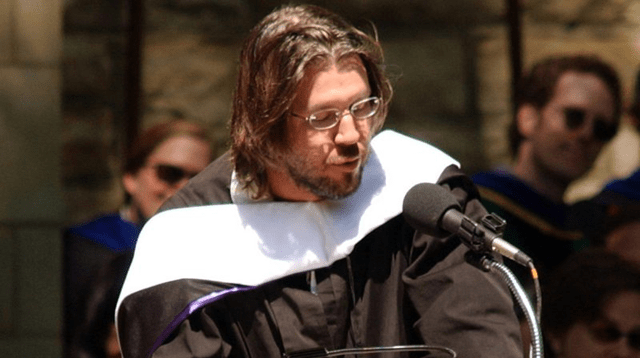
[Image source: David Foster Wallace to Kenyon’s Class of 2005: ‘This is water’ – the site includes the transcript]
You can read the whole speech (there’s a link on the College website above on the picture source-site), but I wanted to summarize the things that I felt held a resonance to learning to live with chronic pain, to overcoming, to battling on, to living with grace and kindness regardless, in spite of, or even because of the pain…
The speech opens with the pretext for the whole:
“There are these two young fish swimming along, and they happen to meet an older fish swimming the other way, who nods at them and says, ‘Morning, boys, how’s the water?’ And the two young fish swim on for a bit, and then eventually one of them looks over at the other and goes, ‘What the hell is water?’”
As if pre-empting the mood of the college students, Wallace then goes on: “If at this moment you’re worried that I plan to present myself here as the wise old fish explaining what water is to you younger fish, please don’t be. I am not the wise old fish. The immediate point of the fish story is that the most obvious, ubiquitous, important realities are often the ones that are the hardest to see and talk about.”
Soon after, Wallace acknowledges, “A huge percentage of the stuff that I tend to be automatically certain of is, it turns out, totally wrong and deluded.” He gives the example, that from his perspective he is the center of the universe, in fact, everything from his perspective points to it. And yet, he notes, such self-centeredness is “socially repulsive”… but deep down… we all think and feel the same; “it is our default setting,” because everything is seen “through this lens of self.”
He then explains an average day of hard work, fatigue, bad traffic, supermarket Muzak, “glacially slow old people” who get it the way of your “junky cart” and how, as mad as you’re getting, you know you can’t take your angst out on the lady at the register. Then it’s back through the litter-strewn carpark, the rush-hour traffic, stuck behind enormous SUVs and so on…
“The point,” he goes on, is that “petty, frustrating crap like this is exactly where the work of choosing comes in. Because the traffic jams and crowded aisles and long checkout lines give me time to think, and if I don’t make a conscious decision about how to think and what to pay attention to, I’m going to be p!ssed and miserable…”
Wallace talks of how tempting it is to be frustrated, especially if we keep imagining life is about us – because all of this mess is an inconvenience to US… and somehow as main characters (my words not his) this story will seem to be wrong. He suggests that the choice to think differently is not an easy one, but, he says, if you choose to look differently at the people around you, you might discover you have empathy for the lady screaming at her child, (who knows what tragedies she’s enduring at home), or be able to imagine her as the minimum-wage employee who showed your exhausted husband a bureaucratic kindness yesterday at the Motor Vehicle Department.
The point is – if you don’t fall back into your default position of thinking about yourself, you might be able to consider alternative possibilities… you can learn to pay attention… you can see goodness… you can acknowledge that there are options to how you think and how you live.
“It will actually be within your power to experience a crowded, loud, slow, consumer hell-type situation as not only meaningful but sacred, on fire with the same force that lit the stars – compassion, love, the sub-surface unity of all things. […] You get to decide what to worship…”
But he cautions you – worship power and you risk ending up feeling weak… worship your intelligence and you may end up feeling foolish, or fearful of being found out to be wrong… worship beauty and you’ll feel ugly when you age… worship money and you will never stop craving it…
Freedom to avoid the ‘rat-race’, he suggests again, comes from how you think; pay attention, be aware, be kind, apply effort, make small sacrifices that help others rather than yourself…
He ends his speech by apologizing for, and reinforcing his message; “I know that this stuff probably doesn’t sound fun and breezy or grandly inspirational. What it is, so far as I can see, is the truth with a whole lot of rhetorical bullsh!t pared away. […] we have to keep reminding ourselves, over and over: ‘This is water, this is water’.”
*
As I said, there is a grimness to Wallace’s version of the world. The younger me would have sat there at my graduation ceremony, stunned and conflicted. The angsty me would have said, “this guy gets it – life is a boring hard slog” but the optimistic and idealistic younger me would have been appalled… frustrated by such a bleak prediction for what my future might look like… he speaks of starlit majesty in the mall and yet everything we might wish to worship is tainted by the stain of its other…
Time calls Wallace’s speech “the greatest commencement speech of all time” and summarises the five big lessons that we can take from the speech:
- You’re not the center of the universe
- Don’t live life by default
- You choose what you worship
- Real freedom is sacrifice
- Be aware of the world around you
I agree, but I also think there is something simpler… maybe sadder… maybe more luminous: the grass is rarely greener on the other side – this is the water that we live in, whether we notice it or not – this moment, right here, right now, this is your life… for better or worse – love it.
Take care taking care, Linda x


 The Mindful Migraine
Leave a comment