
A while ago, I was listening to a podcast about migraines when the pain patient said something like, “if I won the lottery, I would build a green light therapy room in my home.”
What, I wondered, is green light therapy?
According to Time.com, people with chronic pain can be exposed to green light in one of two ways; sitting in a dark room where the only light source is a green lamp, or, wearing green-tinted glasses so the light that comes into their eyes is green.
Apparently, green light can “reduce both their severity of pain and the frequency of episodes of migraines, fibromyalgia, and chronic musculoskeletal pain […and] relieve the anxiety and fear associated with chronic pain.”
“Through a mechanism that’s not yet fully understood”, the green light seems to interrupt the pain pathways between the eyes and the brain.
Whilst the scientists and doctors interviewed understood people might be skeptical, and acknowledged it is still early days in terms of research – they nonetheless suggested there seemed to be something simple, yet potent, going on.
In tests they ran, the pain reduction was significant, BUT it required 2 HOURS of green light exposure EVERY DAY, for 70 days. The article referred to one patient who felt the relief within 30 days and was eventually able to give up her chronic-pain medication.
From what I can tell, you can read or listen to music during the therapy, but I can’t be sure if you’re allowed to close your eyes or sleep… so that’s a big time investment for busy people… unless it can turn OFF chronic pain, and then I guess we could all find the time.
Over and over, the article referenced the fact that this is an emergent area of research. When trying to define how the green light might work, the answer was super-scientific; it “may lie in green light’s ability to trigger melanopsin, a light-sensitive neurotransmitter present in the eye that’s responsible for regulating pupil dilation and contraction. Melanopsin also interacts with the periaqueductal gray matter, a structure in the upper brainstem that plays a role in processing pain.”
The article quickly went way over my head, referring to particular types of brain cells, known as GABAergic neurons, and the c-Fos proteins they produce…
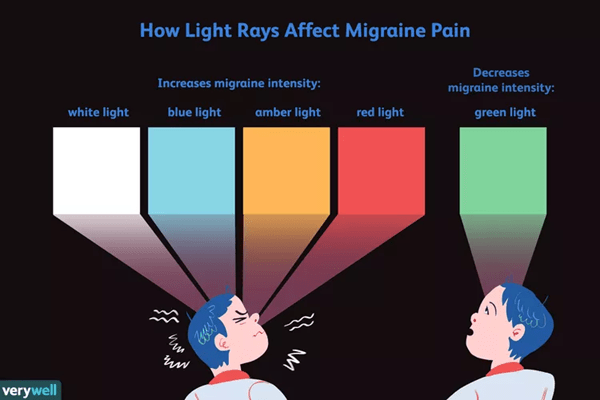
Another website, VeryWellHealth.com, kept things simpler, and spoke of photophobia (or light sensitivity) that occurs with migraines; dark rooms help / bright light hurts. The article included an infographic that didn’t immediately explain the what, why or how of green light, but was nifty regardless:
[Image source: Verywell / Emily Roberts]
[As an aside – I’m going to disagree with the image and say that I don’t have any problem with amber light (such as the warm glow of your standard bedside lamp) but I do agree that white and blue light is painful (it feels as if I am under an interrogation lamp, even if it’s just the glow coming out of the open refrigerator!)]
Later in the article, they noted that “Green light does not activate retinal pathways as much as blue or other light rays, so it is less likely to induce a migraine. Furthermore, you are less likely to experience aversion or sensitivity to green light during a migraine attack.”
In a study done in 2018, 80% of participants complained that white, blue, amber, and red lights made headaches worse, whilst green light only worsened 40% of headaches. Moreover, all the prior colors TRIGGERED headaches in 18% of participants, whilst green light was only responsible for 3% of headaches starting.
[I can’t imagine who would volunteer to be a test subject in the “who wants to see if we can give you a migraine today?” experiment.]
The article ends by suggesting the upside of special LED migraine lamps is that they only emit a very narrow band of green light which activates less regions of the brain involved in pain processing – AND – mentions the downside; the high cost of these lamps.
I did a super-quick scan of possible purchases, and the options came back at everything from $25 to $250 (Australian dollars). The problem, I suspect, will be; you get what you pay for – because not all green lights were created equal… all will be green, sure, but tinted green may not mean they belong to the narrow band of helpful light… or maybe they do… I guess you’d have to do your own product-specific research first.
One other site (TherapeuticBeams.com) shared a list of green-light benefits as follows:
- Boost mitochondrial function, stimulating cell growth and repair,
- Release endogenous opioids (which are part of the body’s built-in analgesic system) to provide lasting pain relief,
- Promote fibroblast activity, increasing collagen production.
This is one of those areas where I am both optimistic (hooray for non-invasive, safe-at-home remedies) – and a little confused.
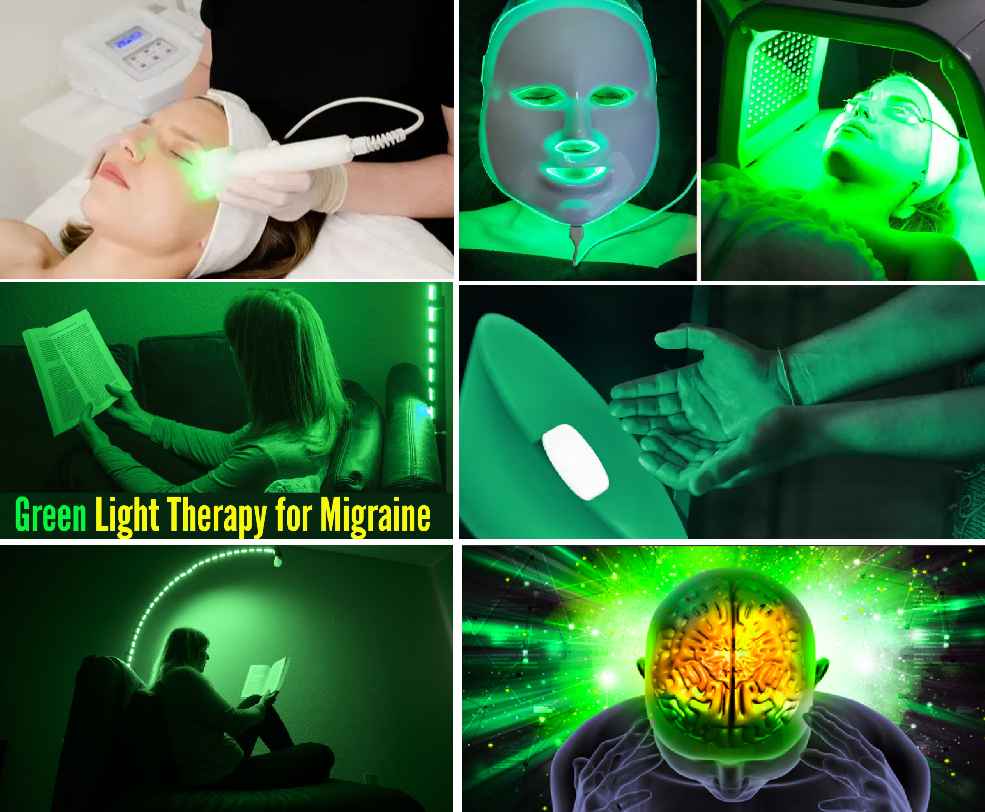
Some of the websites that sell light therapy as a migraine relief tool are not very clear about how many hours a day, or for how many days a week you have to be exposed to green light before you see benefits… nor can I be very sure whether you’re supposed to be lying under the light, having in shone into your eyes, or simply chilling beside the lamp living your normal life – the images I’ve seen while googling the subject suggest a whole lot of things (and accidently risk making it feel like one of those woo-woo therapies):
[Image source: montage of screen shots from Google search “green light therapy for migraines”]
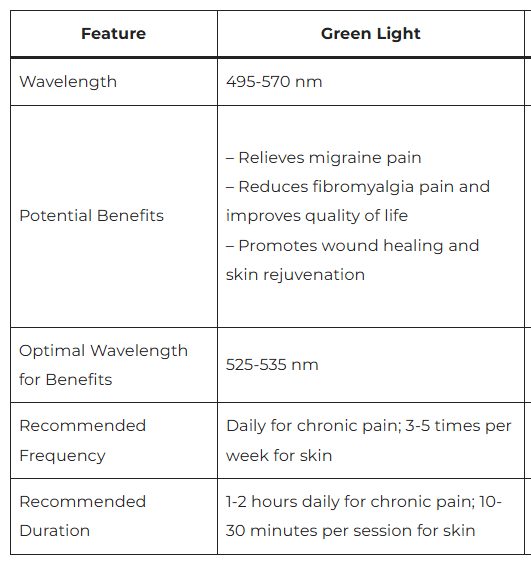
I did find one site however that was quite detailed and suggested chronic pain requires 1-2 hours exposure daily (but even it didn’t seem to mention you might need 30+ days of exposure to benefit) – here’s a partial screenshot of their table:
[Image source: Green Light Therapy: How It Works & What It Can Treat ]
Anyway – it’s given me something to think about. I can’t see myself buying an expensive light to bask under for 2 hours a day (unless perhaps it’s a bedside lamp I can leave on while I sleep)… and I’m not sure if stringing up cheapy-cheerful green Xmas lights around the house is enough to qualify for green light therapy (although it would make me happy!)… hmmm…
Curious to know: have any of you tried green light therapy?
[DISCLAIMER – a quick reminder that I am a migraine patient who researchers migraine related material – I am not a doctor or scientist – please speak to your own healthcare provider for medical advice or treatment options that are best suited to your unique personal circumstances before making any changes to your healthcare routine.]
Take care taking care, greenly, Linda xx
PS – some of the articles referenced lab tests on animals – which made me sad – so many medical advancements for us, make things worse for the poor critters, as I’ve written about before (here).
PPS – On a brighter note (pun intended) – here’s some YouTube videos if you’re interested in learning more about green light therapy:
(2 mins) Expert Insights: What Is Green Light Therapy? (youtube.com)
(5 mins) What is Green Light Therapy? (youtube.com)
PPPS – Studio Migraine was kind enough to post my “‘I have a migraine’ is not a lie” post here: Guestblog of The Mindful Migraine – Stichting Studio Migraine – THANK YOU Studio Migraine!!


 The Mindful Migraine
Leave a comment