

In the Australian news at the moment, there has been a sudden influx of articles relating to Vitamin B6 toxicity. A large corporation who sells over-the-counter supplements is facing a potential class-action lawsuit over claims that excessive levels of vitamin B6 are contained in its products and those high levels have led to serious health complications.
As someone who has an on-again-off-again relationship with vitamin supplements, I thought I better do some research into the issue.
[Disclaimer – a quick reminder that I am NOT a trained doctor or nutritionist – before making any decisions about your own vitamin and mineral supplement intake, please speak to your health care provider and gain up to date information that is relevant to your individual health and wellbeing.]
According to Healthline.com, “Vitamin B6 is a water-soluble vitamin also known as pyridoxine”. It’s primary benefits include playing “an essential role in the metabolic process and in forming hemoglobin. It may help with nausea during pregnancy, improve depression, and prevent cognitive decline.”
Apparently B6 can be found in foods including pork and chicken, peanuts and soybeans, milk, oats and bananas.
The article then goes on to note: “Eating foods high in vitamin B6 is unlikely to cause serious negative side effects, but experts have noted nerve damage and pain from taking excessive supplement amounts.”
The Australian Brain Foundation clarifies the distinction, separating B6 as originating from “natural” sources (they add fruit and leafy vegetables to the food list) and “synthetic” sources. These synthetic sources include: multivitamins, zinc and magnesium supplements, weight-loss shakes, energy drinks… and “migraine products.”
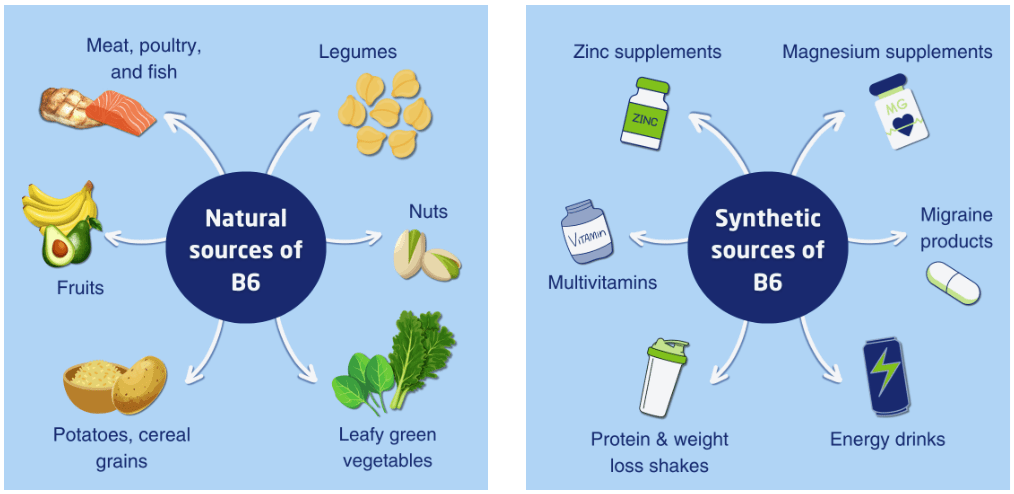
[Image source: What is Vitamin B6 Toxicity? – Brain Foundation]
[On the list, multivitamins and magnesium supplements are a potential issue for me, as are “migraine products” (whatever they might be?)… hmmm…]
They then go on to clarify what B6 toxity is and why it’s a problem:
“Supplements containing vitamin B6 often greatly exceed the recommended daily intake, leading to a buildup of B6 in the body. The primary concern with B6 toxicity is its effect on the nervous system. High levels of vitamin B6 can damage nerves, leading to a condition called peripheral neuropathy […where] there is damage to the nerves located outside of the brain and spinal cord.”
Yikes!
The symptoms of B6 toxicity they list, include:
- Numbness and tingling
- Difficulty walking or unsteady gait
- Pain or burning sensations
- Muscle weakness
- Loss of coordination
The takeaway advice is clear – if you think this might be you – SEE A DOCTOR.
Wikipedia refers to B6 toxicity as “Megavitamin-B6 syndrome” (seemingly pointing the finger right at those pesky supplements). Their page notes that the condition is often reversable – with symptoms ending soon after patients stop taking the supplements. They also suggest that only in very acute cases are the effects irreversible.
Interestingly (to me) is the clarification of why you end up with too much B6 in your body: because “vitamin B6 is water-soluble, it accumulates in the body. The half-life vitamin B6 is measured at around two to four weeks […and] it is stored in muscle, plasma, the liver, red blood cells and bound to proteins in tissues.”
In other words, if you take a tablet today, some of it will still be in your system a couple of weeks from now – by which stage you’ve taken another 13 tablets. I’m no mathematician, but by the end of the year, those daily B6 doses are accumulating and accumulating…
What was also interesting, was that countries around the world have set different daily limits to what their authorities believe to be safe. The UK leads the health-caution-scene and sets the upper limit as 10mg/day with the European Food Safety Authority just behind, setting the limit at 12mg/day. Australia allows 50mg/day and the USA sits at the highest end of permissible amounts at 100mg/day.
[There seems to be a bit of argy-bargy in the data though, as the Australian site mentioned above (here), says our Therapeutic Goods Administration set the limits at 100mg/day for people aged 19 and over (and it was apparently 200mg/day as late as 2023).]
Both the Australian site, and Wikipedia note that in Australia, products that are predicted to give you more than 10mg/day of pyridoxine (B6) must include a warning label. The Australian site states the label must read:
“WARNING – Stop taking this medication if you experience tingling, burning or numbness and see your healthcare practitioner as soon as possible. [Contains vitamin B6].”
Double yikes.
So… should you be worried?
According to an article in TheConversation.com published at the beginning of 2025, they write that whilst “Too much of anything can cause problems”, B6 toxicity is “extremely rare”. That said, they also acknowledge that “the risk varies between individuals and a lot is unknown.”
The article ends with good advice: “always check the label if you are taking a new medicine or supplement, especially if it hasn’t been explicitly prescribed by a health-care professional. […] Be particularly cautious if you are taking multiple supplements. […] pay attention to symptoms that may indicate peripheral neuropathy, such as pins and needles, numbness, or pain in the feet or hands, if you do change or add a supplement. […] Most importantly, if you need advice, you should talk to your doctor, dietitian or pharmacist.”
If in doubt – speak to your doctor.
And with that… I’m off to check some labels…
Take care whilst taking care, Linda x
PS – I just went back and read the post I wrote about “Vitamins for migraines” (18 months ago in February 2024) and it said: “The reason I’m writing about this today, is that an article was published yesterday in an Australian newspaper that basically said ‘too much of a good thing is bad for you’. The article wrote that otherwise healthy people were being ‘poisoned’ by excessive use of Vitamin B6 or ‘overdosing’ on magnesium.” Oops! How far we’ve come… and yet… not at all…!! Sounds like we need a wake-up call to last year’s wake-up call that I forgot to listen to…?!?! Seriously off to check those labels…!
PPS – the multivitamin I take every now and then (even though the label recommends 2 tablets a day) includes 12mg of B6 (so that would be 24mg/day (which exceeds many country’s recommendations)). Interestingly, the bottle didn’t have a warning… why? Maybe they were sold before the label change came into effect (they have been floating around for so long, they were almost out of date! Oops! Off to check more labels for a different reason!!)


 The Mindful Migraine
Leave a comment