
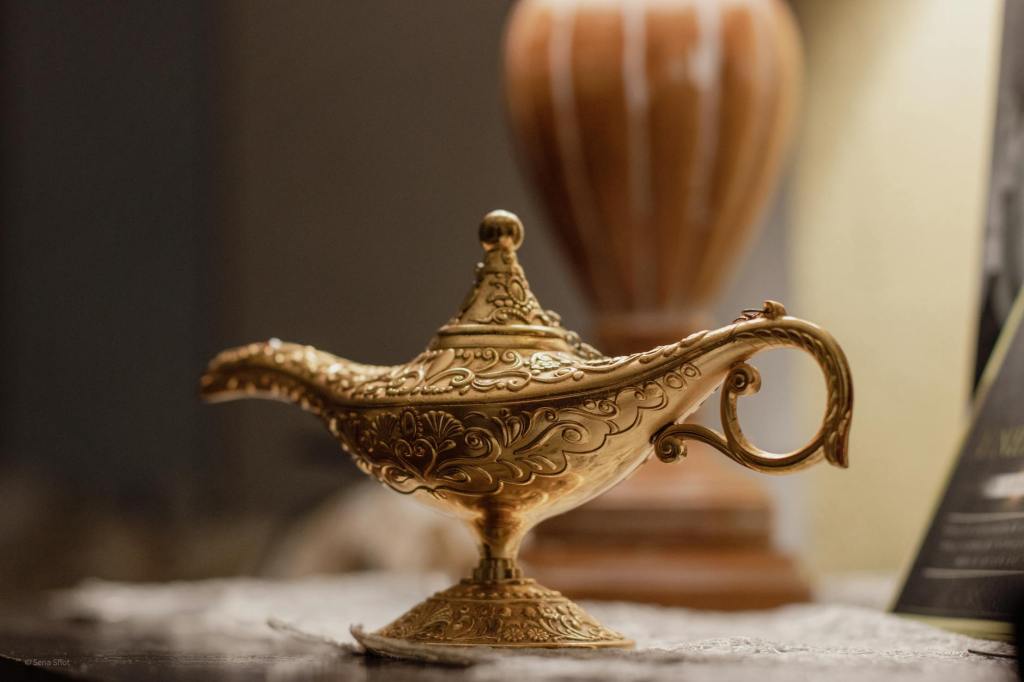
The other day I watched the movie “Three Thousand Years of Longing” (2022) because the title caught my attention. Without giving too much away, it spins around the ancient story of a djinn (or genie) who offers up three wishes. Visually impressive, filled with wonder and weirdness, there was something deeply gratifying about the premise that the lady who releases the magic (a character named Alithea (which means ‘truth’)) is an introvert researcher, someone who writes about writing, a self-proclaimed “narratologist”.
[Video source: Official Trailer | MGM Studios]
Set as the weft and weave of the story are all the stereotypes of “orientalism” we (un)knowingly bring to this genre and therefore the movie-viewing (for better or worse)… all those 1001 Arabian Nights, filled with Alladin, Ali Baba, belly-dancing, brass lanterns, flying carpets, camels, caftans, Sindbad the Sailor, swirling sand, swords and stardust…
The main character, for example, takes a plane trip to Istanbul on Scheherazade Airlines, and stays in the hotel room in the Pera Palace Hotel where Agatha Christie wrote “The Murder on the Orient Express”.
The wonderful thing about the movie is that it quickly matches expectations; the main character purchases a strange stoppered vessel in the markets, returns to the hotel room and rubs the vessel clean (with an electric toothbrush) causing a larger than life genie to jump from the bottle in a puff of periwinkle smoke; “thank you, you get three wishes, you can’t wish for more wishes, someone’s death or your own immortality, so what will it be?”
But – and here’s the fun part – instead of moving straight to stating her heart’s desires, she begins to interrogate the magical man on how he came to be bound in a bottle, not once, but three times over a three-thousand-year period… probably because listening to his origin story would be a narratologist’s dream come true!
More importantly, by stalling her reply, it gives us time to ponder: what would I wish for?
What would YOU wish for?
When I was younger, I was a bit of a fan of the music of singers like Doris Day and Dean Martin and their songs like “Que sera sera” and “That’s Amore”. I’m not actually THAT old, but there was a time when their gentle, easy to understand lyrics appealed. Mr Martin had a song titled “Three wishes” (1949) which included the lyrics (sung over and over in slow motion):
If I only had three wishes
Here is just what I would do
First, I’d wish for days of gladness
With a someone sweet and true
For my second wish, a dream house
Cozy fireside for two
And the last of my three wishes
Please love me as I love you
Gladness, coziness and love – sounds pretty good to me!
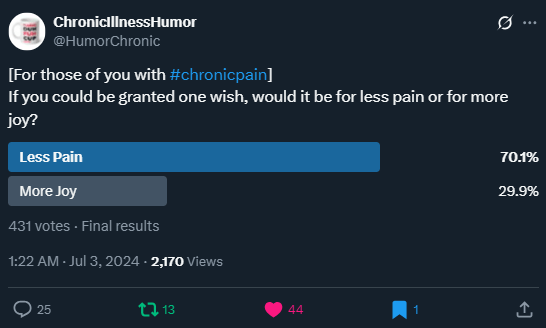
Over a year ago, when I was still active on Twitter-X, I wrote to an account that had a large following of several thousand readers called Chronic Illness Humor (they have also since left the platform). I asked them to satisfy my curiosity and poll their chronic pain people by asking them:
If you could be granted one wish, would it be for less pain or for more joy?
What would you reply?
431 people voted. 70% of those people replied “less pain” with many offering comments along the lines of “less pain will bring me more joy”. But 30% settled on happiness upfront, with one person replying “joy makes the pain less.”
[Image source: ChronicIllnessHumor on X]
More recently, I wrote posts titled “1,000 days of pain” and “Three years (un)well“, in which I was still fairly focused on the “less pain” approach to living (no matter how much I claimed otherwise). Today, I’m feeling more well than unwell, and as such, my focus is squarely on the “more joy makes the pain less” approach. [And for that, I know how lucky I am.]
When it comes to wishes, we ought to remember there is always an element of “be careful what you wish for” in any wish-a-thon. Every fairytale I can remember about wishes (such as the three fisherman and the magic fish or the woodcutter and the tree-fairy) are basic cautionary tales. King Midas was offered whatever his heart desired and chose a “golden touch” only to discover that everything from his dinner to his daughter was turned to solid gold.
There was a picture book I read to my daughters when they were young. One story included children who wished that everyday might be Christmas, and so it was. Faster than you would anticipate, the children grew heartily sick of the growing mountain of presents they had no room or time for, grew sickly from the rich and relentless festival-food, and came to the realization that it was the anticipation of those rare routines and rituals that made them special.
In the same way that I have written about focusing on the good not the bad (“don’t hit the pole!”), the wishes that we choose to manifest ought to be as positive as possible. ‘More peace’ rather than ‘less poverty’ places the emphasis on the good, even though a reduction in bad is equally valid – the positivity lies in the ‘more’.
More joy.
More.
But what would a wish for more joy look like in reality – and how long would it last – and would it be selfish to ask for such a personal thing – moreover, would such a wish really be well spent given that I have already been blessed with so much in life that makes me happy… so long as I pay attention…?
Even the shortest of thought experiments makes me realize that three wishes would be both a gift and a mind-bending dilemma.
And now that I have twisted my head into a knot, and possibly yours too… I’ll leave you to untangle the riddles on your own over the upcoming weekend!
Take care taking care, Linda x


 The Mindful Migraine
Leave a comment