

What a cliche! And yet… where there’s smoke there’s fire… or is there?
Today’s post is a little bit long (it went places I wasn’t expecting) and it is also potentially a little bit tricky as it initially treads into an area many people might consider taboo for public conversation. When I was growing up the list of no-no subjects included sex, money, politics and religion… I’m not sure if they are still considered completely off limits… but my mother sometimes visits here, and I don’t want to make her blush.
So, I’m going to write about head pain at bedtime (without getting too personal), and then I’m going to use the “not tonight honey” frame for a wider view of migraine living.
For ‘normal’ people the “I have a headache” line is often treated as a reason (or some would say lame excuse) to avoid intimacy. Perhaps it carries more weight than simply stating “I’m tired” and is less offensive than “I’m not interested in you that way right in this moment”… or maybe it’s just shorthand for “let’s cuddle instead please”.
For migraine-people, sometimes it doesn’t even have to be said; our partners know we’re too sick for that sort of connection. Sometimes it’s not even about tonight, but several nights in a row that we need to stay as still and quiet as possible (even resorting to sleeping alone on the couch or a blow-up mattress near the bathroom). For a few migraine patients (I’ve only ever read about them and am yet to have anyone admit it to me as fact) their migraine-pain is actually REDUCED by hanky-panky.
I went in search of some memes to express what other people might be thinking so I could avoid having to say too much… here’s one I liked:

[Image source: googling]
The image made me smile… but then frown.
Why does she need an excuse to abstain? Why is there an assumption she might be lying? Why does it always seem to be the woman who is depicted as the headachy one?
The more I looked into it online, the more I noticed the topic came with instruction manuals on how to cope with your wife’s sexual rejection… or else, every version of the “not tonight” line was a punch line… a poor joke… almost always at the lady’s expense.
[When I first started this blog, I wrote a post (here) that showed medication advertisements from the last few decades which referenced how to medicate your partner for “housewife headaches” or worse.]
Turns out I’m not the only one feeling a little perturbed by the assumption that “not tonight” has some negative gender-bias about it.
“Not Tonight: Migraine and the Politics of Gender and Health” (2014) is a book by associate professor of Sociology, Joanna Kempner. I’m not going to lie – the title perked me up instantly, but the cover is not great for people who have migraines… perhaps that’s the point… but for me, its neon yellow and zig-zag borders scream “ouch”:
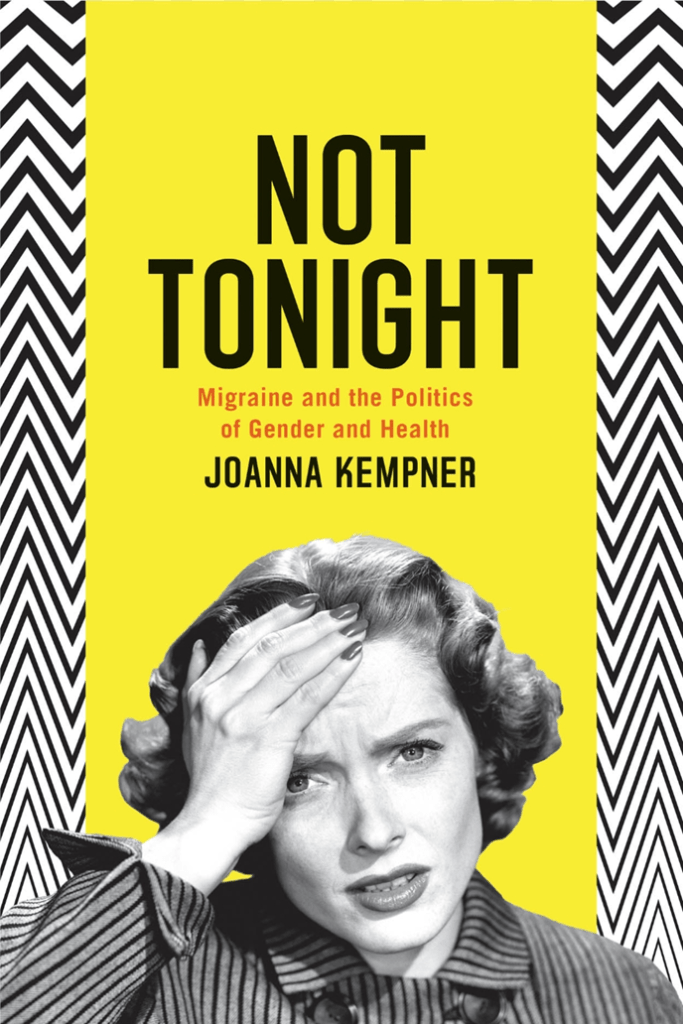
[Image source: Not Tonight: Migraine and the Politics of Gender and Health]
An online book review notes that: “While the [migraine] disorder has been transformed over the past two decades from a personality disorder that affects mainly depressed, whiny women to a brain disorder that can disable men, women and children, Kempner says longstanding cultural beliefs about gender and pain still exist and have made it difficult to change the face of the migraine sufferer.”
The article goes on to suggest the author wants to see less ads of women struggling to look after the kids, and more images of masculine footballers on the sideline or servicemen returning from active duty holding their heads, so that the condition might be taken more seriously.
It sounds like the book aims to highlight that migraine pain has wider real-life consequences than a cheap shot made with a snicker on a comedian’s stage.
So, I tracked down the book to read it for myself.
Kempner’s preface opens with:
“My headaches began when I was five years old. A pediatrician diagnosed me with a ‘type A personality’ and assured my parents that nothing could be done. My mother, herself debilitated by migraine, rejected his diagnosis. Thus began a long and frustrating quest for headache relief.” (page ix)
All but abandoned by the medical profession, lucky to have an advocate in her corner, but left to find solutions for herself… and so begins a self-help journey that sounds like a familiar path travelled by many migraine people I have met.
But, as Kempner later points out, that journey is hindered somewhat by the system that exists: “…the headache research community is supported, in large part, by private dollars from the pharmaceutical industry.” (p. xiv)
Hmmm… already you can sense an undercurrent of self-serving, vested-interest, male-bias sneaking into the equation…
Kempner then recounts an anecdote regarding Cindy McCain, spouse of the late politician John McCain. “After many years struggling with debilitating
chronic migraine, [Cindy] McCain decided to become a spokesperson, throwing her full support and considerable political connections behind efforts to advocate for migraine research.” In 2009 The New Yorker responded by mocking her in a segment within the “Not Tonight Dept” range of articles.
[The full article is here: “Head First“].
Kempner notes, [and I concur] that the article suggested “everything about her seemed lemony,” implying McCain was “an overprivileged socialite whining about an insignificant discomfort.” As Kempner notes; “Migraine remains an opportunity to make jokes about moral character despite its designation as a ‘real’ neurobiological disorder in contemporary biomedical knowledge.” (p.2)
[In the 2009 New Yorker article (written by a woman) Ms McCain is quoted as saying she would eat glass to get rid of her migraine pain, and yet, after listing all the ways migraine has severely affected her life, the author still writes; “McCain has decided to become an advocate for the disorder, which, in her view, is a disability.” In her view? Now the lemony “pursed lips” and “astringent” commentary the author pushes onto McCain seems to have been something closer to projection…]
Here’s a copy of Ms McCain’s image used for the article – empathy much?
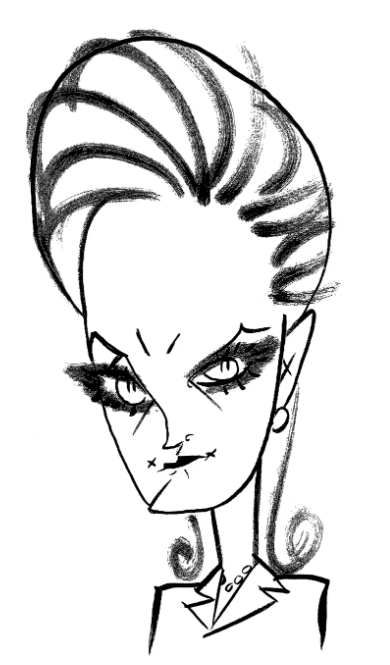
[Image source: Head First | The New Yorker]
As someone who shares those pinched lips, furrowed brow and smudgy eyes… I don’t find this amusing at all. Especially in an article where Cindy McCain is quoted as saying: “The first doctor I went to basically said, ‘Well, you’re just neurotic, you’re just stressed, your husband’s a senator. Go home, put your feet up, and have a drink.’ […] What affected me the most was being talked to like I was dumb. That infuriated me.”
What chance do we have of getting sympathy and understanding if those who don’t share our silent struggle feel they can brazenly mock it??
That infuriates me.
Back to Kempner’s book. I liked her reference to the fact that “Headaches strike a central feature of personhood […] fundamentally shaped by the Cartesian dictum ‘I think, therefore I am’.” (p.7)
Add to that the stigma that comes with having a migraine, and the sense that doctor’s aren’t taking it seriously… because… perhaps they aren’t: “A survey of neurologists […] found that nearly half (49 percent) ‘felt that headache patients were more time consuming’ and a third (35 percent) found them ‘more emotionally draining’ than other patients. Half perceived headache patients ‘as having more psychiatric problems than other patients.’ And a quarter (24 percent) of those surveyed felt that headache patients were motivated to maintain their disability.” (p.8)
Wow.
Later still: “While people who have headache disorders often receive help for their symptoms, they are also likely to receive blame, be silenced, or be ignored.” (p.10)
Kempner then finishes her introduction with a launchpad into the rest of the book: “This analysis of headache disorders not only provides an important vantage point for understanding how cultural beliefs about the relationship
between gender, class, and pain are inscribed and reinscribed into bodies,
it also demonstrates how these factors shape the credibility of people in
pain.” (p.23)
The book is really interesting, but far too long to summarize here. Importantly, rather than focusing on the “no nookie-nookie tonight dear” lazy laugh, it concentrates on a much broader commentary of disadvantage. The book’s last few sentences are worth repeating:
“Maybe […] we should focus attention on reframing stories about the people who have headache disorders. If I’ve learned anything over the course of my research, it’s that people with headache disorders are everywhere, and they aren’t the hysterical neurotic whiners of popular culture. Quite the contrary: it takes great strength and stamina to live and work with a headache disorder. People with headache disorders are fighters. They struggle, but they survive and very often they thrive, despite enormous pain and disability.” (p.169)
Here’s cheers to that.
Remember you are you-nique and so is your pain… and so is your (so called) ‘performance’ (if you know what I mean!)
You be you.
Take care taking care, Linda xx


 The Mindful Migraine
Leave a comment