

A short time ago I wrote a post about the four stages of migraine, one of which is called “aura” (here). The sorts of things that happen to migraine patients during the aura stage include: visual disturbances, dizziness, ringing in their ears, even paralysis. But one of the rarer symptoms that was mentioned was “Alice in Wonderland Syndrome”.
I’ve never heard of such a thing, so today’s post is a review of the condition AND of Lewis Carroll’s migraines that were said to have prompted the depiction of feeling as if you or your surroundings are shrinking-and-growing, as revealed in the Alice in Wonderland book he wrote.
According to Migraine.com, Alice in Wonderland Syndrome (AIWS) occurs mostly in children when “the person feels like their body or objects around them are much bigger or smaller than they actually are.”
Here’s some images showing Alice in Wonderland as she is growing and shrinking… or else feeling as if her surroundings are shrinking and growing…

[Image source: Google Image landing page]
Wikipedia provides extra detail (with links to the nitty-gritty): “People with this syndrome may experience distortions in their visual perception of objects, such as appearing smaller (micropsia) or larger (macropsia), or appearing to be closer (pelopsia) or farther (teleopsia) than they are.”
The cause of AIWS is not known, but according to Wikipedia, there are some who theorize it “can be caused by abnormal amounts of electrical activity, resulting in abnormal blood flow in the parts of the brain that process visual perception and texture.”
Several underlying conditions have apparently been linked to AIWS including head trauma, viral encephalitis, the Zika virus, Epstein–Barr Virus infection, epilepsy, fever, the overuse of psychoactive drugs and… migraines.
And it’s not just perceived distortions of the environment that occur, it can also include a feeling of disconnection from your own “body, feelings, thoughts, and environment known as depersonalization-derealization disorder.” At its most extreme you can become completely detached from your sense of self and your own identity. “It is described as being an observer completely outside of their own actions and behaviors. Derealization is seen as ‘dreamlike, empty, lifeless, or visually distorted’.”
What jumped out at me was a statistic towards the end of the Wikipedia article: “1 in 10 people who experience migraines have symptoms of Alice in Wonderland syndrome.”
The site they source for the statistic reveals the reverse situation is even higher: A 2003 UK study found that 45% of AIWS patients also experienced migraines. It also noted that it tended to effect males more than females (3:2) and 18 was the average age of patients. A 2011 study reiterated the male bias (2:1) but had the median age much lower at 7.8 years old and found 83% of patients with AIWS also had migraines.
Back on Wikipedia, they state that it is still not fully understood what’s going on, suggesting it could be a vascular or electrical issue, and then, in their attempt to explain things, the writing gets VERY technical. It’s over my head, (even though I’m now a Dr (he he)), but if you’re up to it, try this small section:
“…visual distortions may be a result of transient, localized ischemia in areas of the visual pathway during migraine attacks. In addition, a spreading wave of depolarization of cells (particularly glial cells) in the cerebral cortex during migraine attacks can eventually activate the trigeminal nerve’s regulation of the vascular system. The intense cranial pain during migraines is due to the connection of the trigeminal nerve with the thalamus and thalamic projections onto the sensory cortex.”
Yikes.
They note that AIWS symptoms can come before, during or instead of typical migraine symptoms, such as visual aura, paralysis, or vomiting.
It also noted that time becomes distorted for many AIWS patients, and they can also experience synaesthesia where senses become mixed up.
[During a migraine attack I often ‘see’ sounds as if they were flashes of light rather than loud bangs, and I sometimes ‘feel’ them too as if the bang-crash was bursting like shattering glass in my head.]
Patients who go through all this often also experience short term distress as well as long-term anxiety.
Treatment tends to focus on the suspected underlying cause. You might have a brain scan, for example, to check there is no structural issues, and if not, then investigate treatment options related to your virus, epilepsy or migraine.
This infographic summarizes it all neatly (and I see it places migraine as the primary cause):
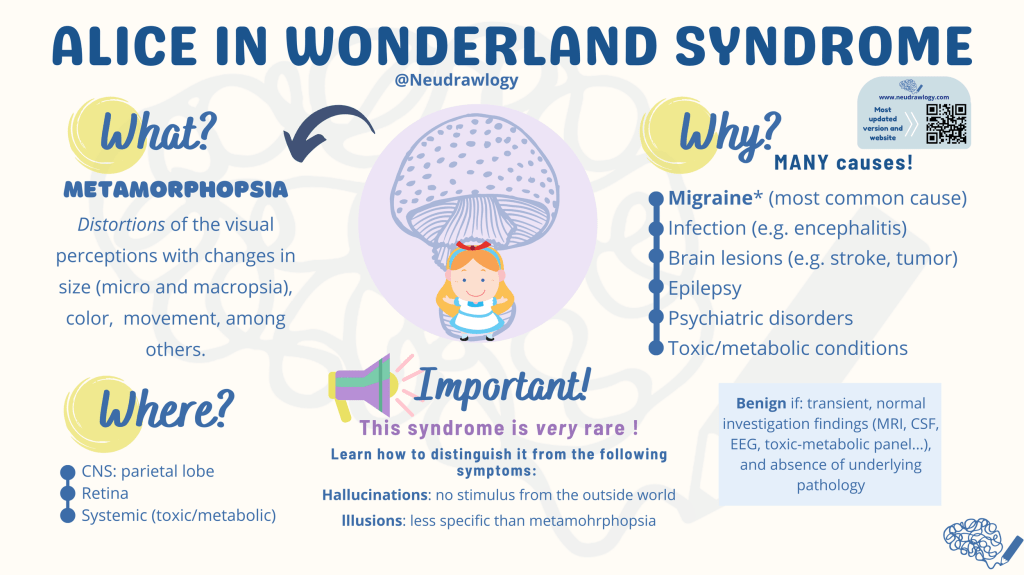
[Image source: Neudrawlogy: Simplifying Neurology]
Interestingly, the earliest medical suggestions for this condition came in 1955 when Doctor John Todd (1914–1987) realized that some of his migraine patients were experiencing distortions of space and time and speculated that Lewis Carrol (the author of “Alice in Wonderland” (1865)) probably had migraines and his experience influenced scenes in the book.
According to Wikipedia, Carroll’s diaries reveal that he consulted an ophthalmologist in 1856 about “visual manifestations” he experienced during “bilious” headaches. In 1885, he noted he “experienced, for the second time, that odd optical affection of seeing moving fortifications, followed by a headache”.
Noting that Carroll was born in 1832, it means he was experiencing these visual disturbances everywhere from (at least) 24 to 53 years of age. That’s a long time. And yet, when I look up his Wikipedia page (here), I discover that Carroll was only his pen name (he was born Charles Lutwidge Dodgson), and that under the section “health conditions” there was a knee injury, whooping cough, a stammer (which he referred to as a “hesitation”), deafness in one ear and a general “lopsided” gait… but no migraine. Miles down on his page is a paragraph of its own: “Migraine and epilepsy”.
How odd that two BIG conditions don’t get a mention upfront!
The article referenced the diary again and stated Carroll occasionally had headaches so bad he lost consciousness. Some who have reviewed the diary suggest he had symptoms similar to epilepsy, whilst other doctors have said migraines seem more likely, and epilepsy was possible but less certain.
Spinning back to spinning out, BezzyMigraine.com ends their article on AIWS with this: “If you or your child start experiencing odd perceptual disturbances that make everything around you seem like a fun-house mirror, don’t panic. // Instead, try to remain calm, provide reassurance (to yourself or your little one), and take note of the symptoms. Then, consult a healthcare professional, preferably one who specializes in neurological issues.”
ClevelandClinic.org‘s article ends similarly: “You shouldn’t ignore AIWS symptoms. While experts still don’t fully understand AIWS, it’s often possible to treat, or even cure, the underlying cause. That means this already-rare condition is usually just a temporary concern for most people who have it.”
Curious and curiouser…
Take care taking care out there,
Linda x
*
[PS – Disclaimer – please remember I am not a medical doctor – if you want more information about AIWS or any other migraine symptoms, please be sure to talk to a qualified healthcare professional.]
PPS – My blog buddy Barry (try saying that 3 times quickly!) has a blog called “Another Spectrum” – he let me know in the comments that he occasionally experiences AIWS and wrote about it on his site – here’s an extract: The Door Thar Recedes: “Each time I extend my arm, the handle is farther away. My fingers stretch, my shoulder leans, but the distance grows. I am not short. The door is not tall. But something is wrong.” – wow – how fascinating (and scary) – read his whole insightful post here: Fragments from the Migraine Archive


 The Mindful Migraine
Leave a comment