

Many, many, years ago there was an ad on Australian television that suggested that modern doctors could tell that the model in a Renaissance painting had breast cancer based on some dimples near her armpit. I’ve always remembered it, and it came into my mind again the other day when I was reading about how detective-doctors retrospectively decided Lewis Carrol (author of “Alice in Wonderland”) experienced migraines with auras based on symptoms he mentioned in his diary 100+ years ago (read more here).
The Renaissance Lady got me thinking…
Were there other examples of medical art-detectives?
The answer is yes.
BUT
It’s highly subjective and filled with false-ends. Sometimes the tell-tale signs presumed to be evidence might actually be a painterly choice or mistake rather than a medical concern… how can we know for sure whether the painter was cross-eyed instead of his sitter… or us for that matter?
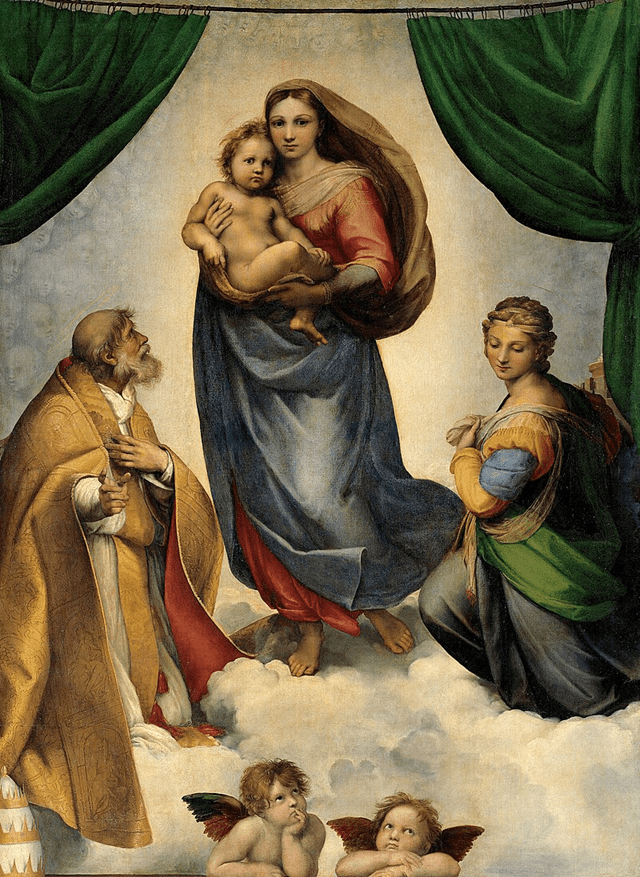
For example – look at the people depicted in “The Sistine Madonna” (1513-14) by Raphael and see if you can find something ‘wrong’ with one of them (and it’s nothing to do with those famous chubby-cherubs at the bottom of the image):
[Image source: Sistine Madonna – Wikipedia]
If you can’t see anything at first glance, look at Pope Sixtus, the man on the left.
*
*
*
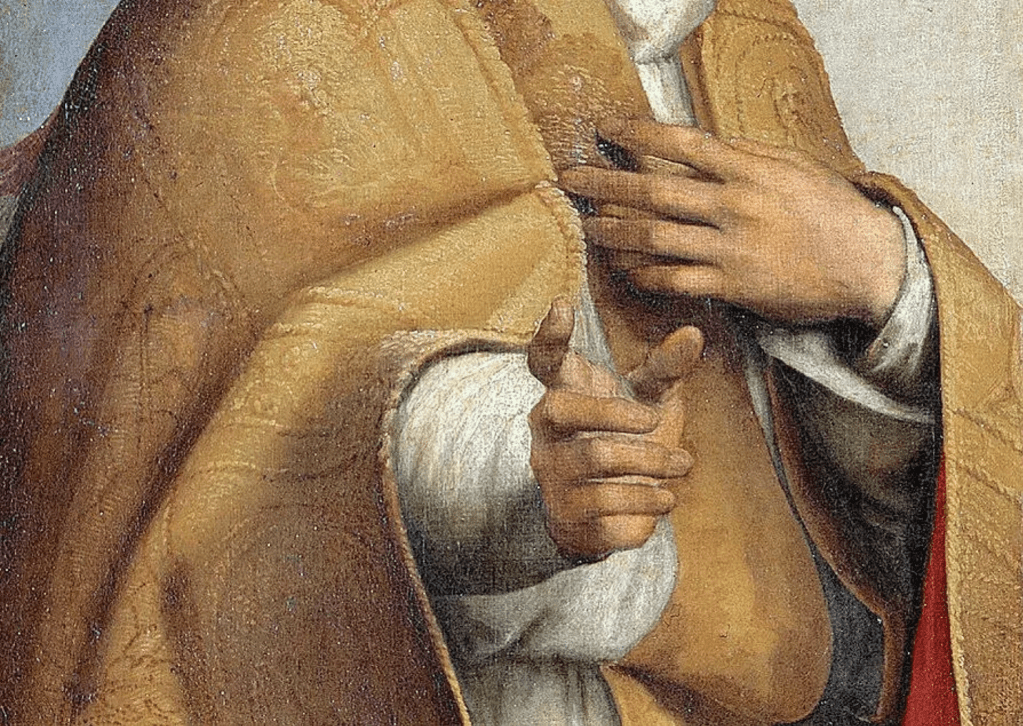
He has too many fingers on his right hand!
But did the Pope Sixtus have too many digits, or did the man who modelled for Raphael? Perhaps Raphael made it up as some sort of play on the number six?? The internet has some wild theories, but most agree that the Pope did NOT have the medical condition ‘polydactyly’.
And if we return to the painting, in more detail, we can see that the Pope does NOT have six fingers on his painted hand either – (so yay you if you’re confused) – it’s just the inside of his palm that looks like another finger when seen from a distance… there’s no mystery to be solved!
[Image source: Raphael in numbers: 6-fingered pope, half-a-billion-euro exhibition, and 3000 gold coins he paid to get his sweetheart | Arthive]
*
The more I looked for examples of medical mysteries in art, the darker the imagery became as the genre of ‘medical paintings’ involves a lot of images where someone is being dissected on a table in front of a large number of medical students… yuk.
That said, I did find a curious spin on being an art-detective… this time it related to unravelling the mysteries of the symbolism in the artwork.
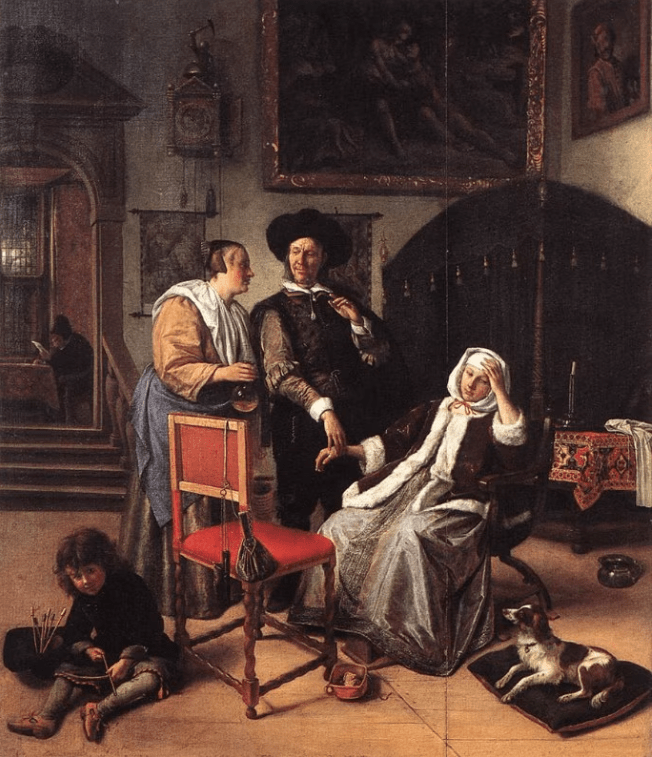
In Jan Steen’s “The Doctor’s Visit” (1661-1662) below, can YOU guess what the seated lady in this painting is sick from (and it’s NOT migraine even though she’s clutching her head):
[Image source: Medicine and science in the great paintings – Domus]
According to the Domus article, the smug look on the doctor’s face and the urine sample in the flask are clues… but mostly it is the young boy playing with Cupid’s arrows and the dog (who symbolizes fidelity).
*
*
*
Apparently it’s obvious: she’s pregnant.
Or is she?
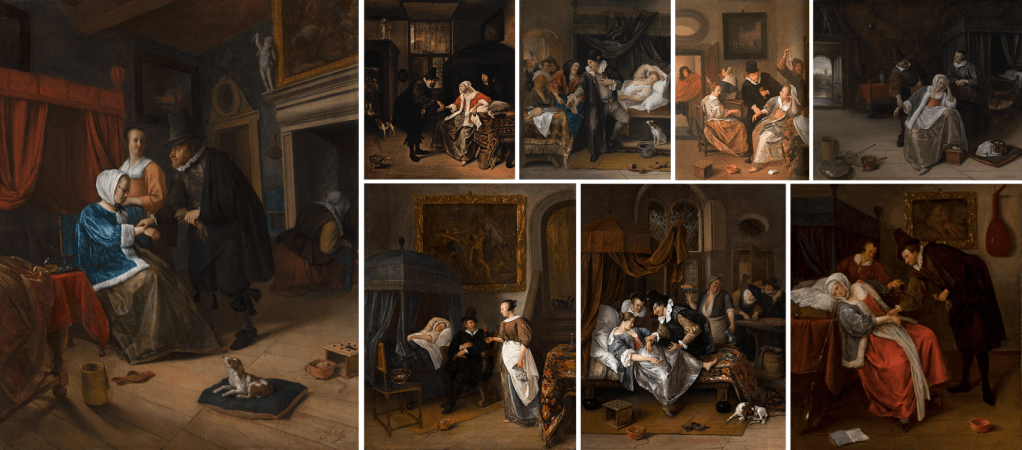
When I went looking for a little extra information, I became completely flummoxed, bamboozled and bewildered. Jan Steen painted SO MANY trips to the doctors, I almost felt like he must have been a chronic pain patient himself!! Here’s a montage of a few I found:
[Image source: googling]
There’s a heck-load of pulse taking going on here… and swooning… and beds… and dogs… chamber pots… pans filled with coals… and strange little baskets on the floor with folded papers inside them…
According to The Metropolitan Museum (who has one of the many versions), they refer to the patient as being “love sick”, and suggest Mr Steen was ridiculing the ‘doctor’ for practicing quackery by pretending he alone could fix.
Mauritshuiss.nl has another version, and they also suggest love-sickness will be the diagnosis. In their description of their painting, however, they suggest the doctor is worse than a quack… he’s a drunk, and they imply, impolitely, that everyone back then knew that the only cure for the young lady’s malady was to spend time in bed with her lover.
Oh.
So, then, maybe cupid, the smoldering coals, the love letters in baskets and everyone rolling their eyes suggests unrequited love…?
Wikiart.org notes that Steen painted 18 versions of this subject (18!! I obviously missed a few!) and says (more politely): “The strange condition had only one socially acceptable cure, marriage.” It goes on to suggest that the reason everyone is rolling their eyes and laughing, is that everyone BUT the doctor knows the patient is love-sick, and all the pulse-taking and urine samples are pointless… silly doctor!
It also clarifies that yes, the little basket is filled with love letters, but also states that the smoldering coals have ribbons on them – it was a quack’s way of determining if someone was pregnant (“the ribbon would be dipped in the patient’s urine and burned, and if the patient would become nauseous by the smell it meant that she was pregnant”)… so… a burning ribbon is like a smoking gun?!?
Ok then.
The more I looked, the more symbols turned up, such as the musical instruments (because music cured melancholy) and seafood (for its qualities as an aphrodisiac).
I’m going to add an unkind twist that’s different to everything else I’ve seen… maybe, just maybe, the lady is a tramp.
In one of the versions, there’s a man waving a fish over the patient’s head (apparently Jan Steen himself was the model for this fishy man) – and it made me think of red herrings – what if the ‘faithful’ dog was an ironic laugh? In the background of so many of these images, there are men sneaking through doors, or working unawares on their books, or else leaning in to hear what the good doctor has to say with a foolish curiosity that implies they are literally, and artistically, in the dark with the doctor. And in at least one of the paintings the patient looks more knowing than either of the men behind her… I mean, is it just me, or is she making eye contact with us as if to say, “sheesh!”:
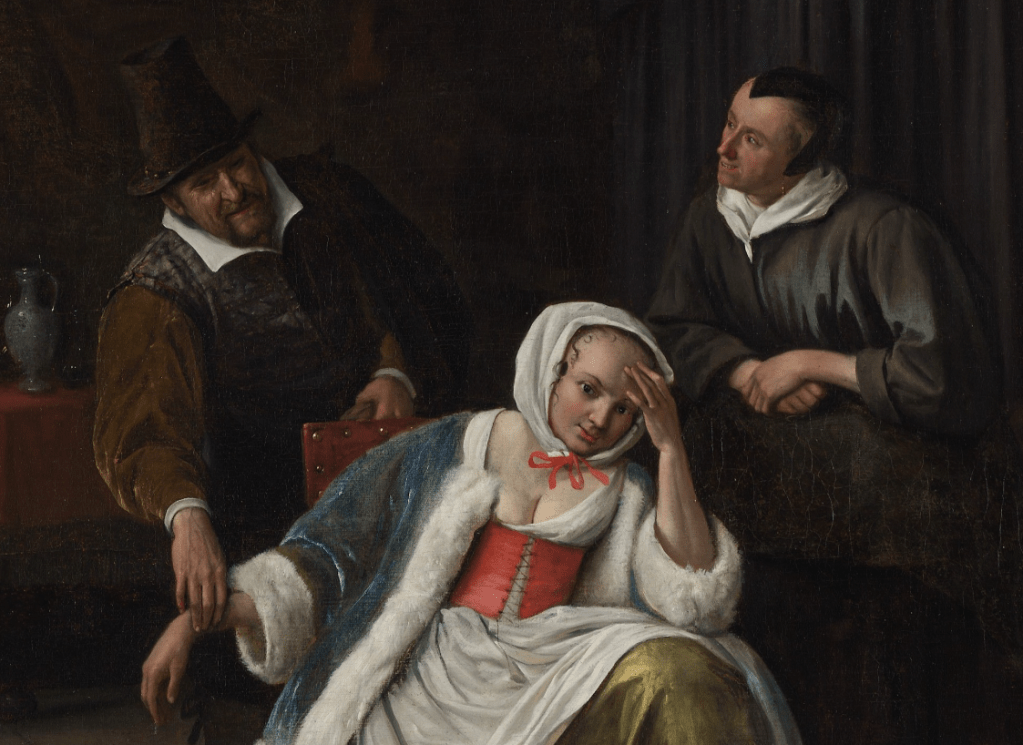
[Image source: Jan Steen – The Lovesick Maiden – The Metropolitan Museum of Art]
…what if all the handmaids (who run the house) know what’s going on and are just running interference? What if the lady in that first image WAS indeed pregnant, but not to the master of the house who is clueless and busy at his books in the other room up the stairs?
OOOHHHH….!
17th century drama!!
Anyway – this blog post is getting long and did NOT go where I expected… ah… the joys of being a medical art detective!
Take care taking care, curious people!
Dr Linda x
*
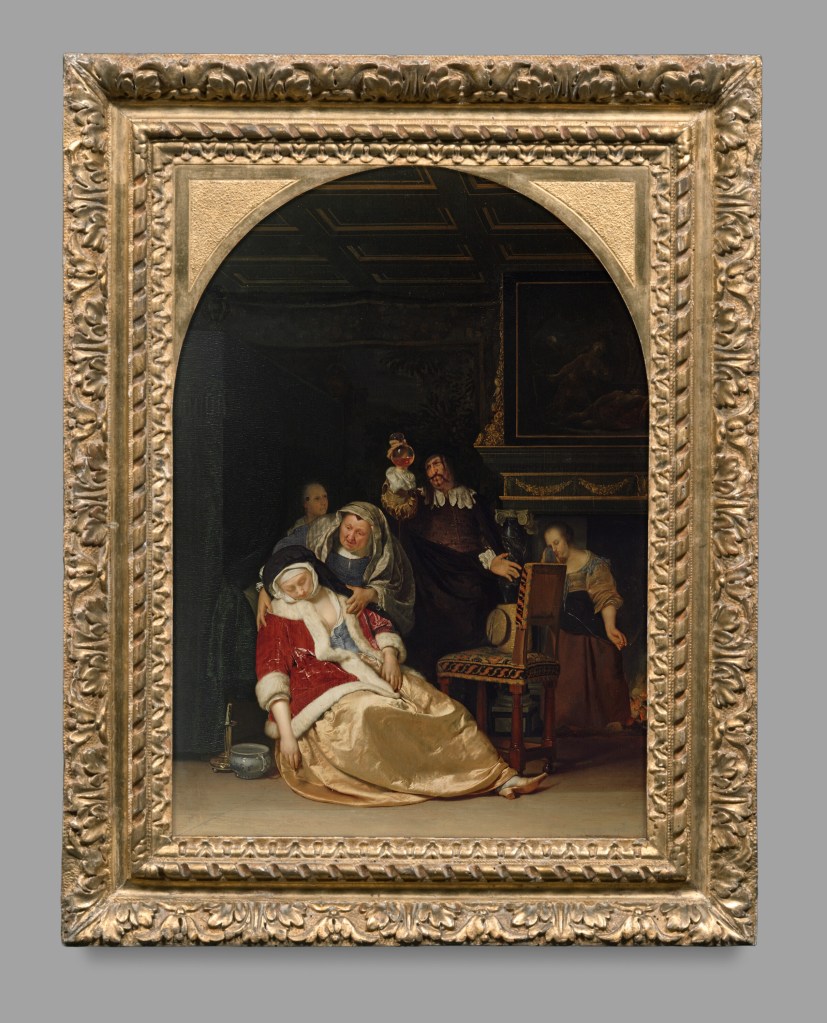
PS – over a year ago, Getty Museum placed a gazillion of their images online for you to use royalty free. Here’s my blog post about it that includes the relevant links: royalty-free-images – oh! and look! they have yet another one of “The Doctor’s Visit” (1667), complete with urine held up to the light and a maid holding the smoking-ribbon…. I do like that frame!:
PPS – quick shout out to the lovely Rebecca, the Canadian priest and artist who translates her migraine pain sensations (she calls them “visitors”) into the imagined colors and lines of a knitting pattern she can mentally wrap herself in. Rebecca is about to publish a book that highlights her “belief in the transformative power of making“, called: “Migraineur: Poems and Patterns on the Experience of Migraine” – read more (and access her free patterns) here: Why Migraines? – Osborn Fiber Studio.


 The Mindful Migraine
.jpg)
Leave a comment