
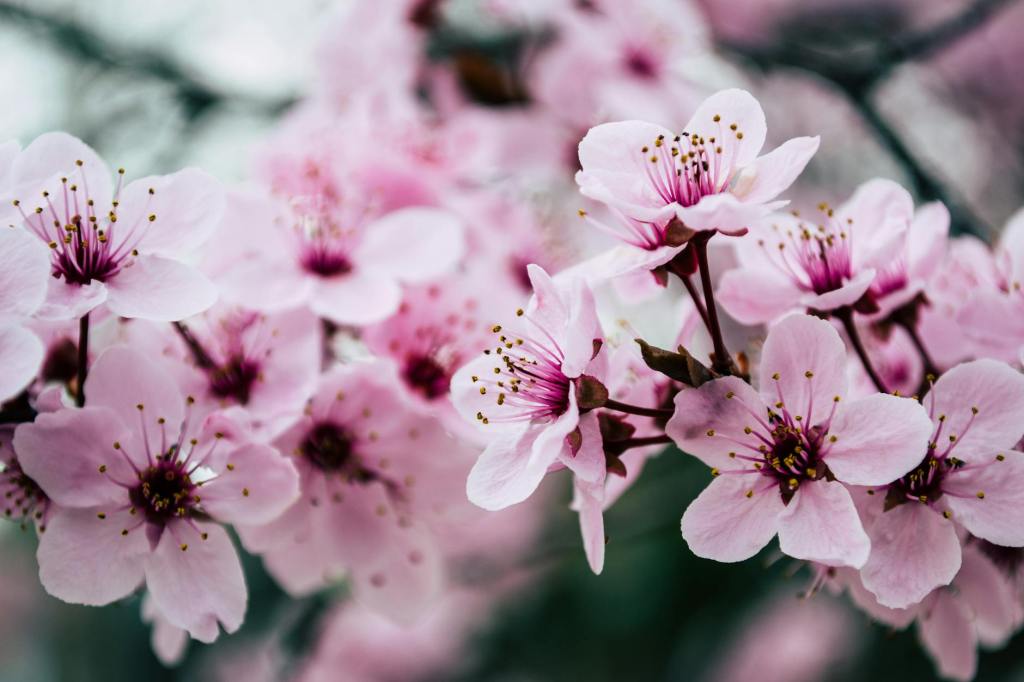
I’m still heavily invested in my “let’s manifest a nicer world” tangent, as part of my New Year’s Revelation for 2026 (there’s personal progress updates (and pictures) at the end of this post).
As such, I was interested to discover a Japanese perspective on manifesting. Straight away, I felt a slight disconnect (because I have lived my whole life with ‘Western’ philosophies) BUT I was also instantly enamored by an approach which seemed more gentle, grateful, communal and cyclical.
In the book “Yoshuku” (2025) by Azumi Uchitani, she explains improving your lot in life with a lovely analogy; we want to be the tree that withstands the typhoon, so we need strong roots and vital energy in order to blossom healthily in Spring. When faced with hardship, we need to dig deeper, hold on and grow, so that our dreams will come true when the time is right (page x-xi).
After experiencing an autoimmune disorder, Ms Uchitani was keen to walk again, and the way that she was motivated to do so was imagining what she would do when she was well; walk the dog with her son and dance the tango. This helped her feel as if her spirit was already dancing and she began to get better; all the exercises she was required to do felt like a preparation for a future celebration and she leaned into the camaraderie of healing (ixv).
This notion of being future-focused, communal, and celebratory were themes that were repeated throughout the book, and they made a nice change from the more self-centered, materialistic vibe that you often get from stories about people manifesting themselves a sportscar or a promotion.
Ms Uchitani defines ‘Yoshuku’ as “the ancient custom of ceremonially celebrating in advance an important life event we wish to happen” (3).
[It should be noted that when I did a web-search on this ideology, the only websites that came up were related to the her book. Ummm… so… I’m not saying it’s not a thing, I’m just surprised that for an ancient tradition there’s not a lot more available information about it.]
The tradition is apparently “rooted” (pun no doubt intended) in Shinto philosophies that believe we coexist with countless divine spirits that live in nature, as well as local spirits and the spirits of our ancestors. Anything we manifest, we are receiving from these spirits, and for this we need to be grateful. Individual manifesting needs to recognize this greater life-force and energy (5-9).
Importantly, this form of manifesting increases your well-being NOW (you don’t need to wait for the future outcome), because you’re already celebrating. It’s very different to what she refers to as the ego-driven manifestations that wish for a future outcome, and as such, assume that gratification will come later (12).
Ms Uchitani states that negative, or limited, self-beliefs can hold us back from achieving happiness now and in the future. We might wish for health, wealth or love, but not achieve them because the ‘roots’ of our ‘tree’ are not strong and healthy. If the hidden, subconscious parts of ourselves are sickly or weak, the tree (that is us) will fail to thrive (16-17).
She notes that there is nothing wrong with desire – the trick is not to tie our happiness to succeeding or acquiring a particular goal, or we will be forever chasing new desires. She likens ego-pampering to craving chocolate – you eat it and are happy, but soon after, the emptiness and hunger returns. That is why what we desire, and manifest, should be as wholesome as possible, deep and aspirational / spiritual, and something to be shared. Moreover, we should do so from a place of abundance not scarcity (22-24).
One way to become grateful, optimistic and generous – is to create a celebration ceremony in the here and now. She notes that we are all good at worrying and becoming anxious (we do this simply by indulging in negative emotions about an imaginary catastrophe that hasn’t happened) – instead, harness that creative imagination for good emotions. Imagine a bountiful harvest that your community will share [or perhaps winning the lottery with your extended family] – and feel the sense of excitement and appreciation in your body that such a blessing would generate. Imagine the party you would throw, and who you would invite to share the moment with. Feel the vibration of positive energy within yourself and see if you can harness that feeling (29-34).
“When we think about what we want, or what we want to achieve, we often focus on the future. However, the key is to bring the energy of these wishes into the now” (36).
The book reminds us that we often (especially in the “West”) think of time in a linear fashion. We’re stressed that we have to get this done now, then this, then that. But time is also cyclical – day becomes night, becomes day again, and the months follow each other in an endless loop. She reminds us that the clock-time of dawn is constantly changing, and that a cherry tree blossoms when it’s ready (and sometimes misses a season if the conditions are not right). What’s more, there tends to always be a mixture of good and bad in life, so the ‘down times’ can be the dawn of a new beginning (37-8).
Another Japanese concept that she introduces is called “Ki” which is the life-force energy that exists in each of us and is beyond space and time (I think it is similar to the Chinese Qi which is an integral part of Qigong (and, I think it shares similarities with the Indian concept of ‘Prana’)).
[I couldn’t help myself – I went looking and found a website that explains all 3 life-forces side by side: Qi (Chi) vs Prana vs Ki: An Exploration of Life Force Energy]
So, returning to Yoshuku, the idea is to purify our spirit and energy with gratitude, light and love – and in doing so – we fertilize the roots of our tree and ready the soil for the seeds of our dreams. And, because we are filled with positivity for a good outcome, we give thanks in appreciation (with gifts, prayer, ceremonies or celebrations) in anticipation of our success (47). In doing so, we are also elevating our spirit and energy higher still (51).
“Manifesting is not just wishful thinking and waiting. Once we are in the vibration of what we would like to happen, we should make daily choices and take daily actions to stay in that vibration” (52).
Ms Uchitani also leans into the notion of serendipity, destiny, and the belief that once we are on the right course, encounters will happen that further our cause (53). When we notice these ‘co-incidences’ happening we should cherish each moment and see it as another seed that will grow and bring new dimensions to our life (54).
Over and over, the book relies on the metaphors of trees and when she finally outlines the practice of Yoshuku, it involves a floral visualization technique:
- Step 1 = cultivate your wish (select the ‘flower’ you want to see)
- Step 2 = prepare your mind (create a fertile ground)
- Step 3 = prepare your celebration (chose a name for your party, invite others to share in your dream, use all 5 of your senses to celebrate the future vision in as much detail as possible)
- Step 4 = daily rituals (tend your garden / nurture it constantly)
- Step 5 = honor the journey (hold thank you celebrations)
*
Overall, I liked this gentle version of manifesting, but I confess that some of what I hope to generate in my future feels personal and fragile – I can’t imagine holding a party where my family and friends all toast to my future success laid bare on the table. For me, I still cling to the notion that the seed of the future can be nurtured in a sheltered, private, darkness.
That said, there is a power in sharing your goals; it helps you stay motivated when those around you know what you’re up to. For example, I printed out my Healing Program (here) and put it on the fridge two years ago so that everyone knew what I was up to and could support me… and now I write a blog which included a team challenge a year ago to keep the communal effort going.
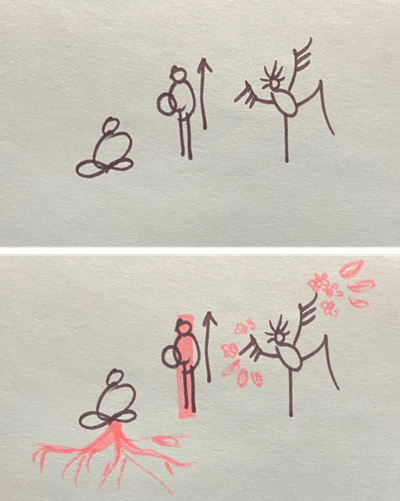
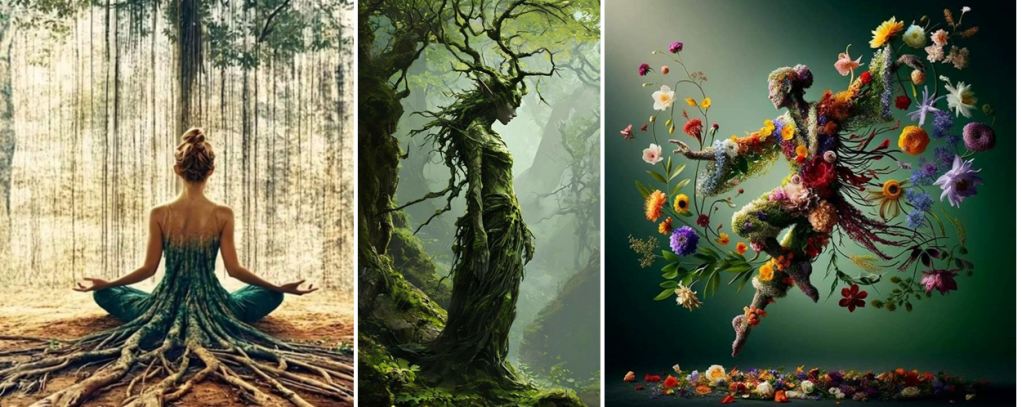
Mostly what I liked about this concept, was that it gave me a new way to visualize some of the manifestations I already had in place. Without going into too much personal detail and distracting you from your own journey, I had begun to imagine 3 versions of myself I was hoping to shape into the future: one who was calm and mediative, one who was strong and warrior-like, and a third who was more self-confident, even dancey-happy-exuberant. I made a little stick-figure-sketch for myself late last year that showed my three selves (sitting cross-legged, in my armor, and dancing in some sort of next-level costumed-celebration)… as you do.
After reading the book, I pulled the picture down off my pinboard, and added some tree-details to it (healthy roots to keep me grounded / a strong trunk / and a celebration of bountiful blessings displayed as leaves, flowers and fruit):
[Image source: me!]
I have a clear image of what these sketches look like in my mind, but they are admittedly vague, so here’s some Pinterest images to help you see what I see:
[Image sources from Pinterest: PLACE OF POWER AESTHETICS / Portada / Pin on сад]
If nothing else, the book proved to me that there’s more than one way to do everything in life – so keep blooming where you are, you-niquely.
Take care and taking care, positively, Linda x
*
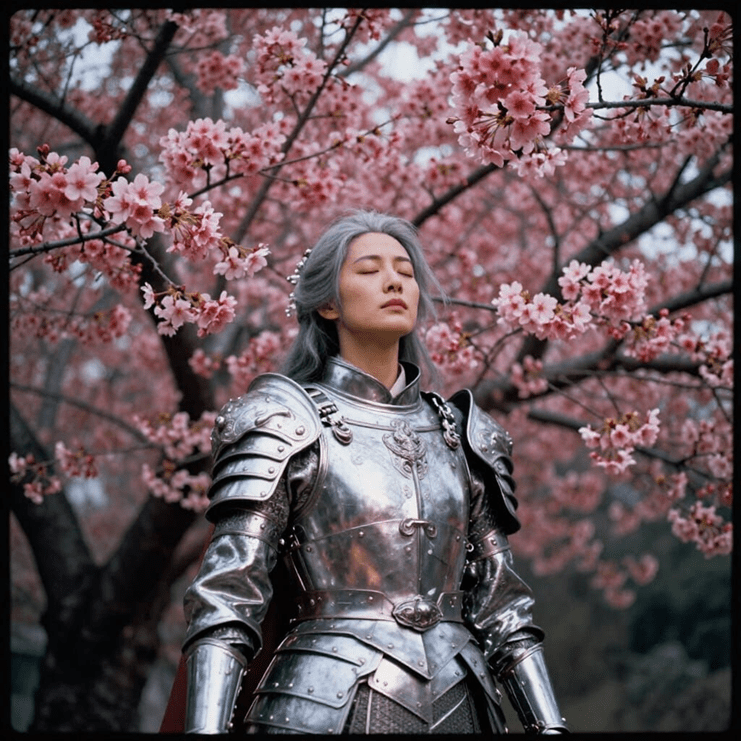
PS – I’m a bit reluctant to use AI for frivolous activities these days, because I worry about the drain it makes on the planet’s resources, but I decided today to make an exception and asked an AI image maker to show me a lady with grey hair, her eyes closed in meditation, dressed in a suit of armor, surrounded by cherry blossoms – and now I have a nice, neat, (albeit unusual) image to hold in my head when I’m manifesting my future:


 The Mindful Migraine
Leave a comment