
First up – a quick shoutout to the people who joined the zoom gatherings over the weekend; I appreciate you so much for your generous support of my baby-blog and I loved getting the opportunity to have a real conversation with you all: you’re the best! (If you missed out, no stress, I’ll run another get-together in mid-December as an early Christmas celebration.)
One of the ladies who participated in the first get-together was a new digital friend I’ve made on LinkedIn – Tracy Jallow. When I was looking for an example of her writing I could link to, I found a post she had written a couple of years ago about Kintsugi, and I just knew I had to riff-off (rip-off?!) her idea!
‘Kintsugi’ – or ‘golden repair’ – is the Japanese art of mending broken pottery with precious metals.

[Image source: Kintsugi: the art of precious scars – LifeGate]
Japanese philosophy (and I’m winging it a bit here, so I’m sorry for my simplistic approach or if I get the details wrong) includes the notion that age implies wisdom and value. Rather than revering youth and newness above all else, they appreciate longevity. Objects which show their wear and tear are not considered worthless, instead, the patina of age makes the item more valuable. Think of those tiny, precious, Bonsai trees that are hundreds of years old, or an antique that has been passed down through the generations, a little beaten up, but clearly well-loved.
A second aspect of the philosophy that fuels kintsugi, is ‘wabi-sabi’ which roughly translates to ‘perfectly imperfect’ and focuses on a world view that accepts that youth and beauty – life itself – is transient. Here, natural flaws are what make a piece interesting and worthy of contemplation. Think of those resilient old stone walls on a farm, made of weathered rock, moss-covered, near collapse, but refusing to fall. Or those wobbly, lumpy, clay sculptures that your children brought home from school, held up high with pride, and how proud you actually felt at their accomplishment. (I know this is not what the philosophers had in mind when they came up with the concept of wabi-sabi, but it’s how I’ve always thought of the idea.)
English embroidery artist Charlotte Bailey, happily adopts the ancient Japanese inspiration and gives it her own contemporary twist with embroidery silk:

[Image source: The Japanese Art of Fixing Broken Ceramics: Kintsugi | Architectural Digest]
[You can watch kintsugi history & how-to videos here: How to kintsukuroi – Kintsugi, Japanese gold repair – The Ceramic School]
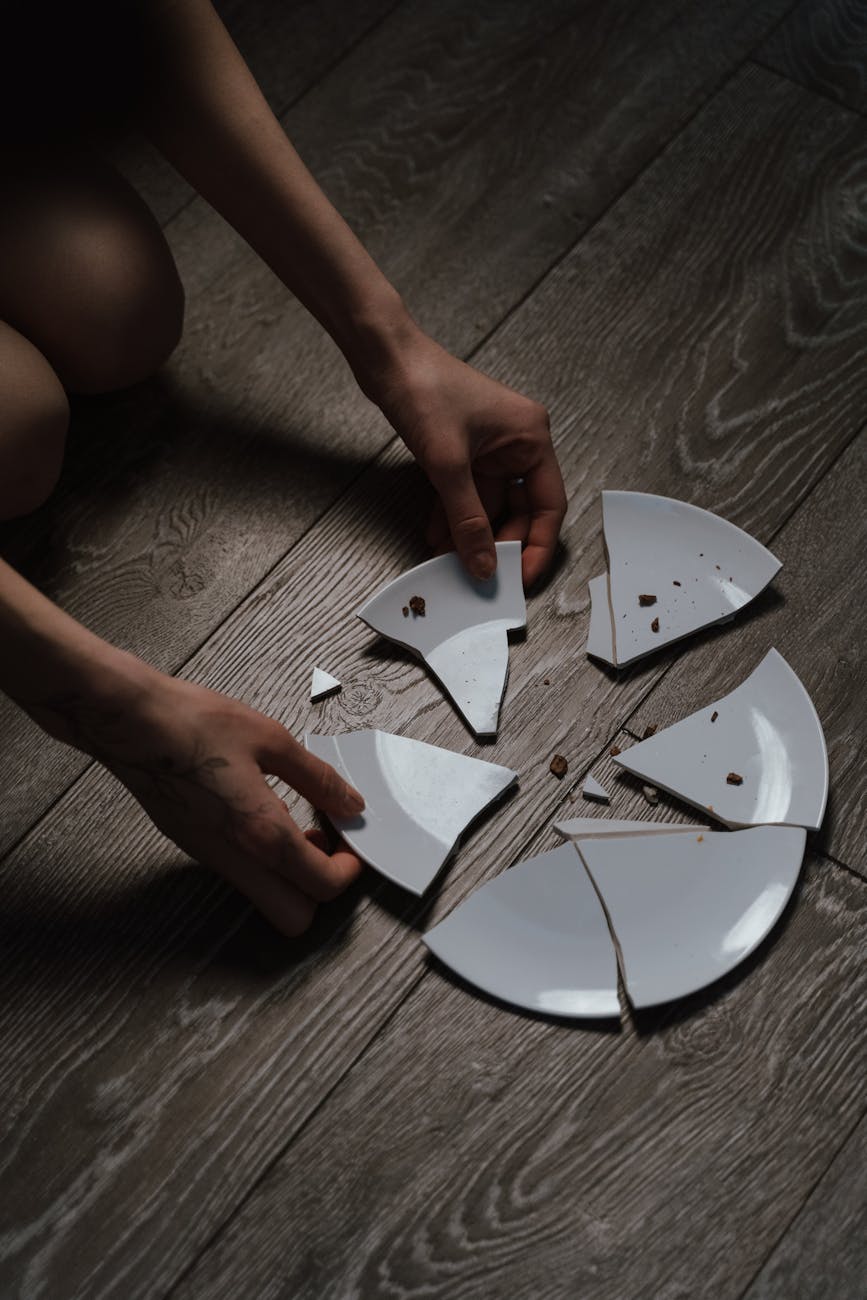
Traditionally, in the ‘West’, when a plate or bowl is broken, we get angry or upset. The breakage is experienced as a negative event. There is a sense that the piece is now worthless. We MIGHT try to glue it together with super glue and hope that the glue dries clear and smooth enough to render the repair invisible or, we set the pieces aside to make a tile mosaic if we get inspired and find enough time. More often than not (myself guiltily included) we simply scoop up the remnants and toss them in the bin… too bad, too sad, sayonara!
In a completely opposite approach, kintsugi, suggests that it’s the breakage – and the repair – that makes an object interesting… as the LifeGate website (noted above) says; the scars become precious and the main focus, not to be ignored.
[It reminds me of an inverted-take of a post I did months ago (here) about living in the grey-zone between healthy-and-sick, that mentioned the website “unfixed” whose cover page opens with “UNFIXED: not fixed but far from broken”… in the kintsugi approach, we’re accepting that we’re simultaneously broken AND fixed. As such, chronic pain leaves us all in a state akin to being (un)fixed.]
Kintsugi reminds us that when we’re ill we might feel ‘broken’ – but even if that label feels right, it does not mean that we are destined for the scrap heap. We are NOT worthless – but we ARE perfectly imperfect.
Tracy ends her own post with the sentence: “I believe I am a better version of myself with all my golden cracks.” How good is that? Here’s hoping we can all learn to see value in our flaws!
Take care taking care, Linda x


 The Mindful Migraine
Leave a reply to The Mindful Migraine Blog Cancel reply