The Healing Art of Tai Chi

Published by

on

When my neurologist told me that “more medicine does not equal less pain,” he added that what I really needed to do was change my lifestyle and mindset instead.  He wrote a list of things to try which included meditation and Yin Yoga. 

As I’ve written about before, the meditation quickly grew on me, but I was initially NOT a fan of the Yoga; there was something very unsatisfying about leaving bed to lie on the floor (I’ve since come to rely heavily on Chair Yoga and what I call “Face Yoga”).

Almost by accident I stumbled across Tai Chi whilst looking for videos of things I could try in those early days of healing.  Since then, I have incorporated my own version of “Tai Chi lite” into my everyday morning routine.  Slow, intentional movements, accompanied by deliberate breathing and an awareness of how my body is moving, and how it feels as it is moving.  It has become a very calming (and yet empowering) way to experience mindfulness.

A few days ago, I discovered a book pushed to the back of my bookshelf.  It was titled “The Healing Art of Tai Chi” (c. 1989) by Martin and Emily Lee, and their two daughters Melinda and Joyce Lee.  The book has several pages at the beginning that explain the ideas behind Tai Chi, and then dozens of pages to teach you 64 moves.  I vaguely remember buying it before I met my husband (so 20+ years ago), around about the same time I was trying to increase my fitness and flexibility (and reduce my stress).  The book has a sense of promise to it, (which is presumably why I held on to it); its form and layout imply that anyone can pick it up and become a master.  But, as soon as I started flicking through the how-to pages, I realized why it had stayed at the back of the shelf; it is VERY difficult to learn how to move your body in a specific way from a book. 

Imagine a book that aimed to teach you how to swim.  Or ride a bicycle.  Or drive a car.  Even the best writer, with the support of several photos and diagrams added in, would struggle to explain the activities in a way that would allow you to 100% “get it”.  Perhaps you could use it as a starting point, and then have a go, and learn in motion… perhaps.  But Tai Chi’s strength (in its traditional form) comes from set moves done in a set order, performed in a set way.

Today, the internet allows you to watch videos of people teaching Tai Chi.  Even still, all videos are not created equal.  Some are easier to follow than others.  I for one, find it difficult to follow a routine when the teacher is facing me – it requires me to mirror-reverse all the moves… when they lift a left hand and sweep it further left, I want to lift my right arm and sweep it right… If the teacher is facing away, then I can follow their moves with more ease, but even then… they move with the confidence and grace of someone who knows what they’re doing… unlike me…

Which is why I tend to watch a few videos, learn a few moves, and then make up my own routine that better suits my body’s ability.  There are still elements of “parting the horse’s mane”, or “embracing the tree” or “sweeping the clouds” but no teacher would commend me on my style or grace!

So then, I am who I am… let’s get back to the book. 

The front pages were an interesting read.  It started with the primary author and Tai Chi master, Dr Martin Lee, explaining that when he came to America from China, aged 16, it was the automatic doors at the front of a building which made him decide to be an engineer.  Many years later, he was suffering from severe allergies when he discovered that Tai Chi made a difference.

After practicing for some time he came to the conclusion that the “self” was made up of mind, body, thoughts and ch’i (energy).  Thoughts sit within the mind as coffee sits within a cup, the book explains.  Similarly, the energy of ch’i resides within our bodies.  All four aspects are interrelated.  The book uses the Yin-Yang symbol to show how our sense of self is then related to our body parts, and later in the book, our individual cells.

[Image source: photograph of page 33]

When we are in a state of wellness (which Dr Lee suggests is made up of happiness, health, harmony and healing), then the relationship is stable, within itself and between its whole self and its smaller parts.  There is balance.  When “wellness” is replaced with “illness”, on the other hand, then the shape shifts – the relationships distort (and we become “messy”):

[page 21]

The four components of self are then related to something bigger than us, (call it the Universe or God): our mind is connected to an infinite mind, our thoughts to eternal thoughts, our body to a universal body and personal ch’i to universal energy:
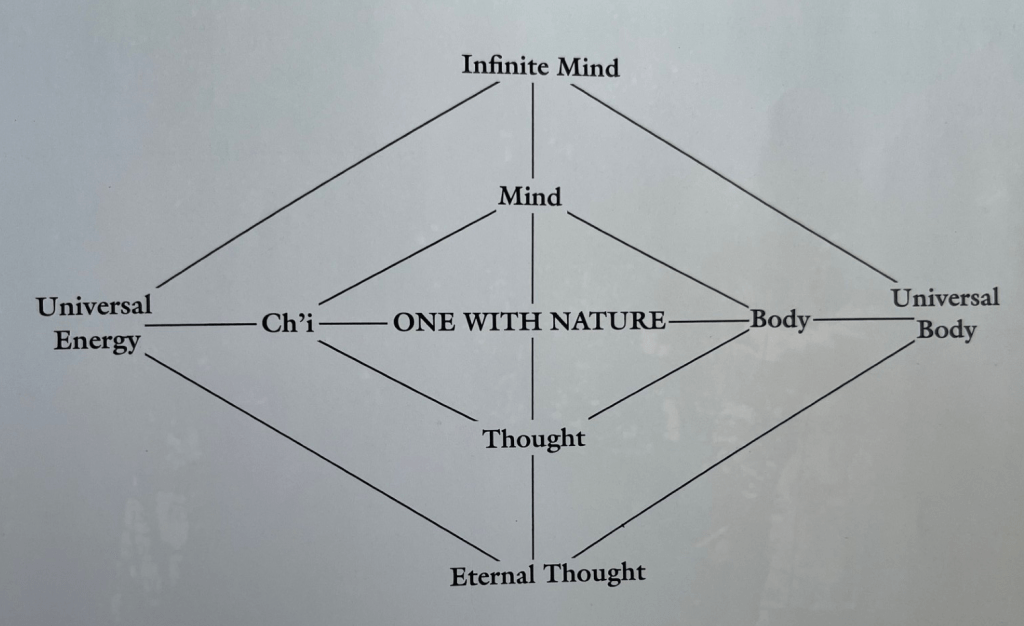
[page 19]

There is something quite nice imagining myself as being interconnected to both a micro (cellular) level and a macro (cosmic) level.  What happens on one level effects the others.  Global issues are creating toxins which are affecting us deep inside… and potentially, the same happens in reverse, if we can create internal health, we might be able to influence a wider healing.

The book also explains that Tai Chi was originally developed as part of marital-arts, so it involves self-defense styled moves; pulling, pushing, deflecting, kicking… when you watch experts do the moves, the defense aspect becomes more apparent.  When you watch Westerners doing the moves in slow motion in a park, it is not so obvious, but the origin story remains there in its DNA.  Sometimes, remembering that DNA helps me move in the morning, makes me feel (don’t laugh) a little more bad-@$$ as I get ready to face the day!

Lastly, the book suggests that you can use Tai Chi to heal headaches through a form of meditating; relax, breathe, do no more… and then when you are ready touch your head (for a few breaths), then your chest, then your thigh.

There was a Tai Chi Proverb that I particularly liked: “To move, move every part. To be still, quiet every part.”

It’s simple, but to the point: when you need to get something done, get it done, but when it’s time to rest – STOP.

Overall, the book won’t help you learn the moves as well as a real class with a guiding teacher, or even as well as a video, but it is always nice to learn more about the details behind the thousand year old tradition.

Take care taking care, and try Tai Chi – it’s worth it, Linda x

PS – here’s the playlist of videos I used to get started: Tai Chi / Qigong – YouTube

[PPS – as a strange aside, there was a photocopy of a magazine page inside the book about half-way through.  It’s dated 1998, and the only reason I can think that I had it, was because it had a quote from Dennis Eck, the then CEO of the then company Coles Myer (where I used to work designing shop fitouts in my 20s).  The quote said: “As a retailer you can only be cautious and you can only be optimistic. Otherwise, you are in some other business. I’m a Gemini, so I can be paranoid and balanced at the same time”… as a fellow Gemini learning about Yin-Yang… I think I get it!]


Discover more from The Mindful Migraine

Subscribe to get the latest posts sent to your email.

25 responses to “The Healing Art of Tai Chi”

  1. What is White Magic? – The Mindful Migraine Avatar

    […] a combination of mindful intentionality, manifesting, and the sort of energy awareness I do in Tai Chi. Put together, it’s a little bit outside my normal life, but I’m OK with that… I […]

    Like

  2. When mindfulness feels risky – The Mindful Migraine Avatar

    […] like to breathe intentionally. I enjoy mindful movement (Tai Chi is my favorite – but I practice it in a “mindful-lite” manner all of my own […]

    Like

  3. Reflexology for migraines – The Mindful Migraine Avatar

    […] because the ground beneath us differs.  Our brain can sense the difference.  One of the Tai Chi moves I like, includes rocking on your feet, slowly rotating, feeling your body’s weight […]

    Like

  4. Liz Avatar

    I have one time done Yoga. It took me a few weeks before I felt I was into it. The class then ended due to not many attending.

    I then went to a Pilates class. I was her first student and I found I liked Pilates better than Yoga and got into it from day one. I attended her classes for years until costs prevented me from attending further. I have a hardback Pilates book with familar moves and moves I have not done before. The tutor said that was the best book I bought. And like you know, it’s best to attend a class or follow on YouTube before understanding and doing further from a book.

    It’s been some years since attending a class. And although I am not a regular doing Pilates at home, when I do some moves, I focus on ones that help me stretch, to prevent an injury reoccurring that got me attending a Pilates class in the first place.

    I absolutely love Tai Chi. I came across it by accident in my teens when I was up way past my bedtime and seen someone on tv doing it. Since then I dabbled in it and as an adult it came more regular. After so many months not doing it, I am getting back into it again. I like following along to David-Dorian Ross after looking through many on YouTube and I have a few of his DVDs. There are one or two other instructors I like. But he is the main one I use and follow to.

    Liked by 1 person

    1. The Mindful Migraine Blog Avatar

      I love that you’ve tried so many different versions of mindful movement… it makes you very mindful! It really is a balance and a juggle, you try different things at different times in different forms… cost and travel have been limiting factors for me too… I’ll have to look up David-Dorian Ross… thanks for the tip! Linda xx

      Liked by 1 person

  5.  Avatar
    Anonymous

    One may say that the path taken by the mind of thought will lead you to the way forward as the mind is the controlling force within us all.

    Love your words and thoughts.

    Liked by 1 person

    1. The Mindful Migraine Blog Avatar

      Thank you kindly – and thank you for stopping by – you are always welcome here! Linda xx

      Like

  6. joannerambling Avatar

    I have never tired Tai Chi but have heard of it, and my sister who does it says that some of the movements in my daily exercise are tai chi movements. I tried yoga but it wasn’t for me

    Liked by 1 person

    1. The Mindful Migraine Blog Avatar

      I think you have to lean into whatever works and lose what doesn’t… no guilt, no shame, just whatever works…! xx

      Like

  7.  Avatar
    Anonymous

    I know I’ve felt better in body, mind, and spirit once I started doing yoga regularly. I include meditation at the end and find it grounding…basically, it helps me feel less stressed. But I know it’s not for everyone.

    The main thing is to find something that works for you and your situation, and it looks like you’re on the right path. 🙂

    Liked by 1 person

    1. The Mindful Migraine Blog Avatar

      That’s absolutely right – “whatever works” is likely to be the best way to proceed – super happy that Yoga and meditation are helping you! Linda xox

      Like

  8. Sheila Avatar

    I enjoy tai chi at home watching YouTube videos. I took a class on it a couple years ago and the instructor was always getting on me (and others) about our technique. She was so particular about doing the minute movements exactly right that I left feeling more stressed than when I arrived! I thought it was going to be like the older people in the park scenario. I am grateful for YouTube.

    Liked by 1 person

    1. The Mindful Migraine Blog Avatar

      Yep – that was my sense as well – to be “in teh flow” it felt better to be in MY flow… I know that’s not the real nature of improving balance and concentration, but when you’re not feeling well, then you have to listen to your body… I am super grateful to YouTube as well! (hope you’re well lovely) Linda xx

      Liked by 1 person

  9. Skyseeker/nebeskitragac Avatar

    I was doing some Kung Fu lessons online a while ago, and it’s hard to do it right. I stretched my nerve in my right hand and even needed to see a doctor about that. It wasn’t dangerous, but I stopped with the training since I didn’t wanna risk some injury. However, if you wanna give it a try, check out this sites

    https://shaolin.online/

    https://www.shihengyi.online/

    Liked by 1 person

    1. The Mindful Migraine Blog Avatar

      Oh! I’m a bit conflicted!! I love a good link – but not the ones that will end me up at the doctors… but I know what you mean… it’s why I think it is risky to teach yourself anything movement related from a book… I’ll have a look at the Kung Fu (because it sounds so cool!) on the weekend, thanks, Linda xx

      Liked by 1 person

      1. Skyseeker/nebeskitragac Avatar

        You’re welcome, I’m glad you’re interested in Kung Fu (yeah, it definitely sounds cool). 😀

        Liked by 1 person

        1. The Mindful Migraine Blog Avatar

          If I do have a go – I’ll make sure there’s no photo evidence… because it wouldn’t be good! 🤣

          Liked by 1 person

          1. Skyseeker/nebeskitragac Avatar

            Don’t surprise if you get sweaty, the free exercises I did were quite demanding.

            Liked by 1 person

            1. The Mindful Migraine Blog Avatar

              Good to know – I might have to do it in slow motion! xx

              Liked by 1 person

  10. My Mindfulness Journey Blog Avatar

    I appreciate your suggestion and will definitely look into the Tai Chi videos you shared. Thank you for sharing your experience with Tai Chi and the helpful resources.

    Like

    1. The Mindful Migraine Blog Avatar

      My absolute pleasure – the trick is to keep trying different mindfulness techniques until you find the ones that work for YOU – but then you know all about that – you have a whole blog dedicated to them! Yay you! L xx

      Liked by 1 person

  11. thingsihavethoughtof Avatar

    Just to add…

    Yoga originated in India as a tool to teach you to control your thoughts, by allowing your attention to rest on your moving body. It was meant to help train your mind ready for meditation.

    As the philosophies moved further east to China, yoga was replaced by Tai Chi but it’s a very similar philosophy. Additionally, at the same time Tai Chi allowed the person to also train the moves of a Warrior in case of war.

    It’s very hard to simply start meditation on a mantra and do it correctly. If I stop for 2 weeks, I can’t go straight back into meditation because my mind will wander uncontrollably. So I need to practise again on the easier physical parts of my body for a few days before moving back into pure meditation again. I then meditate using my breath, which is still physical, before I can move back to using a mantra.

    So there is an original purpose for all these things.

    I know, way too much info….!

    Liked by 1 person

    1. The Mindful Migraine Blog Avatar

      No, it’s great… I think in India Qi / Chi is called Prana… I think it’s fascinating “The East” were so in tune with it, while “The West” were obsessing over I think therefore I am. Such a different approach to living. I’m still a thinker-I-am person, but I’m slowly sensing a universal energy… love that you are so good at meditating… I’m still very much monkey-minded! L xx

      Liked by 1 person

    2. Shravan Avyukta Avatar

      Hey! Thanks for sharing your thoughts! It’s nice to see an interest in both yoga and Tai Chi. I just wanted to clarify a couple of points since I have a background in both practices.

      1. Like you mentioned, Yoga indeed originated in India as a practice designed to prepare the mind for meditation. It’s a discipline involving postures, breath control, and meditation, all aimed at achieving mental and spiritual well-being. And, there are several types – Kriya Yoga, Kundalini Yoga etc.
      2. While both yoga and Tai Chi promote mindfulness and health, they developed independently. Yoga is rooted in Indian traditions, whereas Tai Chi is a Chinese martial art with its own unique philosophy and history, said to be originated in the Chen Village. Tai Chi wasn’t a replacement for yoga but rather a separate practice with its own benefits, including martial applications.
      3. I gotta say that it’s completely normal to find meditation a little challenging, especially after a break. Many people use physical activities like yoga or Tai Chi to help focus their minds before meditating. It’s all about finding what works best for you!

      Liked by 2 people

      1. The Mindful Migraine Blog Avatar

        Wow – this is great – thank you – off to read your blog! Linda xx

        Liked by 2 people

Leave a reply to The Mindful Migraine Blog Cancel reply

Previous Post
Next Post