
“Friday the 13th” – that’s what today is. It sounds so spooky and full of dread. It conjures up superstitious thoughts and nightmare-scenes from horror movies… so what to post about on such a (potentially) dark day?
An architecture of dread… or not.
While looking for images for my university research, I came across some photographs of derelict hospitals, orphanages and mental ‘health’ institutions. They were predictably terrifying. There is something very unsettling about a place of healing left to rot, looking so grim.
Possibly it’s an unfair analysis too, since “derelict in time” does not necessarily equate to “dereliction of duty”. Some of the spaces look like they were once colorful, light-filled and spacious… well intended, perhaps even well suited, for patient caring.
Perhaps the terror that they trigger in us has more to do with the stories that we have heard over time. Memories about early “treatment” methods for certain “ailments” (such as “hysteria” in women), make everything feel a bit cringey and morbid and make our minds go to dark places.
Whilst there are plenty of images to choose from online, here’s three – an abandoned mental asylum photographed by Matt Van der Velde in America, a tuberculosis ward in New York by Johnny Joo and Aaron Miller’s photo of a kindergarten in Chernobyl:
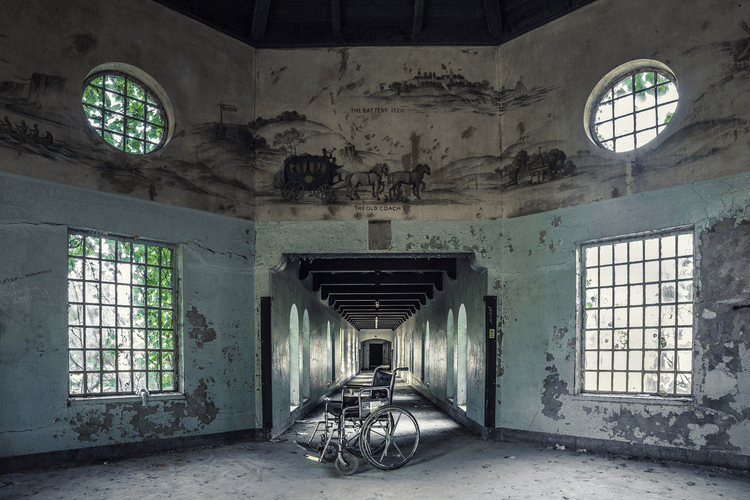
[Image source: These Images of Abandoned Insane Asylums Show Architecture That Was Designed to Heal | ArchDaily]

[Image source: Eerie pictures of Abandoned hospitals in the US – Mirror Online]

[(Witness to decay – the road to Chernobyl – Postcard Intellect (wordpress.com)]
A phrase that that came up in an associated article about these eerie pictures of rotting institutions, was “RUIN PORN”. What we feel when we look at the images, borders on a sublime-terror. These images of decline are so aesthetically evocative it’s hard to look away – but at whose expense are we getting our cheap thrills? Who suffered to make these images? Patients? Landlords? Society? The poor old building itself?
What efforts are we taking to reverse the decline? Or save further buildings from falling into similar decay? What broader moves are being made to make an architecture of healing that is more viable?
Potentially proving the point that we can be short-attentioned and selfish, I too turned my back on the doom and gloom once I had my fill and decided instead to indulge in a newer form of recreational looky-see: “AI-IMAGE GENERATION”.
I asked three different AI art makers to portray the same prompt: “a hospital room designed for holistic healing” – this is what I got:



It is interesting that the three images share several aspects: a neutral color palette, lots of plants, natural lighting, open space, and a shift away from “typical” hospital furniture towards furniture you might see in a hotel…
…the fruit basket and over the top wall decorations of the middle picture are particularly nice touches (no matter how impractical they might be)…
… the two white statues of blob-people in the window of the same (second) image are slightly more unnerving… as is the number of chairs for visitors.
They did make me wonder though:
…who waters all the pot-plants?…
…what would happen if you were a patient with hay fever?…
…how important is a room with a view if you are healing – and does it matter whether the view is a landscape or cityscape?…
…having read the book Healing with Color, I wonder if the beige-on-beige with green accents is as healing as they think…
…what happens on an overcast or rainy day when a bland room loses its light?
Out of curiosity – what do you think of the computer’s approach to holistic healing? What elements do you think contribute to an architecture that heals?
On this Friday the 13, take care taking care…
…in your own space of healing, Linda xox
PS – just as I was about to hit “publish”, I remembered there was one more AI website I had recently been experimenting with, so I jumped over to give it the same prompt. It went all out on the sunshine and greenery, but this time there’s a person included… a well deserving health care worker who gets to heal!


 The Mindful Migraine
Leave a reply to John Micallef Cancel reply