

A while ago I posted about “Mindfulness and its discontents”, a book I picked up from the university library. In the same visit I also picked up another book, titled “The neuroscience of mindfulness” by Australian neuroscientist Stan Rodski (2019).
The book starts straight out with why we need mindfulness; because our brains were designed for the adrenalin rush response to dangers, but modern anxiety and overwhelm are making our brains feel as if danger is chronic – we need to switch that off.
When discussing the physiological effects of fear, the author notes the example that our blood leaves our head, hands and feet, the purpose is to drive blood to the muscles so we can sprint or slash our way to safety – the side effect (or long term effect) of this sort of reaction is that we might have conditions that include cold hands and feet or migraines (page 17).
Mindfulness, he suggests, is like the rest in music – a pause; “an interval of silence” (19).
He gave a nice analogy – your brain is like a snow globe; sit still and let it rest, and all the ‘snow’ falls to the bottom, and the image inside the snow globe becomes clear (20).
Dr Rodski breaks down all the parts of a typical definition of mindfulness: paying attention to something / in a particular way / on purpose / in the present moment / non-judgmentally.
The main thing is to use repetition / patterns / control… and then he segways into a promotion of his coloring-in books.
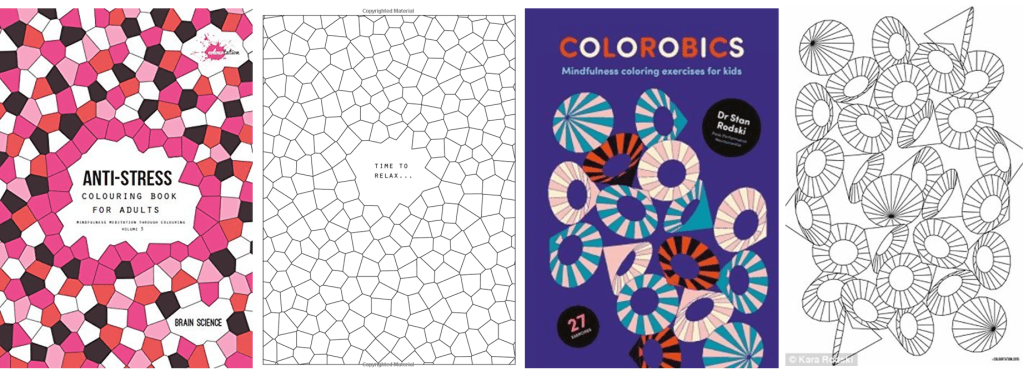
There is a long chapter on different brain waves and the recommendation that you want to get your brain into alpha-theta wave mode. Theta waves apparently appear when we’re falling asleep or waking up, or even daydreaming as you walk along and can’t remember the journey. Alpha waves are generated by repetitive actions; restful yet awake. Coloring in apparently is an alpha-wave-generator.
He then gives several pages of worked examples of how to improve mindfulness through meditation, sleep, breathing… and coloring in.
There is an explanation chapter on the mind-body-connection (MBC) which he reviews in all three parts (133-4);
+ mind: which includes mental and emotional aspects, thoughts, feelings, beliefs, coping mechanisms, and attitudes,
+ body: which includes (slightly countintuitively) the brain, the nervous system (autonomic, sympathetic AND parasymethetic), and the endochrine system which produces hormones,
+ connection: which he labels the immune system.
He suggests the best ways to incorporate MBC is through body work (understand your current physical condition), lifestyle choices (chose to create a safe and sound environment), prioritize your nutrition (understand vitamins, minerals and antioxidants), and understand your MBC infrastructure (like the ‘road’ of your journey, map out and manage your mental-emotional wellbeing).
The three core skills he suggests are (p.74):
+ setting your intention,
+ cultivating awareness,
+ regulating attention.
[I’m a little confused by these, as they sound like they’re saying the same thing three different ways… intention / awareness / attention… but setting / cultivating / regulating ARE slightly different, a bit like, decide / encourage / improve… it helped if I imagined planting a seed, watering it, then nurturing it as it grows.]
Interestingly, the book also includes a whole chapter on Emotional Intelligence. By listening well, understanding that actions speak louder than words, show that you care, avoid arguments, be respectful, and so on, you are improving your wellbeing and the wellbeing of those around you.
Dr Rodski is adamant that until activities are proven by science, they don’t get to classify themselves as MBC. They might still be valid, but alternative therapies, such as faith, chakras, auras, spiritual healing, new age anything, all DON’T count as MBC in his opinion (142).
One of the last chapters is “Creating a compelling future”. Dr Rodski suggests that only 50% of people benefit from mindfulness. He believes that it is because so many of us struggle with low self-esteem which could be improved by having a compelling future to work towards (“find your why”). He is very clear that if you’re healing aim is to “get away from pain” that is an unreliable motivation. These people might get well, but they tend to get sick again. You are “running away” from a scenario. Fear is your main driver, and fear is negative.
[Read “don’t hit the pole” for a similar insight.]
Moving towards health and happiness, on the other hand, is future-focused, and positive. He says that having goals is as important as having goals on a soccer-pitch. There’s nothing inherently wrong with everyone just kicking the ball around, passing from one person to the other, but there’s only a measurable outcome if there are goals to determine the progress.
His advice? Just do it – get out of bed and start painting (or planting, or whatever) if that will make you happier (and healthier).
The front cover of the book proposes that this is a book about: “the astonishing science behind how everyday hobbies help you relax, work more efficiently and lead a healthier life”. I’d say that’s mostly true… but there was a lot more science than hobbies… and more coloring-in than health.
It wasn’t what I was expecting, but then again, I’m not sure what I was expecting…
Take care taking care, Linda xx
PS – Here’s a few links from more information:
+ Here’s Dr Rodski’s website (which includes 3 free coloring in PDFs): Colourtation
+ Here’s my page of resources; scroll to the bottom and there’s some free mandalas to color in or craft with: Resources – The Mindful Migraine
+ Online there are plenty of free mandala’s to color in (this tab takes you to the geometric ones, but there are others): Geometric mandalas coloring pages | Free Coloring Pages (supercoloring.com)
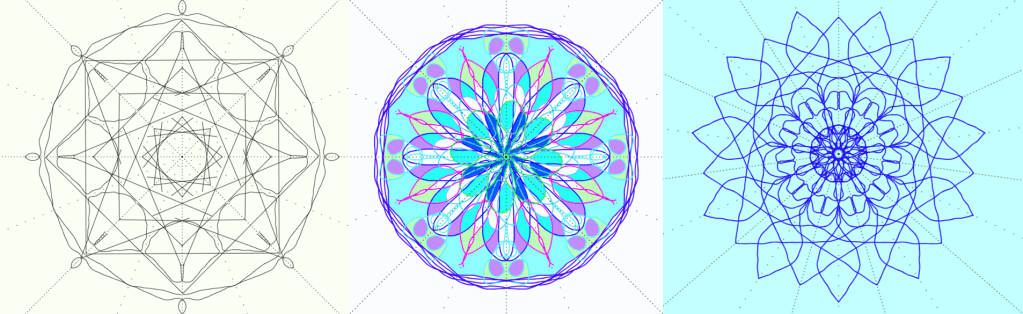
+ I also recently found another website that lets you make a DIGITAL mandala that you can also color in: MandalaGaba – a free tool for creating Zen Geometry – I didn’t have long to experiment, but I was able to screen shot some pretty attempts that felt a bit architectural, or had a sense of my healing mandala:
Enjoy!


 The Mindful Migraine
Leave a reply to majellalaws Cancel reply