

Many moons ago I wrote about the meditation teacher Tara Brach and her Compassion for Overwhelm in which she mentioned “radical compassion”. The ‘radical’ phrase reminded me of the notion of “radical acceptance”. It’s been floating around in my head for a while now, and I thought I should write a bit more about it today.
Psychotherapist Nadia Ahmed writes on LinkedIn that “Radical acceptance is a concept from dialectical behavior therapy (DBT), developed by Marsha Linehan. It involves fully embracing the present moment and reality, even when it’s painful or uncomfortable”.
She goes on: “This practice helps reduce emotional suffering, encourages self-compassion, and allows you to focus on what you *can* control, instead of staying stuck in frustration or denial. It’s not about agreeing with or approving of your circumstances, but accepting them in order to move forward in a healthier, more empowered way.”
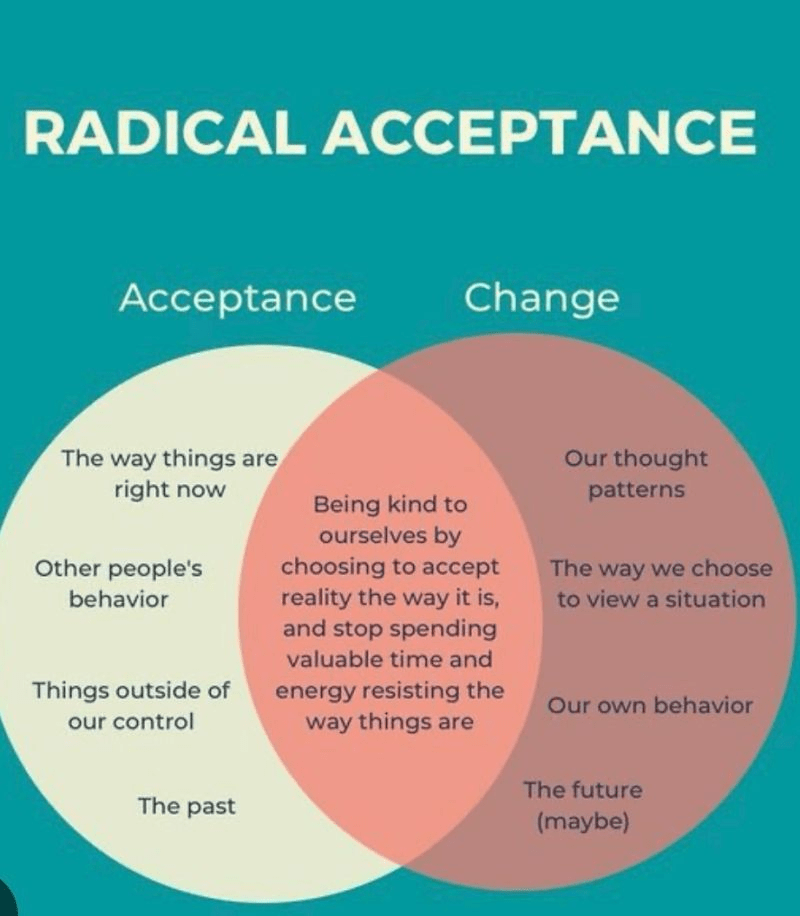
[Image source: Nadia Ahmed on LinkedIn]
I was sick in bed pretty much all day, every day, for a year with chronic migraines. Every morning, I freaked out that the pain was still there, and all day I fought back against my situation, silently (and sometimes vocally) raging against the universe for crippling me with pain. I also suffered from intense guilt and shame at my immobility and lack of productivity. I gained weight from being in bed so much, and came to hate the person I was becoming.
One day, (actually THE day after my neurologist told me that “more meds don’t equal less pain”), I decided I was sick and tired of being sick and tired.
In a way, I accepted that I was in an undesirable situation, but I no longer raged and wept about it. I got up and made small changes. I left the house to walk (slowly) around the block. I started to think about what I was eating and took time to make better choices rather than relying on easy microwave meals that let me scurry back to bed. I wrote a program of things to try. I began to stretch my body and mind, teaching myself Tai Chi. I started to recognize that some things were beyond my control, sure, but some things COULD be influenced by me.
In short, I adopted a form of radical acceptance (even if I didn’t have the name for it back then) – AND – I started to get better.
The MindOwl website has a nice way of explaining it: “if we plan an outdoor event and it rains, there is no one to blame for the fact that it is raining. Rain is just a part of life. Spending our time complaining about the weather is not going to change the weather – it will only increase our suffering.”
Sh!t happens.
It sucks.
No doubt about it.
But for how long are you going to let it get you down?
Why not pick up an umbrella instead and head outdoors regardless?
I don’t say this to diminish your situation as if I don’t care – truly – I’ve been there, done that, suffered mightily… BUT after I started to accept that it was “raining” and life wasn’t what I wanted it to be, I started to separate pain from suffering. My head still hurt, but my heart was no longer filled with rage, and despair and grief. Turning the volume down on all that negativity lightened the load, and my head started to feel better soon after.
The same website has some mantras you can practice with to start your radical acceptance journey:
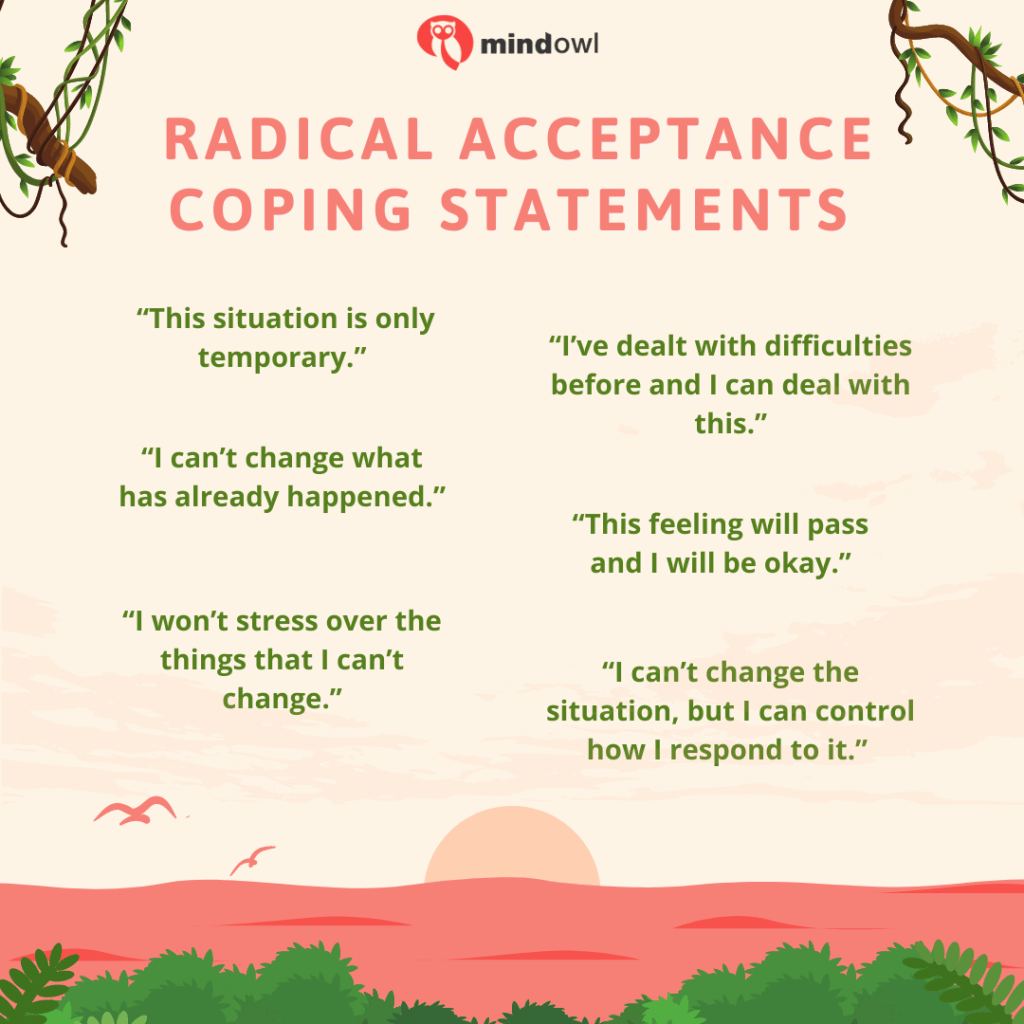
[Image source: MindOwl]
Over on the Very Well Mind website, they also attribute the concept to the psychologist Marsha Linehan in 1993, but also credit Buddhism as being influential. They place an emphasis on “watching your thoughts” and adopting a form of “non-attachment”.
The website says the way ahead “means letting go of bitterness and releasing unhelpful emotions. Once these emotions are managed it is possible to find solutions and make plans for change (where possible).”
The site is helpful in that it outlines 10 steps to try (summarized here – refer to the original article for more detail):
- Pay attention to what triggers resistance.
- Remind yourself that, in this moment, reality can’t be changed.
- Remind yourself that the causes of this reality are outside your control.
- Think about what you would do if you could accept what happened.
- Imagine what things would be like if you accepted the situation.
- Use relaxation / mindfulness practices to understand your emotions.
- Let yourself safely feel your emotions.
- Observe how emotions resonate in your body.
- Accept that life can be worthwhile even when experiencing pain.
- Decide to commit to the practice of acceptance.
The site is also excellent in that it reminds you that NOT ALL situations should be accepted. Abusive or dangerous situations are not OK, and you need not just accept it. As they note, if your physical, emotional or mental wellbeing is at risk – seek help and do what you can to change your situation.
That’s why pain is so tricky. When I was deep in migraine pain, I felt unsafe and perpetually at risk. I wasn’t. I had a roof over my head and food in my belly, and loving family and friends. That’s where the “reminding yourself” aspect of this is important. Assess the situation – uncomfortable isn’t necessarily unsafe. If you are safe, remind yourself that you are safe, separate the pain from the suffering.
On a Borderline Personality Therapy website, they give 12 steps to help yourself, which are similar but different to the other site – detailed in the article (here) but also summarized in a graphic:
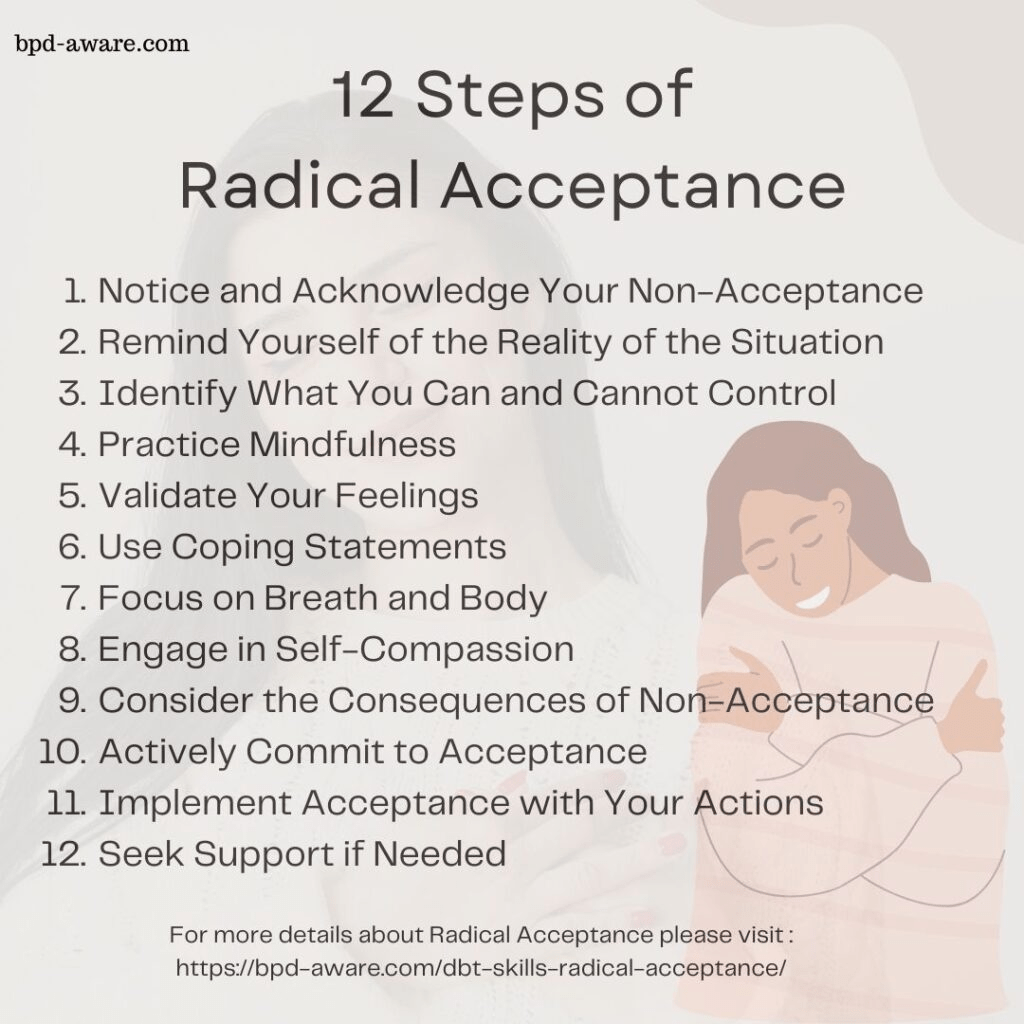
[Image source: DBT Skills: Radical Acceptance – BPD Aware]
Mindfulness for migraines has been my saving grace. It hasn’t “cured” me (yet) but it has massively helped me to calm my nervous system down by breathing better, moving mindfully, reminding myself that I AM safe, and helping me listen to the signs and signals within my mind-body connection.
Whilst I didn’t have the healing vocabulary 18 months ago when I started to heal myself, I now recognize that radical acceptance was a big part of what was happening.
Remember that “acceptance” is not the same as “defeat” – you are not giving up or giving in – you are just separating what is within your circle of control (and what is not) and adjusting your life accordingly.
If it can work for me – it could work for you.
Take care taking care mindfully, and with acceptance (and an umbrella), Linda xox
*
PS – sometimes I like to run these blog post ideas through AI art makers out of curiosity… this is apparently what it looks like to have a migraine, but still make the most of being outdoors in the rain (I love that her umbrella can hold itself up, and the hat-umbrella that the man behind her is wearing… and the fact that she can still smile so wide through the pain!):

Cheerio lovelies! xx


 The Mindful Migraine
Leave a comment