Implants for migraine prevention

Published by

on

I’m conflicted by news of an implant for migraine care – it’s super exciting to think there might be another treatment option for those of us who struggle with chronic migraine…. but I’m also a little queasy about the idea of an implant in my head.

[Disclaimer – as always – please remember to speak to a healthcare professional about medical queries – my blogposts are only my best understanding of a complex scientific/medical subject that I am only just learning about.]

I can’t remember where I first saw the link to the idea of a brain implant, but it must have been around the time the news came out in mid-February 2025 (I told you I’ve been slowly falling behind on everything!)

Anyway – even without reading the article, the images that were floating around, combined with the title started to give me that queasy-excited feeling:
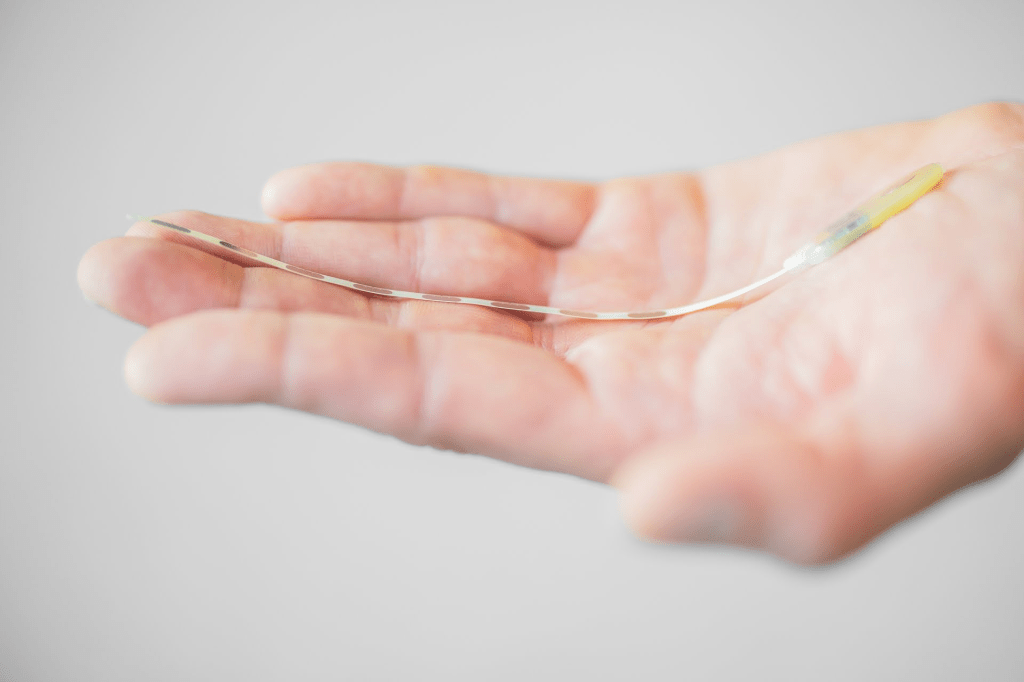
[Image source: First patient fitted with anti migraine implant in Dutch trial – DutchNews.nl]

[Image source: First patient in the Netherlands receives promising migraine implant in clinical study | Salvia News]

The picture implies the implant goes across the forehead… presumably beneath the skin… but was it also beneath the skull…???

Yikes.

When I started to go through the articles in more detail, it turns out “The implant, which consists of two thin electrodes embedded under the skin in the front and the back of the skull, was developed by Dutch company Salva BioElectronics, and works by sending electronic pulses to the nerves involved in migraine. […] The same method, called neuromodulation, has been used successfully in people with epilepsy and Parkinsonโ€™s disease.” (Source here)

Looking up the Salva BioElectronics website they add: “Patients receive an external, wearable device that allows them to activate the therapy with the press of a button. […] Salviaโ€™s unique implant is designed to reduce the frequency and intensity of migraine attacks by delivering gentle electrical pulses to the nerves associated with the condition.”

According to Doctor Frank Huygen on the website, “Our nervous system uses electrical signals to regulate how our body moves, feels, and functions” – but – “In migraine, these signals can become disrupted. Neuromodulation may help correct this and restore balance.” 

If the sound of neuromodulation sounds familiar, it’s because it probably is. There are several devices for migraines which you can buy and wear (I haven’t tried any of them as yet) – they appear to be strapped to your arm or across your forehead.

On the Association of Migraine Disorders website they have a video about neuromodulation devices which opens with a graphic of the sorts of devices we’re talking about:

[Video source: Chapter 5, Episode 6: Neuromodulation Devices for Migraine Treatment – Association of Migraine Disorders]

As their website explains it: “Neuromodulation devices apply external electrical or magnetic impulses to reduce, eliminate or prevent migraine attacks. They are worn or held against different parts of the body to stimulate nerves or areas of the brain and nervous system involved in the migraine process.”

The upside of neuromodulation, according to the video includes help for people “with multiple comorbidities, with sensitivity to medications or their side effects, with or at risk for medication overuse headache, or those who prefer to avoid medications.”

The downside, however, is “they are not safe for everyone. Some devices are contraindicated for people with epilepsy, an implanted device or a history of stroke.”

[Disclaimer – AGAIN – always speak to your doctor before trialing any new treatment approach!]

I suppose transferring the wearable device to an implant is the next logical step. In the same way that diabetics used to use external devices to monitor their blood-sugar level and administer their insulin, there are now options in which the devices are effectively integrated into their bodies (if that makes sense!?)

Here, instead of wearing the device around your head or arm, and taking it on and off when you need it, the device is with you wherever you go, and ready to be turned on with the push of a button.

I’m excited that the options that are available to us are growing all the time… but… I remain a little queasy about the implanting aspect of it all.

I suppose if neuromodulation devices have been a godsend to you so far, then it makes sense to improve their wearability and accessibility, as it were, and take it up a notch… but I would think that you’d do well to try the take-on-take-off version for a while before you lined up for surgery.

But that’s just me.

You do you!

[It’s a little bit of a funny insight, that when you’re in the middle of a migraine episode, clutching your head and weeping into your pillow, you can hear yourself whispering “I’d do anything to get rid of this”… and then… when the pain has turned down a notch and is sitting in the bottom half of your pain scale, suddenly the “do anything” idea shifts and you realize that brain implants might be a tad too far!]

Two things I’ve definitely learned though over the last couple of years since being diagnosed with chronic migraine – living with migraines is miserable – AND – as bad as it is, we really are living in the best possible time to be diagnosed with migraine: the options available to us are increasing all the time!

Don’t give up peeps – there are always more things for us to try!

Take care taking care out there, Linda xx

PS: Here’s the articles if you want to read more (they seem to repeat the same source material and only change slightly between articles):

First patient fitted with anti migraine implant in Dutch trial – DutchNews.nl

First patient in the Netherlands receives promising migraine implant in clinical study | Salvia News

First patient in the Netherlands receives promising migraine implant in clinical study


Discover more from The Mindful Migraine

Subscribe to get the latest posts sent to your email.

30 responses to “Implants for migraine prevention”

  1.  Avatar
    Anonymous

    As a pediatric headache provider, I would be hesitant to suggest an implantable device. However the external devices have a lot going for them. The Nerivio device is approved for kids as young as 8, can be used every other day as prevention or just as rescue when you have a migraine. The best thing is that there are minimal side effects. It is controlled by a smartphone app, which manages the intensity of the stimulation and also contains relaxation exercises and other educational material. You decide how much stimulation you need. It is also something a kid could use at school. It is not prohibitively expensive as many of these devices are. There is limited insurance coverage as well, depending on where you live. Something to consider………

    Liked by 2 people

    1. The Mindful Migraine Blog Avatar

      Good to know! I’ve tried a different version and had some success, but it made me feel odd”- the trick is finding the right one for you.
      Love that you’re here – feel free to send me an email if you ever want to write a guest post! Most of all – thank you! – Thank you for being the kind of person who helps people like me – you’re the best! Linda xx

      Like

  2. moragnoffke Avatar

    Very interesting. But you put it well Yikes! ๐Ÿ˜ณ๐Ÿ˜ณ

    Liked by 2 people

    1. The Mindful Migraine Blog Avatar

      I know right?!?!

      Liked by 1 person

  3. James Viscosi Avatar

    Interesting stuff! It’s good they continue to look for treatments for these debilitating headaches. I used to get them regularly but not frequently, but I have known people who did get them all the time, and probably would have jumped at the chance to try something like this.

    Like

    1. The Mindful Migraine Blog Avatar

      The best thing about it is that it adds another option for patients to chose and try… whether they do or not is up to them, but hooray for options! L xx

      Like

  4. The Posh Foodie Avatar

    Wasn’t aware there are implants for migraine care. Hopefully this technology can really help.

    Liked by 1 person

    1. The Mindful Migraine Blog Avatar

      It’s news to me too – how rapidly the world is changing! Here’s hoping it’s mostly for the better!! xox

      Like

  5. sibongilecharitysehlake Avatar

    So informative but also enlightening about technology and migraine. Thank you

    Liked by 1 person

    1. The Mindful Migraine Blog Avatar

      You’re welcome – we live in a pretty amazing timeline in terms of medical advances! L xx

      Liked by 1 person

  6. joannerambling Avatar

    The thought of having something inserted into my brain doesn’t sit right with me, it is amazing how they have come up with such things and if it works for some that’s good but I would have to be really bad to consider it.

    Liked by 2 people

    1. The Mindful Migraine Blog Avatar

      Iโ€™m with youโ€ฆ it would have to get a lot worse for me before I would consider it! But good news for those who need it! Xx

      Like

  7. Stephanie Avatar
    Stephanie

    Fascinating research!

    Liked by 1 person

    1. The Mindful Migraine Blog Avatar

      It really is amazing how far weโ€™ve come – 50 years ago there was no migraine specific medicine for my mother and now thereโ€™s several option plus this and more!!

      Liked by 1 person

      1. Stephanie Avatar
        Stephanie

        I remember taking one of my kids to a specialist, and one of the doctors helping us remarking “I have a headache almost all the time”, lightly, as though it was just how things would always be. It really woke me up to how many people are functioning like that. Having dealt with illness for a long time, I still felt like it wasn’t many of us, until then.

        Liked by 1 person

        1. The Mindful Migraine Blog Avatar

          I think we are all pretty stoic as a result of our pain, and get better and better at hiding it and functioning despite it… the fact that there are “millions” of people with migraine couldn’t work if we were all in bed all the time – it would be a better understood illness if that were true… so many/most of us must just be muddling through! It’s a sad reality, but a reality nonetheless! On a brighter note – have yourself a wonderful (upcoming) weekend – it’s Friday afternoon as I’m writing this, so I guess I’m a little excited at the prospect!! xx

          Liked by 1 person

          1. Stephanie Avatar
            Stephanie

            Have a beautiful weekend, too. Thanks for such a thoughtful reply. ๐Ÿ™‚

            Liked by 1 person

            1. The Mindful Migraine Blog Avatar

              Thank you lovely, take care, L xx

              Liked by 1 person

  8. Dawn Pisturino Avatar

    It might be worth it if it helps. I would wait and watch the results.

    Liked by 1 person

    1. The Mindful Migraine Blog Avatar

      Itโ€™s definitely early daysโ€ฆ but headed in the right direction which is great!๐Ÿ˜Š

      Like

  9. The Oceanside Animals Avatar

    Lulu: “Interesting! We hope it can help people!”

    Liked by 1 person

    1. The Mindful Migraine Blog Avatar

      Thank you lulu (and crew) xx

      Like

  10. lbeth1950 Avatar

    I suspect I might try it.

    Liked by 1 person

    1. The Mindful Migraine Blog Avatar

      Really! Iโ€™d love to do a zoom catchup with you if you decide to (even if you donโ€™t, we should chat after Easter if you have time). Xox

      Like

  11. Silk Cords Avatar

    SO… they want to use electro-shock therapy to cure migraines…

    That never had any long term consequences when used in the past… ๐Ÿ™„

    Liked by 1 person

    1. The Mindful Migraine Blog Avatar

      Um… yeah, so I didn’t want to write about that angle, because I’m not sure if they are the same-same… but it DID absolutely cross my mind… ๐Ÿ™ƒ

      Like

      1. Silk Cords Avatar

        I get it. ๐Ÿ™‚ My comment does appear as snark without doing the research, BUT… what you’re describing sounds eerily similar. Electro-Shock Treatment or electroconvulsive therapy as it’s been rebranded, IS applying electricity to the brain. The Mayo Clinic describes it as using “small amounts” of electricity but following that up by saying it causes seizures in the process. It’s curing insanity via frying the brain.

        MAYBE this is different since it’s more targeted and presumably uses smaller amounts of electricity, but my cynical side can’t help but wonder if it’s just boiling the frog slowly instead. Too much of medicine nowadays seems geared towards keeping people in a complacent stupor.

        Liked by 1 person

        1. The Mindful Migraine Blog Avatar

          I didn’t read it as snark – I remain excited about advancements, but still cautious – as you said, there is a long history of making things easier for the doctors than the patients… so we’ll see how it goes… but I won’t be signing up to be a guinea pig! xx

          Liked by 1 person

  12. Krista Furgerson Avatar
    Krista Furgerson

    Jefferson in Philadelphia was advertising a study for an implant via surgery. I almost called for info, but then decided I didn’t want to fly for it. I do fly to get treatment there, but surgery seems a bit much.

    Liked by 1 person

    1. The Mindful Migraine Blog Avatar

      It really is interesting that there is a line between what we are prepared to do or not – I can’t fly long-distance (something about the altitude gives me a raging migraine) – but I’ll travel a fair way for treatment if it seems suitable. That said – even if they offered a chance to do brain surgery at the nearest hospital, I think I would still be nervous. Super grateful for those patients who are stepping up to help us all! Linda xx

      Like

Leave a comment