

A little while ago, one of my blogging friends, Silver Apple Queen, left a comment on my post “Our Woven Selves” to say that when she thought about migraine metaphors, she imagined her migraines as Pablo Picasso paintings.
And if you know anything about his abstract art, it’s not hard to see why.
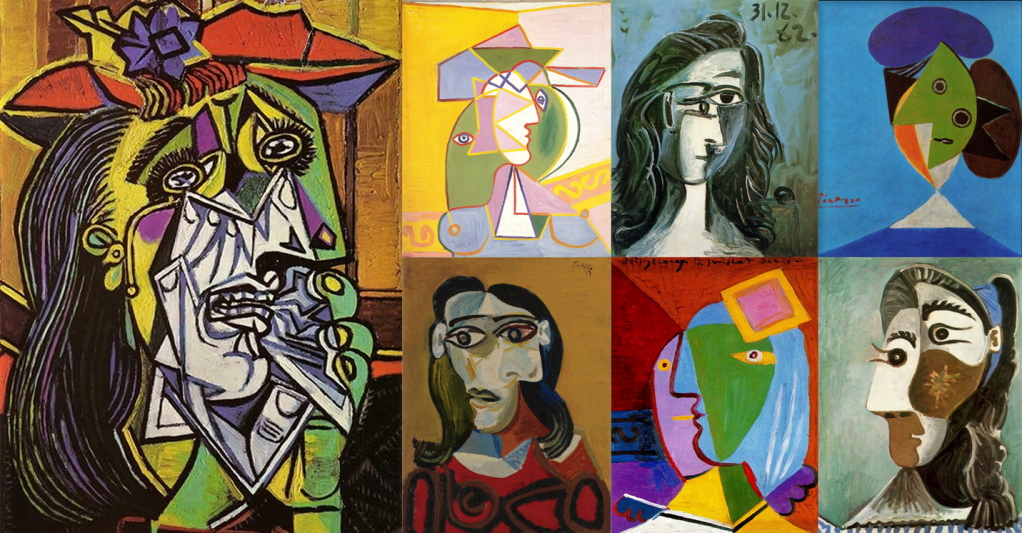
“The Weeping Woman” (1937) is an iconic image that jumped into my mind, with its abstract features and pointy, paper-plane shaped tissue (or newspaper with bad news) folded before her face. Whilst the colors are bright and cheery, her skin is turning a sickly shade of green, and her grief seems intense.
Many of Picasso’s cubist paintings really do scream migraine, with their forward-sideways confusion and head-crushed-in-a-vice-distortions that imply a disoriented sense of self that leave a migraine person feeling so unlike a ‘normal’ person:
[Image source: googling]
Interestingly, in the year 2000, the researcher Joost Haan, MD, PhD, (a double doctor!) authored a paper in which he hypothesized that Picasso’s fractured, jagged, splitting form of cubism might have been the result of living with migraine aura (referred to here). By 2011, however, he authored another paper (here) stating: “We conclude that, although the idea is still fascinating, there is no proof of Picasso suffering from migraine with aura.”
It’s tricky isn’t it.
Any image that appears fractured, folded, crushed, creased, torn, tussled, stretched, squashed, deflated, diminished, could be said to be the result of a life lived with pain. But who’s to say that it isn’t emotional pain that is being depicted rather than physical (as in The Weeping Woman who was apparently grieving the Spanish Civil War).
And who’s to say someone as creative as Picasso can’t imagine himself into that pain without necessarily living it himself. And who’s to say whether any of us are reading any work of art ‘correctly’…?
Whilst studying for my PhD in architecture, I came across an interesting aside.
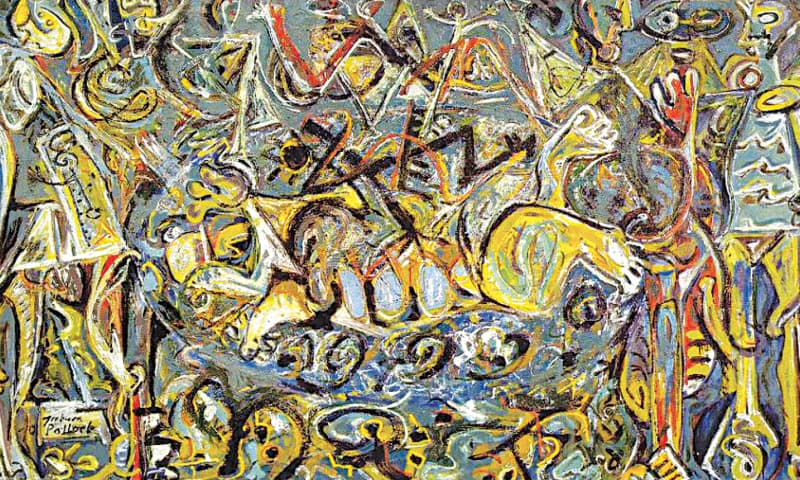
In an article by Ruth Bernard Yeazell, titled “The Power of a Name; In Bruegel’s Icarus for Instance” (2013), she recounts an anecdotal cautionary tale. The MoMA director of painting, she writes, publicly appraised Jackson Pollock’s abstract painting “Pasiphaë” (1943) [below], confidently identifying its animalistic forms, physical ecstasy and mythical ambience. [Personally, I see the dread feet and face of William Blake’s Tyger.] Pasiphaë, it should be noted, was the Queen of Crete who hid in a hollow-cow-contraption and consorted with a bull to sire a minotaur…
[Image source: DISCOURSE: WHAT’S IN A NAME? – Newspaper – DAWN.COM]
According to Yeazell, it was only later that the MoMA director discovered Jackson had originally named his painting “Moby-Dick”, before his patron Peggy Guggenheim objected and a former curator suggested swapping to the new title “Pasiphaë”… to which Jackson apparently replied, “Who the hell is Pasiphaë?”
If Picasso’s Weeping Woman was titled “Hay fever” would it change the way we see the image? I for one, would assume all that green and gold was related to Spring and easily imagine all the pollen in the air. Does this reading diminish the power of the intended purpose? Or make the image even more relatable?
I suppose what I’m saying is, beauty is always in the eye of the beholder, and art is whatever you make of it.
Whilst looking for images from Picasso to include here, I realized that now I am not struck down with migraines every day, all day, I relate less to his cubism, and more to his early works.
There’s his portrait of “Gertrude Stein” (1906) that speaks to milder-migraine-me due to its washed-out colors, the ‘slumpy’ posture of the sitter and the eyes being different sizes (my migraine eye often shrinks to be smaller than the other eye):

[Image source: Gertrude Stein – Wikipedia]
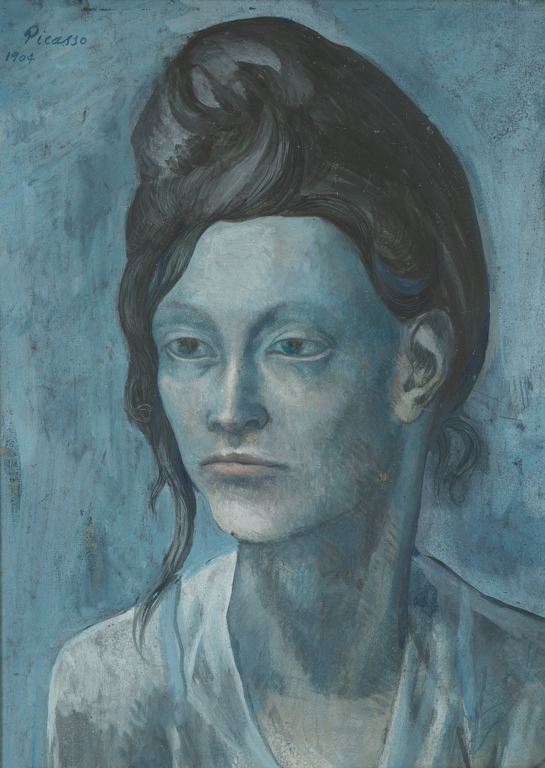
From Picasso’s Blue Period, I also relate to “Woman with a helmet of hair” (1904) because the image reminds me of brain-freeze, intense fatigue, and the sense of sorrow that comes from missing out on so much of your own life unfolding… as well as the idea that a migraine-brain is its own form of helmet that somehow accidently holds the pain in, not out:
[Image source: Picasso’s Blue Period – Wikipedia]
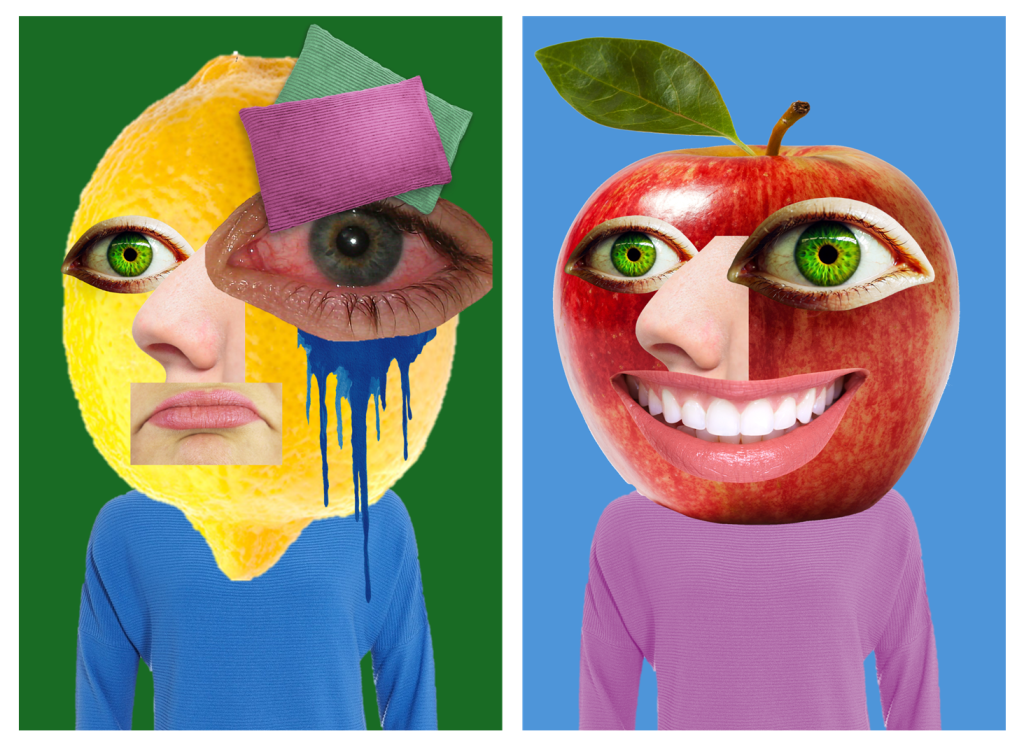
And now, because I often think of Mr Potato Head when I look at many of Picasso’s portraits (as you do), here’s a quick rendition of me on a bad day, and a good one, Picasso-fied using Powerpoint and random clip art:
[Image source: me wasting time!]
OK, so that’s just me joking around with the idea that “an apple a day keeps the doctor away” and the good days being so much better than lemony ones… because as I’ve said before, feeling bitter isn’t better.
If you don’t know what I look like, here’s the real me cut-and-pasted and Picasso-fied (sort of):

Take care taking care my friends, as colorfully as you can, Linda x
PS – Happy World Menopause Day tomorrow to all the wise women in our lives.
PPS – Shout out to a dozen recent blogs to cross my digital path – if you have some time, pop over and say hi to a couple:
Édith – Sur nos espoirs et nos rêves.
Explore Conesus Lake – Travel and Lifestyle Magazine
Learning from Dogs – Dogs are animals of integrity. We have much to learn from them.
R M Meadow | Meadow seeds today, flowers and maple trees tomorrow
Scottie’s Playtime – Come see what I share
Starry Steps – Playful or dreamy insights & beautiful gems… by Nicole Sara
Tate Basildon – Private Chef, Writer & Podcaster


 The Mindful Migraine
Leave a reply to ali redford Cancel reply