
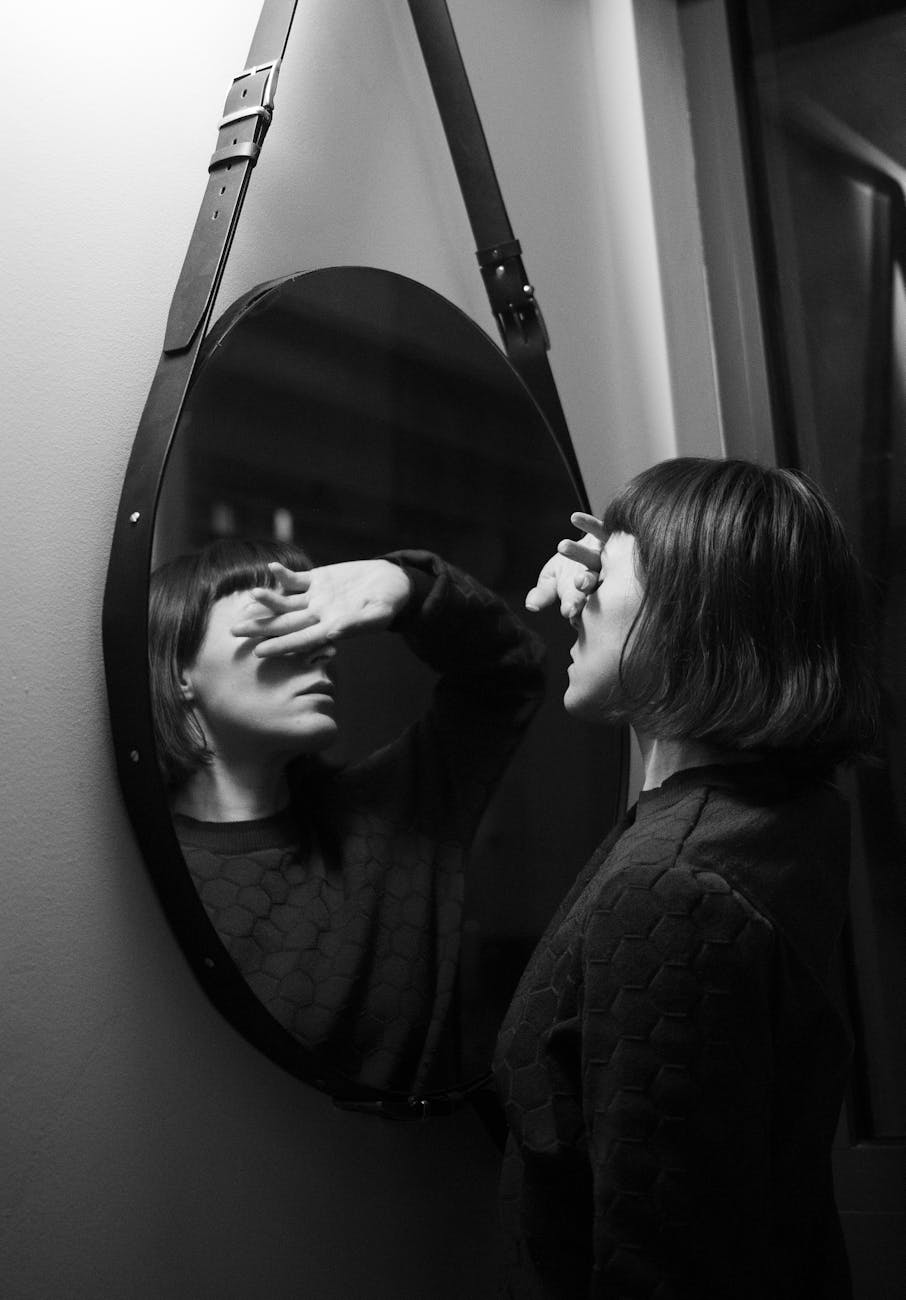
Stories about humans who have a shadow version of themselves are not new. Gothic literature is filled with painted Dorian Grays and hideous Mr Hydes, whose names contain the very obfuscation of fog and smoke their stories attempt to portray. So why would I choose to tell another such story? Because this time the story has moved from generic fiction and into the realm of personal fact.
So many gothic tales rely on the discovery of ancient manuscripts, dreams, or narrative chains of she-said-he-said for a reason. It provides distance from the dissonance. The author is describing something that happened to someone else, often long ago; suspend your belief and don’t shoot the messenger.
More often than not, as in the case of Emily Bronte and her “Wuthering Heights”, it also allowed the author a modicum of decency. ‘No upright young woman could conceive of such a thing’, could remain true, because her story was not ‘hers’, but a babushka doll of unreliable narrators; disgruntled tenants listening to gossipy housemaids who recounted what their friend had overheard…
But all that sidestepping comes at the cost. First-hand accounts become lost in a game of Chinese Whispers. Authenticity is replaced with a sense of falseness, forgery, hoax or prank. In the same way that we are rightly suspicious of the translation of a translation, or skeptical when anything lost is ‘accidentally’ found, stories within stories feel potentially tainted.
And yet the model is surely more comfortable (for reader and writer both), than when I say, “this is me – I am haunted by a shadow selflet – it is my soul that is possessed… it is me, myself and I, who is fractured… ME is WE when folded down…”
If there are no layers, then there is no filter, no veil, nowhere to Hide in the Gray.
Here we are.
So, with all that preposterous delay, let us begin.
{Editor’s note: finally!}
First, let me remind you that telling tales involves a form of contract between the reader and the writer. “Chekov’s gun,” for example, is a rule in which a weapon referenced in Act One must be discharged by Act Three. That is a narrative pact that we enter into you and I. No one likes a loose end, regardless of how terrifying the conclusion to which Ariadne’s umbilical-red-cord-thread is tied.
But the reader also has certain obligations. When you read, you must suspend disbelief as much as possible, as already noted, but you must also bring a lifetime of experiences to this experience. When the tale-teller references “a black cat”, it is on you to summon up the mental image of a black cat, preferably with unlucky luminous green eyes, sharp claw and pointed tooth.
Often, the best stories are those in which the contract is stretched but not broken. Inverted and contorted, playful enough to challenge your assumptions, while poking at the scabby scars of prior misinterpretations. Jane Austen’s “Northanger Abbey” is a wonderful subversion of gothic expectations, deliberately tweaking over-active imaginations to create a mystery out of nothing, while the real horror of women’s cruelty to other women, slowly seeps out from between the black and white lines of text.
This seeping-other exists for all forms of art. There is always an initial interpretation, and then there is the alternative… one that arrives later, slow-boiled or instantly incinerated. It is a shadow-version of the original meaning gleaned. Whether it lasts or lingers, takes over or fades away, the double, once manifested, can no longer be denied.
Surely the same is true of people. There is the life we lead in public, and the one that we keep to ourselves. Just as there is a respectable front porch decorated with festive trimmings, there is also a cupboard in the basement that is filled with dirty laundry and dirtier secrets. There is the person who we wish to be and the one who we really are. The sparkly castle of our dreams with its fancy car in the driveway and the tumbledown ruin of reality, mortgages and overdue loans.
It is why so many stories include mysterious outsiders, masked men, robber-barons and all those cruel and greedy people who dabble in the dark arts… the wicked and degenerate need to be seen in all their monstrous proportions to ensure that we understand and value the good. If everything was beautiful, nothing would be.
But it is also a sneaky way of suggesting that the enemy is rarely within.
It is subterfuge.
Perhaps I am stalling.
{Stalling in an understatement – get on with it!}
You don’t care about rules, or ruminations… you want my truth, right here right now.
But gothic tales are always labyrinthine and anticipatory in nature. There needs to be dead-ends, tunnels and secret doorways, to be ‘genuine’. And I also think that it is important that I remind you that times have changed. The arcane and the cursed were replaced a long time ago by vampires and zombies. Our collective anxiety has moved away from duplicity to the undead. Red satin and black velvet must be blanketed not just with blood, but also toxic green slime, surrounded by bone towers, combined with the dread of an internet provider gone silent and one night a year of permissible extreme violence…
Our appetites are rawer, more feral. We yearn for the visually barbaric rather than narrative strength. The ‘found manuscripts’ of “The Castle of Otranto” that started the whole gothic genre have been replaced with the found footage films of “The Blair Witch Project”.
Although, it must be said, Mary Shelley’s “Frankenstein”, interestingly, remains a constant – (re)made over and over in new forms – the monsters we make of human parts, though partly inhuman, still ask of us: just because we can – should we?
{Get. To. The. Point.}
Fast forward further, the fears that surrounded the Industrial Age were replaced with the Information Age and are now morphing again in the era of the Artificial-Intelligence Age. Our others have become our digital selves, alternate versions of us that reside online, in black-mirrored databases we may or may not have authorized, identities which can be stored, stolen, or made to dance naked (or worse), dishonoring us spectacularly.
The gothic novel is under threat, because all books are. But not in the way that Umberto Eco’s “The Name of The Rose” made books so dangerous. The pages are not the problem, it is us. Our reading habits have changed, our attention span is shorter, we live in a post-truth world that is nonetheless addicted to data. We believe almost nothing that we see online, and yet we continue to reside there. This is a world closer to Mark Z. Danielewski’s “House of Leaves” where the word ‘house’ appears as a hyperlink (just as my oft-repeated blog-page-reminder for where my other GOTHIC stories are stored) and the word ‘minotaur’ appears in red, simulating an inactive, no longer valid, dead-end distraction…
{OK, so I understand the meta-fictive approach that you are taking – but you risk straining the reader’s patience – contrary to your earlier statement, you have been generating so many loose ends that you will never be able to tie this all up in a neat bow with the words ‘the end’…}
So let me finish where I began. As a blogger, I have an ever-present shadow self. I am two people. Writer and Editor both. The one who tries to underline the truth as I see it, and the one who often tries to undermine those attempts, worried, perhaps that I will tread on sensitive toes, or make unreasonable demands on people’s lack of time and very short attention spans…
{You can’t say that – it sounds a tad condescending.}
But I know that you are smarter and more patient than society gives you credit. You know how to read, AND how to read between the lines… because so many of you are Readers and Writers both… you too have yourself and a shadow self beside you.
{Fair enough.}
How wonderfully creative that is.
How wonderfully creative you are.
And with that, let me finish off by saying: The End.
*
Thank you as always for reading,
Take care taking care of every version of yourself,
Linda xx
*
PS – shout out to a blog post I read last year that has some indirect similarities to today’s post: Emailiano del Refugio’s Sculpting Your Life: How Thoughts Shape Your Reality


 The Mindful Migraine
Leave a reply to John Cancel reply