

Today’s post is a book review – sort of – it’s about “Splitting: the inside story on headaches” (2020) by physiologist and neuroscientist Amanda Ellison. The reason it’s only ‘sort of’ a book review, is that it was a pretty intense book, for a potentially more medical-trained readership, so I only read a couple of chapters specific to migraines.
So, apologies in advance that this is such a brief description of a very detailed book, and sorry to Professor Ellison for abbreviating all your hard work.
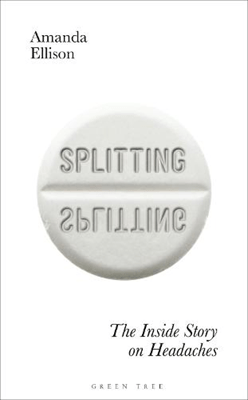
[Image source: google search]
[Disclaimer – remember – I am not trained in medicine, so please do not take medical advice from this blogpost, and be sure to speak to a professional for personalized assistance.]
*
To start, I’m going to let you know that whilst the book was filled with scientific information, specific research findings and anecdotal evidence, there was still a fair amount of uncertainty attached to the subject of ‘migraine’.
Page 173, for example, was writing about the relationship between migraines and alcohol. Here’s the beginning of every sentence on that page: “There may be a genetic link here, or a behavioral one…” / “In this study…” / “Although…” / “Again, this might be…” / “Or perhaps…” / “Alternatively…” / “This is…” / “It’s a protein…” / “This may be…” / “Too much…” / “And one precludes the other.”
OK, so that feels a bit of a strange thing to do, but you can see that out of 11 sentences, (they were long sentences), 6 of them include ambiguity and hedging words (may be, although, might be, perhaps, alternatively, and may be (again)), plus there’s 2 uses of ‘or’ in there. It was enough of a trend that my mind got snagged on it and made a note.
I’m not raising this to be critical of the author. What I want to make clear is that here, in a formal, scientific, published book by a neurologist, a sense of migraine-mystery remains. So, if you ever wonder why you or your doctor are still struggling to sort things out – you’re not alone – it’s complicated.
Moving on – chapter 6 was “What’s a migraine?” and it states: “The most interesting aspect of a migraine is that it is an experience that goes beyond the headache component.” (her italics, p112). It then covers the 4 stages of migraine (I’ve previously summarized them here) and notes the value of learning your personal signals that tell you a migraine might be coming – such as excessive yawning, drowsiness, food cravings, adversity to light, increased thirst and blurred vision (114).
And whilst she recommends that we never underestimate these signals, she also notes that even the highest levels of self-awareness might still be wrong because there can be confusion about whether bright light (for example) is a ‘trigger’, or if you’re sensitive to the light because your migraine has already started and it is now a migraine ‘symptom’ instead.
[It’s a bit of a chicken-and-egg conundrum.]
Another interesting sign a migraine is coming is feeling ‘needy’ (121) because our oxytocin has dropped. We get a boost of this hormone when we fall in love (or after we give birth) and there are apparently plenty of oxytocin receptors on the trigeminal nerve (which plays a big part in migraine (read more here)). So – smiles, hugs, attentive friends, sex, risotto (her suggestions) – and anything else that makes you feel ‘loved-up’ might help postpone a migraine.
[I’d add gentle music, massage, a warm bath or dark shower, and the company of your pets].
But there’s one passage that I read that made the whole book worth borrowing from the library. It came in a section titled “Own Goal” and comes after several very complicated pages [136-139, which I might be reading wrong] about how the brain sends ‘waves of excitability’ that radiate from your visual cortex (in response to light) and how it creates a ‘brainstorm’ of electrical activity. There’s a lot going on with sodium and potassium, and ‘glial cells’, but the gist seems to be that this wave literally flows from cell-to-cell through the whole brain, disturbing memory and motor skills as it goes, and affecting our other senses such as smell and hearing. Apparently, the ripple effect takes about 30-50 minutes, and is a reason why the early stage of migraine triggers visual aura in some patients and feels like a slow-motion whole-body catastrophe (my word not hers) complete with all those symptoms / signals I mentioned above.
[I think I have actually experienced this in real life – I saw the flash of light reflected off a car windscreen, felt a stabbing pain in my migraine-eye and KNEW I only had a few minutes to write my name and address on a piece of paper, call a taxi-cab and get curbside as quick as I could before I melted into a migraine-mess.]
So, what was the passage?
Wait a second longer.
The chapter was explaining the way that a migraine brain ‘messes up’ signals in a way that a ‘normal’ brain might not. There’s a lot going on in our brain that is ‘fast and furious’ and responses have often reached an ‘all-or-nothing’ situation in reacting to external stimuli that are perceived as negative. So, she writes, imagine it this way:
“It’s a little bit like the last minute on a football match when you are 1-0 behind. […] Your team throws all of its players forwards, including the goal keeper. But disaster, your number 11 has a bad touch, loses possession and the other team goes for the break. All of your players are out of position and can’t defend against the inevitable goal.” (139)
I’m not sure that’s an actual ‘own goal’ based on my understanding of my daughter’s soccer games… but I know what she means; in all its enthusiasm to defend against the bad stuff, team-brain rushes forward at speed… and then fumbles.
So, in a similar way that I have written (here) about migraine-pain-brains being super-sensitive nuclear reactors (compared to more stable coal-fired generators of brain-energy), the own-goal is another great metaphor for why it’s not really our fault when we get sick, it’s just our brain trying to do its best to protect us – trying to prevent that pesky sunshine glare (or other trigger) from beating us… it’s just that it’s a tad over-efficient at defense and has moved too far into the attacking end of the playing field. Sometimes it might be that it saves the game and we don’t even notice (because no migraine occurs) but, if it’s tired and overwhelmed like my migraine-brain was every day for a few years, it actually makes sense that an unlucky, fumbly, own-goal would be ‘inevitable’.
It’s not you – it’s your brain’s goalie you can curse next time you get sick (but kindly – they’re trying their best!)
The book covers a lot of ground, looking at genetics, suggesting high inflammatory proteins or low oestrogen influences your susceptibility, stating that MSG has probably been wrongly vilified as a migraine trigger but the nitrates in cured meats aren’t great, and noting that alcohol is actually a nuanced trigger which depends on whether it’s red or white wine, and even goes so far to explain how light coming through venetian blinds and stripey t-shirts can give people migraines.
[I joked that the cover of another book I reviewed was “ouchy” and even slightly migraine-inducing because of its black and white stripey lines (pictured here) – and it turns out it’s a real thing that goes back to exciting that hyperactive visual cortex of ours!]
In amongst all the other (slightly difficult to understand) sections about brain structures, neurotransmitters and hormones, there was one more metaphor I really liked – “migraine is the dark symphony of all of these components working together. With so many factors involved, it stands to reason that migraine may be caused in many ways.”
Our poor, beautiful brains are making music like everyone else, it’s just that our tune is a little more maudlin… more melancholy…
I’ll end on her advice about looking after yourself when a migraine is ‘finished’ (but you’re really still in the postdrome phase and recovering): “Give your body time; it has undergone a pretty spectacular brain event that’s affected everything, it has to recover. If you don’t, and your hormones and neurotransmitters remain haywire, a migraine will happen again, and sooner than you would wish.” (149)
And the very last sentence of her book: “Pain means something, take it seriously.” (210)
Take care taking care everyone, everywhere – I see you – I understand.
Linda x
*
PS – for a little bit of dark symphony, Petrovich Mussorgsky’s “Night on Bald Mountain” complete with demons, would get my most-memorable vote (my sister was a tiny tot when we saw this scene in the movie Fantasia in the 1970s – we had to leave the cinema she was so distressed – so be warned!!):
[Video source (8 mins): Fantasia, Night on Bald Mountain]
PPS – on a brighter note – this Sunday is Mother’s Day in Australia – so happy Mom’s Day to all the mothers out there – you are amazing!! xx


 The Mindful Migraine
Leave a reply to richardbist Cancel reply