
Migraine Love Language

Published by

on

We need help when we are sick. Sometimes we ask for it. Sometimes we just hope that our loved ones will read our mind and turn up with what we need when we need it. Sometimes our family and friends want to help so they provide what they think is useful and kind, but it’s actually not as helpful as they think… it’s so hard being sick AND being understood… but it’s also hard for those who are doing their best to support us.

Oftentimes, especially when the migraine is very bad, my wish list of how you can help me consists of a single item: SILENCE. Please, don’t do the dishes, don’t open and shut the garage door, don’t have friends over, don’t leave the door to the lounge room open so the TV sounds fill our home, don’t laugh or squeal good-humoredly… sorry, but I’m in agony and silence means silence.

Other times my wish list is a little longer – on top of the silence, don’t cook things that will fill the house with strange odors, but could you please reheat my heat-packs every hour if possible, to save me a trip out of bed.

Then there are the times when my list gets more complex: I’d love someone to massage my neck, if anyone could track down my essential oils for me that would help, maybe a piece of buttered toast and another bottle of electrolytes would be good, and perhaps grab my mobile phone out of my handbag so I can listen to some quiet music or a meditation when I’m feeling a bit better…

But there are also times when I think that I need all those things, and then when the toast arrives it makes me feel ill looking at it, or someone touching my neck suddenly feels intrusive rather than caring, and there’s the frustration that comes from the door being opened and shut (with the best of intentions), especially if it pulls me out of my deep coma-like-healing-sleep and now I’m awake again and fully aware of my pain… sigh.

There is no doubt that our family and friends receive mixed messages when we’re ill… it’s not deliberate, it’s just that healing is a moving target.

What I need in today’s migraine attack is different to what I needed yesterday – because the symptoms are different.

To make things worse – when our loved ones are trying to figure out what we need today, they ask questions. The problem is that when I’m sick and you keep asking me questions (again, with the best of intentions) the questions become problems not solutions – you’re trying to help but you’re filling my brain with noise and options and confusion… my brain fog is fumbling, it makes me frustrated and irritable.

You’re trying to help, but it’s making things worse, and even though I don’t want to be cranky at your kindness… sometimes I just am.

Add to that the fact that migraine treatment is also a form of torture. Solitary confinement and sensory deprivation are what we need to survive an attack – but in large doses (like those of us with chronic migraine need) the solitary silence becomes lonely and depressing… we want company, but it needs to be gentle and fleeting… not too much… but not nothing…

SIGH – it’s not easy I know – but trust me when I say it really stinks for us.

Anyway – I was thrilled to see an image on the Migraine World Summit websites that seemed to recognize how hard it is to ask for help. It suggests that you fill out some ideas that will help people know what to do the next time you’re unwell, including, “these chores would help me…” and “The food / drink I would love is…”
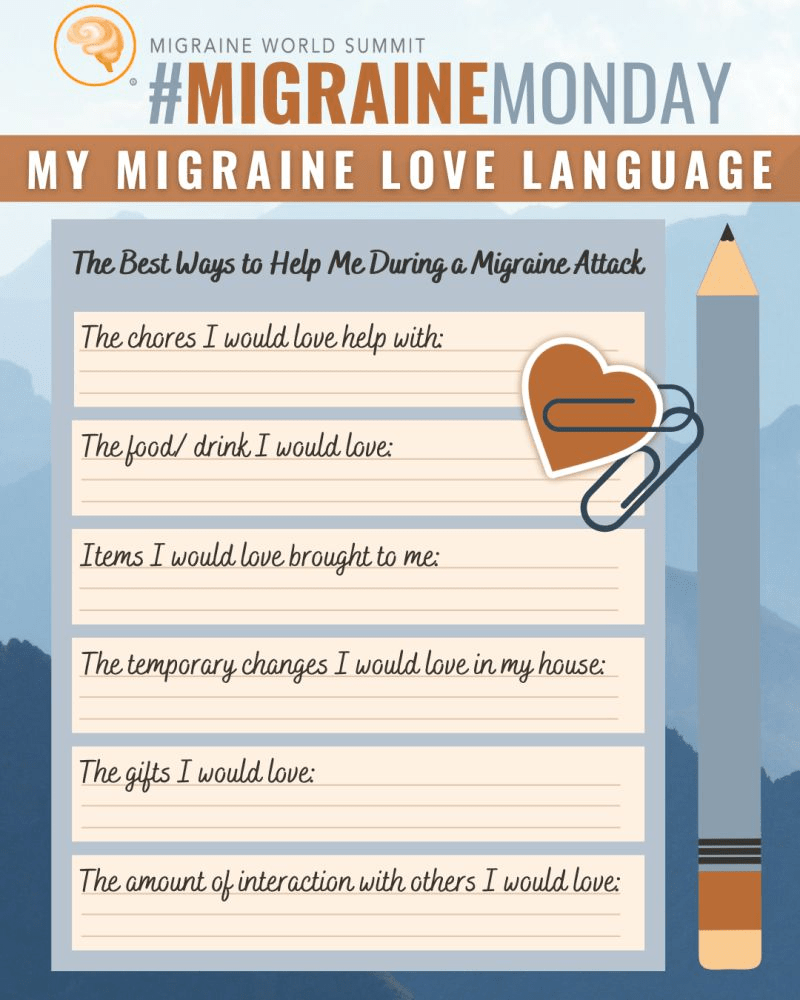
a template for the list of things you would like people to do next time you are sick

[Image source: Migraine World Summit: Instagram / LinkedIn]

I can’t imagine being able to fill this in when I’m sick, or being able to come up with cast-in-stone answers, but I do like the idea of using it as a template to talk to the family before the next attack:

“So kids, I would love it if you could help me out with some housework the next time I’m unwell for the day, but at the risk of sounding fussy, maybe just fold some clothes, do some ironing or swap the sheets on your bed, but don’t wash the dishes because the clinking sound is hard to sleep through… and definitely no vacuuming!”

OR

“In terms of food, maybe you could just bring up some dry crackers, some jellybeans and a drink bottle, but no coffee or a toasted sandwich because sometimes I’m good for it, but other times the smell is too much… it’s too risky, so let’s keep it simple… but, before I forget, maybe only bring in food if you hear the toilet flush so you know that I’m awake… it’s better not to bring anything in otherwise, because I might be in a deep sleep…”

Maybe there’s a way that you can create some strategies that will work most times, and they can become your go to version of a Migraine Love Language that your family can follow.

I think that it is important to find a way to express what you need to the people who love you and want to help you… but maybe do it today when you’re all feeling ok, rather than wait for the next time you’re sick.

Take care taking care – your way, Linda x

Thanks Migraine World Summit for the discussion prompt!


Discover more from The Mindful Migraine

Subscribe to get the latest posts sent to your email.

33 responses to “Migraine Love Language”

  1. jennyarm Avatar
    jennyarm

    I absolutely love this blog. When I am feeling anxious and catastrophic, I almost expect my partner to be a mind reader in the way he treats me, if that makes sense. And it’s tricky to give him guidelines because he just doesn’t understand it so everything he says is wrong! Luckily it doesn’t happen too often and I just talk it over with a fellow catastrophiser xx

    Liked by 1 person

    1. The Mindful Migraine Blog Avatar

      It is really, really hard – I too expect everyone to just KNOW what I need when I’m sick – but in reality, it’s more complicated than that… here’s to spending more time together in 2025 – we fellow catastrophizers have to stick together – because we get it! xox

      Like

  2. jeanvivace Avatar

    Very interesting!

    Liked by 1 person

    1. The Mindful Migraine Blog Avatar

      Thank you – I hope it helps if you know someone living with chronic pain. L xx

      Like

  3. billy202484 Avatar

    Love the message I think to myself some of it even applies to mental health thanks for the story

    Liked by 3 people

    1. The Mindful Migraine Blog Avatar

      You’re so very welcome – I think we can all improve how we communicate with our loved ones – I don’t think we mean to take each other for granted, but sometimes it happens. Have a wonderful weekend, L xx

      Liked by 1 person

      1. billy202484 Avatar

        Very true and hope you have a blessed wonderful weekend yourself

        Liked by 1 person

        1. The Mindful Migraine Blog Avatar

          🌞

          Like

  4. satyam rastogi Avatar

    Nice post 🌺🌺

    Like

  5. festo_sanjo Avatar

    It’s really complicated. Reading it alone created some sort of pain onmju forehead, lol.. I’m glad to read your stories, Linda. I do remember when I was about 7 to 11 or so, i used to have migraines or headaches, especially in the evening, and I told no one, now you always bring flashbacks of how tough that period was. About the noise and triggers, it’s hectic as you talked about even seeing something may intensify it. I think it’s best to be calm in your mind and just feel the pain in the present moment, allowing it to be. That helps alot..

    Liked by 2 people

    1. The Mindful Migraine Blog Avatar

      I definitely never want to cause you pain – so I’m deeply sorry for that if I do – but it IS interesting (when you’re up to it) to investigate how memories return us to that previous physical pain – the past and the pain are often so deeply inter-twined that thinking or feeling one thing is enough to re-anchor us to the original suffering… I think awareness is key: once you recognize that is happening you can begin to interrogate and challenge that connection and eventually “turn it off”…. I’m no therapist though, so it is hard when you try to confront some of this stuff on your own… Meanwhile – reconnecting yourself back to the present (as you do) is definitely wise; you are safe, you are loved, YOU ARE OK. ❤️

      Liked by 1 person

      1. festo_sanjo Avatar

        Eckhart Tolle always talks of the “pain body.” If you look at it, it’s like our bodies have memories, and it’s not that bad if you are conscious of it because it teaches you that you’re not your pain. It’s just that the body runs in patterns, and restructuring helps to alleviate it. Thanks, and stay safe, too. Those affirmations are on point.

        Liked by 1 person

        1. The Mindful Migraine Blog Avatar

          🥰

          Liked by 1 person

  6. Kym Gordon Moore Avatar

    Oh yes, sometimes complicated and overwhelming. Love your message Linda! 🤗🙏🏼😊

    Liked by 1 person

    1. The Mindful Migraine Blog Avatar

      All we can do is keep trying! xox

      Liked by 1 person

      1. Kym Gordon Moore Avatar

        Yep, you got that one right! 😜💖🤗

        Liked by 1 person

        1. The Mindful Migraine Blog Avatar

          👏🥰👏

          Liked by 1 person

  7. Stella Reddy Avatar

    🌞

    Liked by 1 person

  8. markbialczak Avatar

    I was already thinking of possible actions before I scrolled to those checklists, Linda. I came up with drawing up (alone or with your family, your choice) an available to them template of your favorite combination of their actions that help you during a migraine. It can be a list that contains 10 or 20 or 100 different pages. That’s up to you. Then when you know which one you feel at the onset of your migraine rest, you can text the caregiver: I need somebody to follow Help List 14. Or whatever the proper care guide.

    Liked by 1 person

    1. The Mindful Migraine Blog Avatar

      Ohhh…. that’s a good idea! All the possible things that would help and then I don’t have to re-write them out again – I like it!

      Liked by 1 person

  9. Sue Dreamwalker Avatar

    Yes it really does stink for those who are suffering… Thank goodness my heavy migraine days are behind me… But at their height with a baby and a toddler to look after and with a hubby who then worked 12 hour shifts… I really don’t know how I coped, but we do… Between bed, sick bucket and cold cloth on your forehead, crying baby and a toddler into everything wanting your attention..

    So if there are any teenagers out there reading your words Linda…. Then help your parents through these difficult days with a bit of TLC as you help them by keeping your rooms tidy or washing up a few pots..

    Sending lots of love your way Linda.. ❤

    Liked by 1 person

    1. The Mindful Migraine Blog Avatar

      Thank you lovely! I’m so on your page – teenagers – lift a finger! As for the baby thing; I’ll never forget when my eldest was about 2 years old at the beach and she picked up a sand-bucket and started making strange noises into it. The other mums at the picnic were as bemused as me… then I realized she was imitating me being sick!?!?!🤣

      Like

  10.  Avatar
    Anonymous

    You are right about the SILENCE.

    However, allowing loved ones into that space can make a lot of difference.

    Liked by 1 person

    1. The Mindful Migraine Blog Avatar

      It really does make a big difference – I guess it’s about balance – keeping them away is just too lonely… I sounded a bit grumpy in the writing, but I am very blessed to have such a loving family. xox

      Like

  11. joannerambling Avatar

    Oh yeah when my head and body hurts so much I often just want silence and a cool dark room

    Liked by 1 person

    1. The Mindful Migraine Blog Avatar

      Seems mean – but it’s about survival sometimes…

      Like

  12. Kevin Avatar

    As someone who acted as a caregiver for a very, very long time, I can attest how draining long term illness is on not only the victim, but those trying to help as well. Anything that can give a general guideline beforehand is very likely a plus, as it may eliminate at least a few frustrations and hurt feelings for both parties.

    Liked by 1 person

    1. The Mindful Migraine Blog Avatar

      The hardest part is that the goalposts keep moving for both parties – the caregiver has their own set of needs and wants and availabilities that are fluctuating at the same time as the ill person’s… it’s not easy – but empathy and patience goes a long way – thanks for being such a good person!

      Liked by 1 person

      1. Kevin Avatar

        Agreed, it is a delicate balancing act and not everything on either side of the equation is completely stable. All we can do is our best to adapt as things shift and move.

        Liked by 1 person

        1. The Mindful Migraine Blog Avatar

          Keep “dancing” 🥰

          Liked by 1 person

          1. Kevin Avatar

            That’s all we can do sometime, right?

            Liked by 1 person

  13. Poetic Spirit Avatar

    You are absolutely right. It is a complicated thing and it can be overwhelming for everyone sometimes ❤️.

    Liked by 1 person

    1. The Mindful Migraine Blog Avatar

      It’s hard – I’m lucky enough to be surrounded by people with patience and empathy … and yet… there are still some days…. all we can do is keep doing our best to speak our (changeable) truth and keep helping one another as best we can! xox

      Liked by 1 person

Leave a comment

Previous Post
Next Post