

A few weeks ago I read a post on LinkedIn by Migraine Ireland that referred to something called Compassion Focused Therapy (CFT). I’ve never heard of it before, but it instantly caught my attention as something that might be helpful for my healing journey.
In their post they wrote:
“Compassion Focused Therapy (CFT) takes an evolutionary perspective as one way to think about ourselves as humans. One of its core ideas is that we all just find ourselves here. No-one asked to be here! No one chose their family; no one chose their own body; no one chose what they look like, no one chose pain. Pain like a lot of experiences in your life, is not your choice and it’s not your fault.
CFT helps us to understand how different systems in your brain/body such as the fight-flight system; the rest-and-digest system; the thinking-feeling-behaviour system; the hormonal system; and so many more can contribute to your experience of migraine. CFT can help us to bring balance to these different systems.”
Super curious about what sounds like a common-sense, and KIND, approach to addressing yourself, I went looking for more information.
According to Psychology Today, CFT was recently developed by the British psychologist Paul Gilbert and “is a therapeutic approach that aims to help those who struggle with shame and self-criticism, often resulting from early experiences of abuse or neglect. CFT teaches clients to cultivate the skills of self-compassion and other-oriented compassion, which are thought to help regulate mood and lead to feelings of safety, self-acceptance, and comfort. The technique is similar to mindfulness-based cognitive therapy in that it also instructs clients about the science behind the mind-body connection and how to practice mind and body awareness.”
This is pretty much EXACTLY what I have aimed to do over the last year. Reduce my stress. Increase my sense of self-worth. Listen better to my body’s signals. Convince myself that “I am safe”. Achieve balance between my head and heart, mind and body.
For a long time, I battled against my chronic brain-pain, AND a sense of guilt that I was not doing my fair share around the house because I was spending so long in bed. There was also a deep sense of shame that I was not able to heal myself and hurry up and get better. There were even days of self-loathing that came from the idea that I was a complete failure and nothing but a burden.
Mindfulness has made a huge difference for me.
Breathing better, calming things down, stressing less, turning down the volume of the negative narratives, giving myself grace and goodwill and believing, really believing, that self-care is not selfish.
From what I’ve read across several sites, a CFT therapist will apparently talk to you about your lived experience, place it into a wider context, help you to understand it’s background impact, “size” it appropriately (be real about how bad it is, or isn’t). They will help you identify the good in your life (and yourself), and how to value and celebrate it. Visualization, guided meditations and role playing might all be used.
The following infographic gives you a sense of what might be covered:
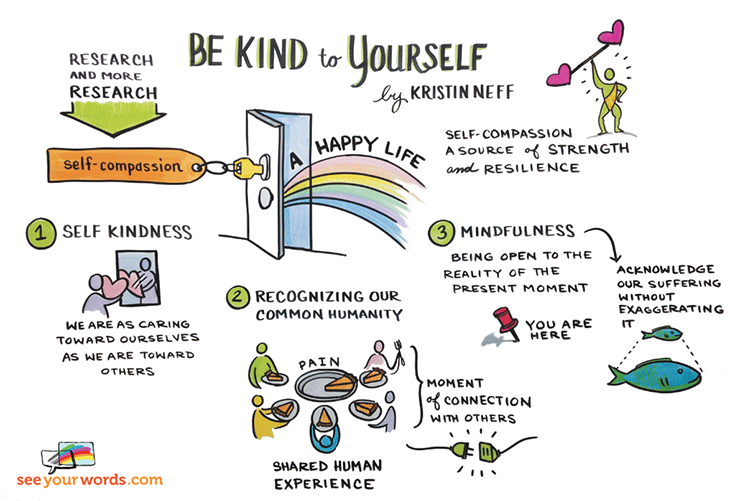
[Image source: Compassion-Focused Therapy (CFT) – West Coast Therapy]
The CFT model appears to be based on the idea that we are all made up 3 main emotions – vigilance against threats, the desire to be soothed, and a drive for excitement or achievement. The aim of CFT is to understand the role of each of these, AND aim to get them in a form of equilibrium:

[Image source: Understanding emotions – Trust Therapy]
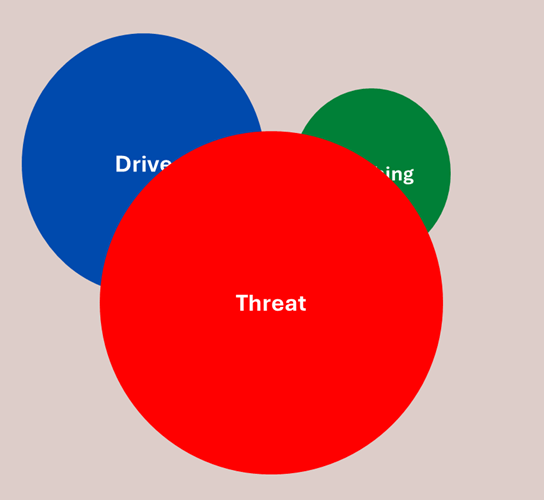
If I look back to where I was about 3-4 years ago when my episodic migraines began to slowly merge and creep towards becoming chronic, I can remember feeling a strong combination of drive (I was studying my PhD and trying to home school the kids during COVID and REALLY wanted to do well at both, as well as help my husband keep his business going and kept cleaning so the house didn’t become a tip) and dread (fear of failure, of COVID contagion, and the unknown were constantly looming large in my mind). The notion of soothing myself, or having a rest from the fast-paced world was near enough non-existent. I vaguely remember collapsing into bed each night, exhausted and overwhelmed, and hoping that I would be able to still my racing mind enough to go to sleep.
If I was to draw this relationship up, using the bubbles from above, there was NO BALANCE. The sense of “threat” loomed large over everything else and literally and figuratively obliterated everything. “Drive” kept close by, though, still pushing back and refusing to give in. “Soothing” was essentially lost to the bigger two bubbles, deprioritized until it disappeared. Turned into a graphic, it might look something like this:
[Image source: me]
When I look at it like this, as an actual graphic, my feelings manifested in blobs, I can start to understand why I got so sick. AND I can see why I suffered so badly emotionally with issues of guilt and shame. I just wasn’t giving myself any compassion or down time. If everything HAS to get done PERFECTLY and all within a context of doom and gloom, AND you have developed a habit over a lifetime of always berating yourself for falling short (even when the situation is clearly against you) no wonder I came to the conclusion I’m useless and started to beat myself up.
Fear of failure and rejection combined with an environment of extreme uncertainty was (in hindsight) an implosion waiting to happen!
For me, that implosion was the green bubble fighting back. Some part of my self said; “if you won’t take time to sooth yourself, I’m going to put you in bed every day for a year until you get the rest you really need – call me clumsy, but a migraine will get you to stop in a way nothing else will – so chronic migraines it is!”
UGH.
As problematic as the near-constant migraines were, I’m now starting to see that my nervous system was over-reacting to the lack of balance. Because I was unaware of the imbalance, and unable to adjust it, my system didn’t reign in the big bad blue bubble or turn down the alarm-system-red blocker, instead it went all out with its best guess at what self-soothing might look like:

Not helpful. And yet, I feel a sense of compassion for myself that understands (finally) why this might have happened. I feel a sense of sympathy for my exhausted self that couldn’t turn the volume down on the “push through no matter what” approach that was grinding me to smithereens, so out of desperation, it turned up the volume on “lie down now – and stay there!”
That’s the point of compassion based therapy I guess – to see yourself and your (in)action with empathy. I am who I am, and I did the best I could (sub)consciously. And I now give myself a loving hug for doing the best I could… and I’m going to learn from the past and see if I can’t gain more balance moving forward.
Life isn’t as scary as it sometimes seems. I am safe. I am capable. Migraine isn’t all bad – I’ve met amazing people and discovered new strengths and skills I didn’t know I had. Life is good. I can have “drive”, but I don’t need to be so relentlessly driven. I know now how to rest and how to exhale. I’m getting better all the time.
Based on what I’ve read, the people who find CFT hard are those who are relentlessly hypercritical or who dislike attention being focused on them. CFT requires you to look inward and see the good and the bad for what it is. If that inner-focus is hard, then CFT will be hard… but not impossible.
As someone who is hypercritical and shy, AND prone to putting everyone else before myself, it’s a strange feeling to make yourself the focus. But the more you do it, the easier it gets.
You SHOULD be allowed to take time for self-care.
You SHOULD be allowed to set boundaries.
You SHOULD be allowed to prioritize progress over perfection.
You SHOULD be allowed to feel sorry for yourself… for awhile.
You SHOULD be able to silence the inner critic and stop the trash talk.
You SHOULD be able to look in the mirror and see that you are you-nique.
When I read words like “therapy” or “trauma” my instinct is to say “that’s not for me” – I had a happy childhood, I have a good life, a loving family, a roof over my head. I don’t associate with the word “trauma” at all… BUT… in this one short post, I realize that whilst that might be true, there ARE some deep-seated imbalances that I could be helped along to recognize and improve.
Whether you do it with a trained professional or on your own – keep going, keep growing, keep being curious.
Thank you, Migraine Ireland for the prompt – I’ve learnt more in the last hour about myself and my condition than I could ever have imagined!
Take care taking care, Linda x
[PS – Disclaimer – I’m not a therapist, so please be sure to speak to a professional before taking too many deep dives into your psyche, or making any significant changes in your healtchare approach.]


 The Mindful Migraine
Leave a reply to “No mud, no lotus” – The Mindful Migraine Cancel reply