Why do we hide our chronic illness?

Published by

on

A little while ago I posted a book review titled “hidden from view“. The idea was that the real root-cause of chronic illness is often hidden behind other more obvious reasons. We think it’s a physical, structural reason, but is often a deeper more subconscious, psychological cause.

More recently, the idea of “hiding” took on a different meaning for me – (I still resonate with the way root-causes might be out of view and that’s why it is hard to heal) – but I also started to think about the way I hide my illness from others.

I’m going to suggest that in those early months of creeping from episodic migraines to chronic, it was because I didn’t actually know that I was becoming so sick. As chronic illness coach Cynthia Covert says on Linked in:
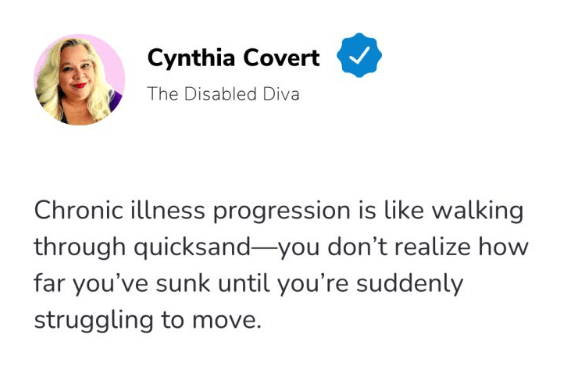
a screen shot of a LinkedIn post that says "Chronic illness progression is like walking through quicksand - you don't realize how far you've sunk until you're suddenly struggling to move".

I became aware that my eye was aching in a way that usually says “migraine coming” in June 2022. It suddenly occurred to me that the pain was there 24/7, but the full-blown catastrophe of a migraine did not always accompany the symptom… as the days turned into weeks, and the migraines came and went with more regularity, I realized something wasn’t right. Life slowly became less and less manageable, and it was getting harder and harder to “push through” and ignore the pain… it was no longer hidden from me that I was SICK… and – I was SUNK.

The next thing that happened, however, was that I began to hide the fact from the outside world.

Why?

The phrase “I’m embarrassed” comes instantly to mind – but embarrassed by what? If I was diagnosed with cancer would I be embarassed? Perhaps, but I feel like there is something subtle in the lingering nature of my condition that feels embarassing.

If I had COVID I’d say so. It feels like you were just unlucky to be sick. Long COVID however seems to carry a different weight; as if you were somehow careless or weak.

To have occasional migraines is unlucky. To have migraine pain of some sort every day for 1,000 days straight seems like I’ve failed somehow.

It reminds me of the quip from the Oscar Wilde play “The Importance of Being Earnest: A Trivial Comedy for Serious People” (1895) – the line is spoken to an orphan: “To lose one parent, Mr. Worthing, may be regarded as a misfortune; to lose both looks like carelessness”… sigh.

On LinkedIn a little while ago I saw an amazing post by Shabnam Rakhiba, chronic illness mentor, about the reasons we might be hiding our chronic illness, which she summarizes with a great infographic:

infographic includes reasons such as fear of judgment, guilt and shame, protecting relationships, stigma in the workplace and emotional exhaustion.

[Image source and full post: here]

They all seem like valid reasons to me. But – as Shabnam rightly points out; “hiding comes at a cost. Suppressing our needs and masking our struggles can lead to worsening health, deeper isolation, and emotional burnout.”

She speaks of how she becomes increasingly stressed when she hides her issues, and slowly senses she is becoming invisible.

It was similar for me. I felt as if retreating and staying silent was the best option, and yet silent retreat was lonely and depressing… this blog began specifically as a means of reversing that trend. I became increasingly disheartened that I was all alone in my dark world of pain. Speaking out, reaching out, finding out, has all led me to a place where I know I am not alone.

YOU are NOT alone.

It seems sad to acknowledge that there are so many of us struggling – but it is also a LOT less lonely realizing that. Speaking out also becomes empowering… the more you practice speaking out, the easier it becomes.

Stigma and misunderstanding and disinterest remain real.

I’m not saying that the world is suddenly going to be open to your pain, happy to listen, or empathetic of your plight… that would be… optimistic… perhaps even unrealistic… BUT if you can find a couple of people who are open to seeing you as you (such as me), it really does make a difference.

Silent suffering is not ideal.

Drop some hints every now and then when you’re finding it hard to live with pain… and if those hints land on a receptive ear, keep going… provide some extra details, encourage them to ask questions…

And as always, remember this goes both ways – be a receptive ear – listen to others when they try to reach out with stories of their illness situation… be a supportive shoulder to cry on, if you can… (there’s a dozen other posts I could mention about making space for other people’s pain when you’re struggling, but the introduction to my sister’s pain is one of them).

Take care taking care,

Linda xx

PS – the ever-roving version of me came across another blog that made me smile, and a poem-post that moved me to near-tears (I try not to get weepy as it can trigger a migraine) – it will only take you a minute to read, but it’s one last migraineur’s spin on the “hiding” theme: When I Can’t Bear You – Mind of an Enfant Terrible


Discover more from The Mindful Migraine

Subscribe to get the latest posts sent to your email.

25 responses to “Why do we hide our chronic illness?”

  1. screw it, i’m eating tater tots – episode 73 – A Grace Full Life Avatar

    […] Why do we hide our chronic illness? – The Mindful Migraine […]

    Liked by 1 person

    1. The Mindful Migraine Blog Avatar

      😍

      Like

  2. Sarah W Avatar

    I tend to try and hide my chronic illnesses from most people. I think this has come from the reactions of other people since I have been ill. I have been judged so many times by people (family included) who believe that if I tried harder, “sorted myself out” and /or took more medication, then fibro and the migraines would be cured. I just can’t be bothered dealing with that any more, so I tend to hide what’s really going on for me.

    Liked by 2 people

    1. The Mindful Migraine Blog Avatar

      Ugh, that’s so relatable! It really is often very exhausting trying to explain why you can’t make it here or there and why it’s not your fault, only to met with a sideways tilt of the head and a slightly suspicious replay along the lines of “you always seem so tired for someone who spends so long in bed!” I know there’s no cruelty intended, but it a little bit heartbreaking nonetheless. Know that I see you – you’re doing the best you can and that’s amazing, Linda xxx

      Like

      1. Sarah W Avatar

        Thank you Linda – it means a lot to have found like minded souls in this wonderful blogging community.

        Have a wonderful weekend

        Sarah x

        Liked by 1 person

        1. The Mindful Migraine Blog Avatar

          You too lovely! L xx

          Like

  3. Silk Cords Avatar

    I’m not able to add much that would be new to this one. You covered all the bases. Most of those causes I believe have a core origin of society treating anybody with any sort of “disability” as ‘less than’ in just about every way they can imagine. Then you get the FAR Right calling anybody on public assistance a leech, a fraud and stealing from taxpayers… It’s disgusting.

    Liked by 1 person

  4. Skyseeker/nebeskitragac Avatar

    I get that part about feeling invisible, I feel like that sometimes. I don’t talk about my illnesses often, although I should.

    Liked by 1 person

    1. The Mindful Migraine Blog Avatar

      There’s a balance I think – I don’t want to be overly associated with my illness; I’m more than a mere migraine – but at the same time, it is a fundamental part of who I am at the moment, and hiding it away seems to feed into the unnecessary sense of shame and stigma we could all do without. There’s no right or wrong – you do you – and know that you’re not alone, and never invisible to me! L xox

      Liked by 1 person

      1. Skyseeker/nebeskitragac Avatar

        My thoughts exactly, I as a person, as a being am more than my illnesses but they are parts of me. It’s a bit difficult with invisible disabilities, cause you sometimes you have to explain people your limits cause they can’t see them, that makes me uncomfortable, but it is also a challenge to become more assertive, and I generally lack assertiveness. Everything happens for a reason, I believe in that, so I guess we have to deal with our issues for a reason. It’s a chance to become better person, but that’s the case only if we choose to thread that path. Lots of us live in cages of self-pity, frustrasion and dissatisfaction. But we all have a choice between those two paths. The first one is harder at first, but incomparably better on the long run.

        Liked by 1 person

        1. The Mindful Migraine Blog Avatar

          I like to think it all makes us stringer and more resilient, and I agree – the aim is to live a life outside the cage – great metaphor! xx

          Like

          1. Skyseeker/nebeskitragac Avatar

            I agree it makes us stronger and more resilient, but it’s up to us to choose to become stronger. It’s a choice you have to be brave enough to take and it’s the right one if you ask me.

            Liked by 1 person

            1. The Mindful Migraine Blog Avatar

              Agree – just noticed my muddled brain wrote “stringer” – who knows what form of ‘strong’ that might be…. how long’s a piece of string after all?? Linda xx

              Liked by 1 person

              1. Skyseeker/nebeskitragac Avatar

                I noticed and understood that you meant to say stronger. But, hey, strings can be strong as well. 😃

                Liked by 1 person

                1. The Mindful Migraine Blog Avatar

                  🤣🥰

                  Liked by 1 person

  5. Liz Avatar

    Yes. I agree with Joan it’s sad to feel you uave to hude it, but I understand why and if I had been in the same position, I more likely woukd have hid it too. I don’t talk about my mental health with many outside of this blog because of the stigma. I have heard what my mum had to put up with as hear it myself from others that made certain remarks about mental health.

    I did though, get to a point in my late 20s or early 30s where I heard the same remarks regarding people’s mental health from a same group of people that I couldn’t keep quiet any longer about what I thought about their comments and gave them my two cents. How everything went quiet after that when they realised that the place they used to call for their “laughs” that I knew the place so well because my mum had been there and because of how long, I grew up with that place. I told them hiw many lovely people I had met and how so easily they could be there or know someone who has and that they would soon receive a wake up call how when someone is ill in the family can effect that person and those around them.

    Liked by 2 people

    1. The Mindful Migraine Blog Avatar

      It does almost feel like we live two lives – the one we are prepared to share publically (which is often a mask) and the one where we get to be our more vulnerable authentic selves online… it’s a little unfair that we have to live like this, but I am also eternally grateful that there are people like you who get it and are kind enough to hear me out. The “ripple effect” of illness you mention is so real. Sending love, Linda xx

      Liked by 1 person

  6. majellalaws Avatar

    I was waiting to answer this Linda, because there was a program scheduled to be on SBS Insight last night on invisible consequences of chronic conditions/diseases which would have been interesting. When I looked today it hadn’t happened, they had run a repeat of something else. Will be worth a look I think when it does come on.

    Liked by 1 person

    1. The Mindful Migraine Blog Avatar

      I was looking for it too?! I think the Pope’s passing might have led to a reschedule of the night’s program – I was really looking forward to hearing about what other people had to say – it’s so reaffirming to realize we’re not alone! I’m guessing they might roll it back a week – I’ll keep an eye out too, L xx

      Liked by 1 person

  7.  Avatar
    Anonymous

    This post was such an eye opener to read, there are the obvious reasons why might one hide them, but there were a few that hadn’t occurred to me. I could think of a few other reasons: stigma, being labelled, being pitied and treated differently, not wanting to accept the reality. But at the core, It is a lot like cats when they hide in pain, the root cause is always fear, vulnerability and self preservation.

    thank you for mentioning my writing, I’m honored and grateful to be part of it 🧡

    Liked by 1 person

    1. The Mindful Migraine Blog Avatar

      My absolute pleasure!
      I think self preservation is the overarching idea now that you mention it – pretty much every other emotion slips under its umbrella.
      Linda xx

      Like

  8. joannerambling Avatar

    It is sad that some people think they have to hide a chronic illness, it is even sadder if they do so because they are embarrassed by their illness, some do it because they do not want other people to pity them. I am not one to hide my illness, I have Parkinson’s and that’s not easy to hide………..lol

    Liked by 2 people

    1. The Mindful Migraine Blog Avatar

      Don’t be embarrassed – just keep movin and grovin (my hubby’s dad had it for 20 years – it took me 2 before I realized his tremble was more than a shiver from the cold!) xx

      Like

      1. joannerambling Avatar

        I don’t hide and I don’t get embarrassed can’t see the point, not like I can change it

        Liked by 1 person

        1. The Mindful Migraine Blog Avatar

          Yeah, you’re good like that – I wish I shared your courage – it’s a mixed bag for me – I suppose it depends on the audience how authentic I am. Keep being you, L xx

          Like

Leave a reply to Skyseeker/nebeskitragac Cancel reply