

I recently came across a comment that went something along the lines of “AT helped me end my migraines” – HOORAY! – I thought, but also, what was AT, and was it something that could help me?
Turns out it stands for Alexander Technique, and as Philipa Batty writes in the post that caught my attention, it “doesn’t offer a medical cure — but many people experience fewer headaches” because it “helps with the stress-migraine loop” – read more here: Hidden Struggles, Gentle Support — What June Awareness Reminds Us
As Philipa writes in her post: “I see how everyday pressures, long-held tension, and survival habits show up in people’s bodies. […] awareness days offer an invitation: to pause, listen, and learn how we can support ourselves — and others — with more compassion.”
Philipa’s website quotes actor John Cleese and writer Roald Dahl as advocates of AT.
So then, what is AT? (and who is Alexander??)
According to AlexanderTechnique.com, “An Alexander Technique teacher shows you how to move with less stress on your body” and “The Alexander Technique is for you if you are ready to feel more comfortable in your daily activities.”
The website was a little tricky to navigate for quick answers, so it was off to my favorite starting place: Wikipedia, which revealed both the what and the who of Alexander.
Frederick Matthias Alexander (1869-1955) was an Australian who loved Shakespeare and public speaking, but was often hoarse to the point of fully losing his voice. When doctors could not help him, he decided to find his own cure. After watching himself in the mirror, he apparently discovered postural issues that could be improved, and by focusing on reducing bad habits, he was able to lose the breathlessness. He then moved between England and America teaching his respiratory and postural techniques to others.
The Alexander Technique is considered an “alternative therapy” and/or a “complementary therapy” used alongside conventional medicine. (Interestingly, Wikipedia does not appear to use the word “pseudoscience” as it did for the alternative therapies Rolfing and EFT tapping.)
Another site (AlexanderTechniqueScience.com) explains the therapy sessions this way: “Alexander Technique rarely involves repetitive exercises like those prescribed by physical therapists or memorization of complex movements like those taught in Tai Chi or Pilates. The goal instead is to consciously intervene in habitual neurological patterns. A number of everyday movements are typically used in lessons and at-home practice, such as walking, squatting, lunging, bending, reaching, moving between sitting and standing, and standing on toes.”
Recurring themes I found on several sites include: movement re-education, better posture, freedom of movement, trunk stability/mobility, head poise, movement coordination, improved balance, improved self-perception, reduced muscle tension, improved overall wellbeing.
Here’s a nifty (3 min) video that summarizes the learning technique:
[Source: How does the Alexander Technique work? Towards a scientific model]
From the video, there was a flow chart of sorts that explained the way the feedback loop of body-awareness and postural-improvements works:
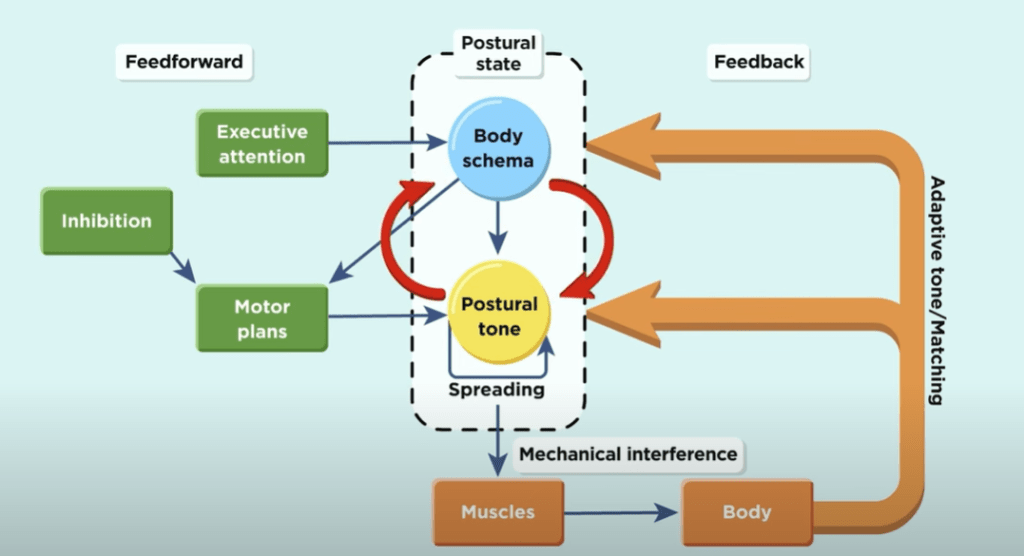
[Images source: screen shot from How does the Alexander Technique work? Towards a scientific model.]
AlexanderTechnicqueScience.com lists several pages of peer reviewed studies that reveal the health benefits of AT. And whilst it all sounds very promising, what I didn’t find were many links to migraine specific material. In fact, when I did a word search for “migraine” on a couple of the key sites, I got “nothing found” replies, which would suggest migraine is NOT a key pain-source that AT aims to treat.
That said, on a site from Brussels, there WAS a reference to migraine (here: The Alexander Technique and migraine): “Through the method of conscious control, a fundamental principle of the Alexander Technique, the practitioner will focus on teaching the release of excessive tension in the neck, helping the head to move more freely and the shoulders to relax, and obtaining a flexible lengthening of the back, the entire process seeking to achieve a dynamic expansion of the whole of the body. This conscious process is able to cancel out the inverse effects of a migraine, notably a constriction of the blood vessels of the brain and poor oxygen supply.”
I’m a little torn.
At the recent Migraine World Summit, one of the doctors gave a “fact or fiction” presentation (which I wrote about here) and suggested constricted blood vessels to the brain was an out-of-date explanation for migraines. As such, AT would be addressing a non-root-cause.
On the other hand, I have also written about power poses (here) and how I absolutely believe that my slumpy-humpy back was a problem – if not causing the migraine, then absolutely not helping them.
In other words – I DO think that posture and breathing play a role in minimizing stress in the body, and therefore help your migraine-pain-brain… if not super-directly, then still-importantly-indirectly.
As such, I would think that AT could assist some migraine patients. But as always, the cause of migraines is so particular and individual, the help has to be individualized as well. If, for example, your migraines are almost always triggered by hormonal changes or weather extremes, then learning to sit straighter in your chair might not help you a lot. If, however, you rarely give any consideration to how you move your body, then increased awareness can’t hurt.
I have no doubt that AT could work for some people and positively impact their migraine life.
(Philipa Batty is one of those people – she started out as a patient of AT and when it helped her minimize pain and maximize empowerment, she used her new found knowledge for the greater good and became a teacher – yay!)
Curious – are you one of the people who AT has helped??
Take care taking care, Linda xx
[PS – DISCLAIMER – I have no medical qualifications – I only write about what I research – please speak to your own health care provider to ensure that you receive advice that is relevant to your own personal physical condition and medical comorbidities.]


 The Mindful Migraine
Leave a reply to Mary K. Doyle Cancel reply