

A short time ago I reviewed a piece of writing about migraines, plants and pain, written by Tan Tuck Ming. There was a phrase that he used that stood out to me at the time of reading, and has stayed with me since – he mentioned his pursuit of a “frictionless life”.
I totally get it – especially when you’re not feeling well, you just want life to be as simple as possible, you want everything to run smoothly, with no snags, no glitches, no trips or traps… no tension.
Kid’s not helping clear the table after dinner? Normally you’d pull them up right? But tonight, you just want to get to bed as soon as possible, without any drama, so you decide to let it go… you’ll do the dishes rather than risk a fight. It might not be the best parenting decision in the long term, but when you’re feeling unwell, the path of least resistance feels like the right way to go in the moment.
Whilst Tan Tuck Ming’s writing was densely filled with metaphors of plants and dim light, and created an overall feeling of jungle-warmth and humidity, the phrase “frictionless life” caused a completely different image to appear in my mind’s eye:
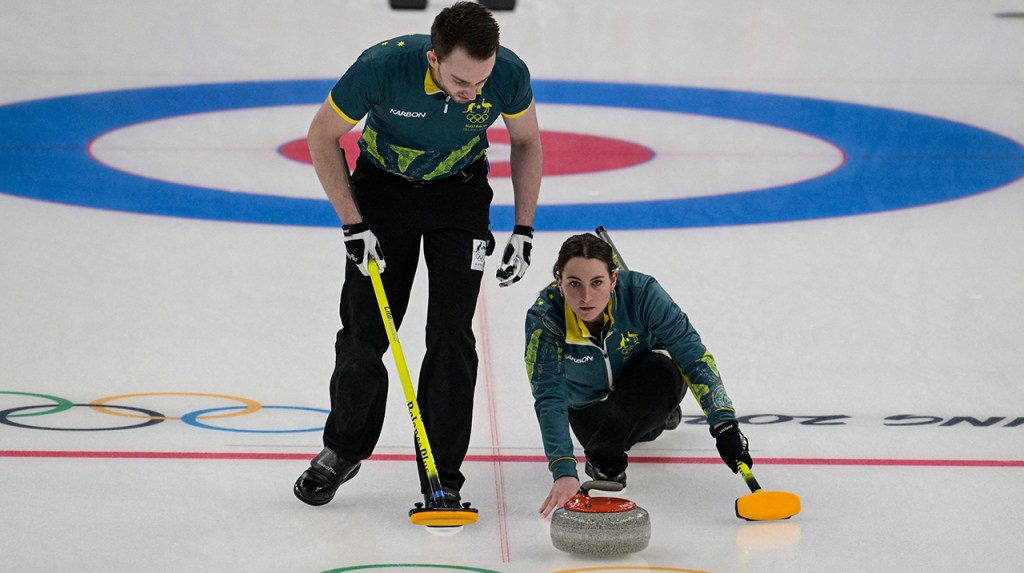
[Image source: Olympics.com.au]
If you don’t know what you’re looking at, don’t feel bad – I had no idea what was going on until a few years ago… it’s the Australian mixed-team competing in the 2022 Winter Olympics’ sport of curling.
According to Wikipedia, curling originated in Scotland in the 1500s. In the earliest version of the game, players used flat-bottomed river rocks or stones from their ploughed fields. From what I can tell (and for once Wiki is wishy-washy), the game is like bowls in that you skim the stone across a frozen river or lake and try to land it as close as possible to a target (whilst also scooting your competitor’s rock out of the away).
Here’s some people curling in the bottom left of Pieter Brueghel the Younger’s painting “Winter Landscape with Bird-trap” (1631):
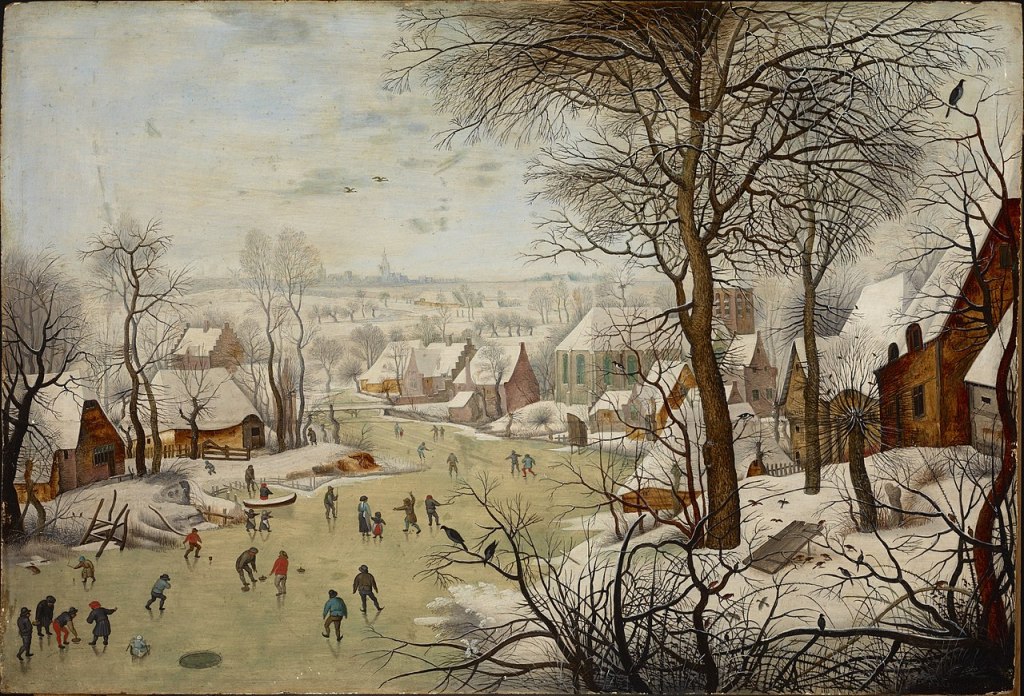
[Image source: Google Arts & Culture]
The modern game involves a long rectangle of ice with a starting line at one end and 4 concentric rings at the other. The player still aims to sliiiiiide their rock (which grew a handle in the modern era) from one end to the other to reach a target. Somewhere along the timeline of history, brooms were added to the game. At first, they were corn-strand-brooms similar to those used to clean house, but now they can be made of fabric, horsehair or hog-hair. The point was to smooooooth the ice in front of the puck-rock to help it go further and improve its chances of hitting the target.
[As an aside – Wikipedia notes that in the 2015-16 season there was a scandal nicknamed “Broomgate” (it was big enough to have its own Wiki page!). Half the players were criticizing the other players for using brooms that had fabric that was like sandpaper on a microscopic level. When used, it could turn a bad-rock slide into a good one by altering the surface of the ice so much it was as if the players had a joystick. There are now standards for what you can use on your broom-head, and from what I can see, most of them look like corncobs (as a potential throwback to their corn-stalk-origins?)]
Bottomline: brooming the ice in front of the puck gave the rock it’s best chance of a frictionless life.
Here’s a 20 second video of the Chinese team in the 2022 Beijing Olympics: watch how furiously the man is sweeping the ice – from beginning to end – it’s big-time-brooming: no friction here please!
[Video source: Curling at its finest]
So, what’s my point?
In our quest for a frictionless life, a life lived with as few triggers and glitches as possible, we risk having to manically clean a path ahead of ourselves, and end up looking a lot like a frantic broomer.
Having people over tomorrow? You don’t just clean the house like everyone else, you start figuring out how to adjust the lighting, the music (style and volume)… ‘most people’ might eat dinner at 9, but your blood sugar will drop by then since you’re used to eating at 7 and being in bed by 9.30, so you make plans to put lots of nibbles out around 6 and try to have dinner finished by 9… at least then there’s half a chance you can slide people out the door by 10… and maybe clean up the day after… and water… you’ll need to place water jugs everywhere so you don’t forget to stay hydrated…
‘Normal people’ might make a fuss over what to cook and wear, of course, but they probably won’t have to worry about all the potential triggers that go along with the main course… as a matter of course… because cheese is a trigger for so many, of course…
The point is – so much of what we do on a day to day basis, as chronic pain people, is more than ‘just this’ or ‘just that’. There’s no “Oops, I forgot the cheese – I’ll just pop out and pick that up”, because we have to figure out what pain level we’re at, can we drive, can we find parking, how heavy will the shopping bags be, is there time to rest between that spike in activity and the arrival of guests…?
Yes – it’s partly our overly anxious brain over-thinking everything… but it’s also about “being prepared” in a way which is a must for chronic pain people.
Go back to the painting – the bottom left is all about people enjoying the winter sport… now go to the bottom righthand corner of the painting; that’s the bird-trap that is mentioned in the painting’s title. If you look closely at the board hovering over the birds, you’ll see a string that goes all the way back to a dark rectangle of a window. Someone is in there… watching… waiting… getting ready to pull the string!
Without being overly dramatic, that’s a bit what it’s like being a chronic migraine person; stuck inside when everyone else is outside having fun, obsessing over trips and traps, always having to hustle baby hustle… which brings us back to that image of the frantic curler brooming…
It works.
BUT
It’s exhausting.
Now that the image of curling has become attached to my desire for a frictionless life, I’m not sure I can get it out of my head. AND I’ve realized two things in my own personal “broomgate”:
I’m a curling queen AND my broomstick has become a rod in my own back.
Just this morning, I asked my daughter to take her washing basket downstairs. She moaned as if I had kicked her… then proceeded to walk away (without the basket). I opened my mouth and then shut it. I decided to let her go. I wasn’t in the mood for an argument. She has a big exam in a couple of days. She’d come back and get it later. And if she didn’t, well then, I could remind her again… and if it still didn’t get downstairs, I guess it wouldn’t kill me to take it downstairs for her.
Here’s the problem – in making her life easier (and mine in some ways because it’s fight-free) I’m actually making my life harder.
There’s a nifty saying that suddenly rings true: “prepare the child for the road ahead, not the road for the child”.
Curling queens who create frictionless lives for their family and friends, also risk being surrounded by lazy adults who won’t know how to face challenges when they arise; everyone’s rock has to snag sometimes…
I’m not sure I’ll be able to hang up my broomstick forever…. not for the kids, or for myself… I am who I am… BUT I am going to really try to cut back on my use of it… give myself a break… ask for a little more help… accept that snags and glitches are a normal part of life…
That’s the theory anyway!
Take care taking care, with not too much friction.
Best wishes always, from (ex)broomer Linda xx


 The Mindful Migraine
Leave a reply to Veerites Cancel reply