

It feels like only yesterday I learnt the term “quiet quitting”, which refers to employees all but giving up on their job. They turn up to the office each day, but they put in the bare minimum of effort, without enthusiasm, and without anything close to an “above and beyond” attitude.
The reasons for quiet quitting can include: disengagement (when people don’t feel recognized for their efforts they lose their sense of commitment); burnout (people are so stressed out at work they just can’t give any more of themselves to their job); and/or a desire for a healthier work-life-balance (if their employer won’t recalibrate the effort they are required to perform for their pay more fairly, then the employee decides to be proactive and reclaim a little autonomy back by making their own adjustments to manage their health and wellbeing.)
More recently, I read somewhere (I can’t find it now – sorry) that the real motivation behind quiet quitting is control. The world is a mess right now, and everyone is feeling disillusioned. Add to that an enormous sense of job insecurity and the awareness that any of us could be shuffled aside (replaced by cheaper humans or AI, or else our role could be scrubbed entirely, and all that we worked for made ‘redundant’ (what a word!))
If the daily reality for so many is to feel under-valued and at risk of replacement or redundancy, why would those same people be inclined to give their all or offer unwavering allegiance to their place of work?
I quickly skim-read articles written for Human Resource Managers and employers, and they all said the same thing; don’t give your staff more tasks – or more perks – just shower them with attention to let them know they are needed and wanted and irreplaceable.
It felt a little smoke-and-mirrors to be honest.
[And it’s bringing up bad memories of the time my boss handed me a box of tissues and a therapy-brochure when I asked for assistance with my ever-increasing workload (which I wrote about before: a-new-take-on-ASAP).]
Now that we have a bit of background on quiet quitting, what is this new term “quiet cracking” about?
I first came across the term in a recent Australian news article (Aussie bosses warned over dire consequences of new ‘quiet cracking’ workplace trend).
The suggestion is this turn of events is more serious than quiet quitting. Employees are still unable to leave their job (mainly for fear they won’t be able to find a replacement job and can’t afford to be unemployed in today’s economy), but rather than just withdrawing their efforts to maintain their wellbeing, they’re working harder than ever to convince employers they are valuable… and their wellbeing is falling apart:
“A study of more than 1,000 Australian workers by The Change Lab founder Dr Michelle McQuid found 55 per cent of workers were quietly cracking, or ‘maintaining expected performance while experiencing significant internal distress’.”
There was a live poll on the newspaper’s site with hundreds of votes:
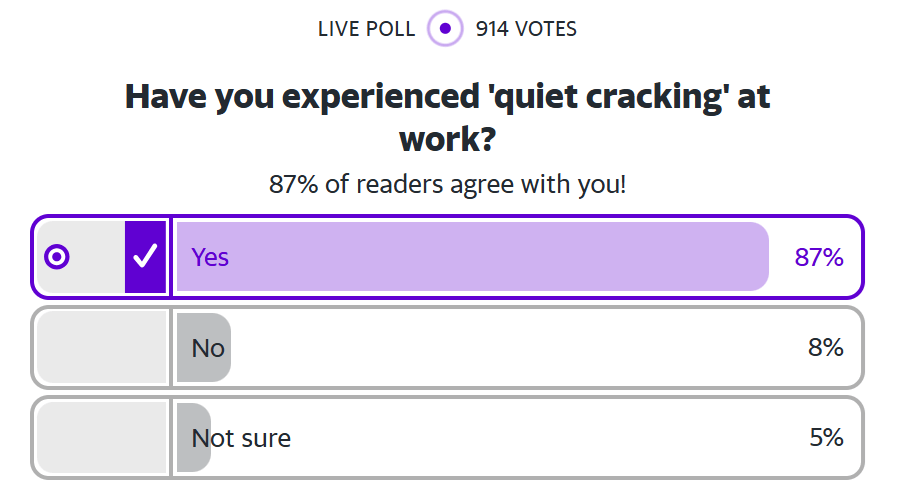
[Image source: screen shot of the news article here]
The article then pivots to a reminder to businesses to get on top of this problem, as staff falling apart is bad for the staff, but really bad for productivity (both in terms of the individual business and all of Australia): “The Australian Productivity Commission estimates poor mental health more broadly costs the economy between $12.2 and $22.5 billion each year.”
“Boo-hoo business” comes to mind… can I get you a box of tissues Australian Productivity Commission?
But more seriously – I GET IT.
No one wins in a stressed out world.
When I was looking up ways to reduce the chance of quiet quitting at work, most of what popped up was written for employers. Recommendations included: encourage psychological safety and security, recognize people’s efforts, manage workloads better and communicate expectations, encourage transparency, invest in training programs, provide opportunities for personal growth, be empathetic and prioritize organizational wellness.
For employees, the article recommends you look for new project opportunities or relationships within your current place of work so that you can find new meaning in your old job. Other suggestions I found online included honoring your feelings, trying to engage fully with the job as it is, appreciate your strengths and core values, make small changes where you can, and reach out for help if and when it’s needed.
I’m going to flip this trend slightly and say that quiet cracking doesn’t just have to be about your place of employment. Now that I have a name for it, I’m going to suggest that quiet cracking as a homemaker was part of why I went from occasional migraines to chronic migraines.
I’ve written about “my descent” a couple of times now. Once in a post about Compassion Focused Therapy and another time in my post about celebrating those times when we have a nervous break-through rather than a nervous break-down.
The short story is: I was trying to do too many things at once (parenting, working, studying, and then helping the kids with their schoolwork when we went into COVID lockdown). Due to the intensity of the COVID experience, on top of starting my PhD and continuing on with my normal housekeeping and part-time employment, I was exhausted – but I can now also recognize (taking hints from the language above) that I also felt overwhelmed, undervalued, trapped, insecure, uncertain, lacking control, and burnt-out…
AND like those employees who can’t just up and leave, I couldn’t just walk away or give up on my family, so instead of quietly quitting… I quietly cracked.
In hindsight, the fracture lines were there to see, I just kept pushing through, until I broke… but now I’m lucky enough to be in a position to put myself back together again.
And it’s reminding me of the Japanese pottery art of Kintsugi (I posted about here) in which artisans take a broken piece of pottery and stick it back together again with a strip of molten gold.
The memory sent me looking for images on Pinterest. Here’s a montage of ones I liked that give you a sense of how fragile we are… and how beautiful:

[Image sources: Aesthetic, Gooseflesh, Hidden Face in Lotus, Character ideas, Pin on kintsugi, Kintsugi, focusart80, Pin on 2024]
I think the key takeaway for me is that we ARE fragile and need to look after ourselves. If you feel yourself under pressure, ask for help, and do your best to protect your boundaries and your wellbeing as much as possible.
It’s tricky. I know. I lived it.
But looking back, I wish I knew then what I know now.
We are worthy. We are strong. We matter.
I no longer need a boss to tell me with smoke or mirrors… I know it to be true.
Protect your golden self – and when the time is right: share your glow with others!
Take care taking care my friends, Linda xx


 The Mindful Migraine
Leave a reply to Panagah Amn Cancel reply