

When I was an architecture student, I loved the style called Minimalism. It was represented by designs which were simple and functional, made with natural materials and an emphasis on light and space. It was building pared-back to its essence. A skeleton of what was required, if you like, or else, the equivalent of a naked person, honest and upfront, no excessive coverings and certainly no gaudy gold ornaments.
It was very similar, but also different, to “Brutalism” which was harsher, rawer, more concrete and cold steel. Minimalism was ‘bare’ but not ‘bland’ and never a ‘bully’. There WAS still plenty of concrete and steel, but it was offset with warm timbers and polished marble in green and grey.
Examples from around the world that come to mind are Oscar Niemeyer’s Brasília Cathedral in Brazil, Tadao Ando’s Church of the Light in Japan, Frank Lloyd Wright’s Guggenheim Museum in New York City, and (my favorite) Mies van der Rohe’s (once-was / now recreated) Barcelona Pavilion in Spain. Mies was the architect who is often attributed with the core minimalist saying: “less is more”.
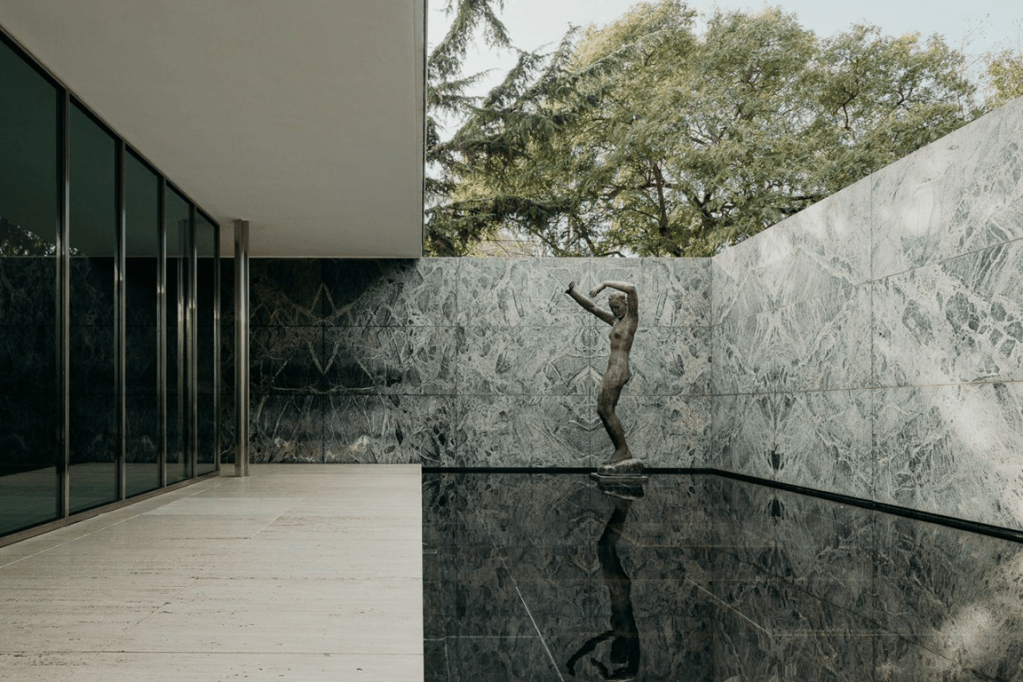
[Image source (and fabulous article on the replica Pavilion (as photographed above)): The Barcelona Pavilion By Ludwig Mies Van Der Rohe Is A Textural Delight – IGNANT]
*
Starting with an industrial-aesthetic in the Bauhaus School of Design in Germany (c.1919), the concept of Minimalism morphed into an eco-friendly form during my days at university in the 1990s, highlighted by Australian Glenn Murcutt’s unpretentious and environmentally sensitive designs influenced by his “touch the ground lightly” approach.
After university, I travelled and studied more and started to see a lot of similarities between Minimalism and the Japanese practice of Zen. They share a preference for unadorned simplicity and material honesty but, in Zen, there is an even greater push to align any built structure with its place in nature, as well as an inclusion of spaces designed for meditation or contemplation.
As an adult, I still LOVE minimalism, and much of my own house is decorated in neutral tones, is clutter-free and led by the idea of quality over quantity. BUT I also have other spaces that lean more towards maximalism; shelves loaded with displays of family heirlooms and travel souvenirs, for example, and an eclectic photo-wall that includes formal wedding photos and happy snaps, purchased art and children’s craft projects, all crowded in together in a way that symbolizes (to me): “family lives here”.
I think my brain adores the ideals of minimalism, but my heart desires some more-is-more moments as well.
Why am I telling you all this?
Because, I was recently over at Studio Migraine’s website in the Netherlands and found a post that I really liked: Migraine minimalism: why it hurts to downplay.
As soon as I saw the title, the ‘room’ in my head emptied out until a single chair was all that was left in my mind’s eye… a lot like the image I selected to start this post… but maybe without the blanket… in other words, the word ‘minimalism’ instantly triggered a clean slate effect in my brain… a blank tabula-rasa ready to receive new information… with a hint of brain-fog.
Then, as I started reading Studio Migraine’s post I saw where they were going with the “less is more” approach for migraines, and why it is so risky.
Their post helps you understand if YOU might be a “migraine minimalist”:
You may recognize it:
* You tell yourself that your migraine isn’t “bad enough” to complain about.
* You keep your complaints to yourself because you don’t want people to think you’re posturing.
* You pretend to function just fine, while you collapse inside.
You say things like:
* “It’s not that bad, I’ll be fine.”
* “Others have it worse.”
* “If I don’t pay attention to it, it won’t be there.”
I’m starting to realize it’s not just my house that’s a bit Minimalist… I’m definitely a pretend-to-function-whilst-collapsing-inside sort of person… It’s a lot like the notion of “quiet cracking” I recently recognized in myself and wrote about. It definitely has Australian “she’ll be right” vibes that I tend to live by…
The problem with this “laid-back” or “stoic” behavior, is (as Studio Migraine notes) there are consequences to always down-playing your pain:
- You postpone seeking help, with the risk of chronification.
- You stay in a pattern of overload and exhaustion for longer.
- You don’t recognize your own limits – and slowly burn out.
Oh my gosh: tick, tick and tick! That’s so me, and so why I think I might have slipped from occasional to chronic migraines… and why it’s taken so long to reverse the condition!
But it goes further still: there’s a ripple-effect from being a Migraine Minimalist that affects you as an individual, AND flows onwards and outwards to all of us living with chronic pain:
- people don’t understand why you are sometimes absent, confused or withdrawn;
- colleagues or friends think you are “difficult” instead of sick;
- you unintentionally help maintain the stigma.
The post is clear: “Putting things into perspective is different from hiding.”
Instead of saying “I’m fine” or “I’m just a bit tired” to those around you, the post suggests you try something more detailed. Tell others you’re struggling and be honest; “Sometimes I’m afraid that people will find me difficult, while I’m actually sick.”
Trying to adopt an ‘it could be worse’ or ‘I’ll wait until it’s really bad to do something about it’ just doesn’t work when it comes to chronic pain. As the post says: “Don’t wait for a ‘border’ that you have to cross first [before you reach out for help]. It doesn’t exist.”
As Studio Migraine notes – sharing is not the same as oversharing, and you don’t have to share with everyone. But every now and then, let people know what it’s really like to live with chronic pain. At first it will feel tricky (my earliest blog posts were pretty bland), but the more you practice, the easier it gets to stand up and say, “UGH – I’m struggling“.
Keep opening up, keep trying to be seen, keep allowing yourself to be heard.
If we circle back to architecture, you could sleep through a migraine on the floor of a room, with no pillow, no blinds on the window to block out the light, no water, no medicine, no support from family or friends, no healthcare interventions… you could take a minimalist approach… you COULD, but be honest; it would be pretty miserable, and most of us would prefer not to.
Of course, I’m one of the lucky ones – I have the option to ask for help, and there are people who listen. Not everyone, everywhere, has access to an available healthcare system, affordable medications, a loving family, or a comfortable home. I acknowledge that life with the bare-basics is so much harder… and as lame as it sounds, if that’s you, I know I can’t fully understand, but I am really sorry for your struggle and I’m sending you bucket-loads of love and support.
For the rest of us, try not to hide your pain away and stay vocal if you can – raise awareness for yourself and others – try to be as authentic as you can in your dealings with others and how you represent your situation.
The more of us who speak our truths, the sooner we can ditch the overly-simplistic (let’s call it ‘brutalist’) perspective that “migraine is just a bad headache” – because boy oh boy, it is NOT.
Sorry if this post got a bit grim – it’s not meant to be – what I’m trying to say is: you matter, and so does your voice.
Minimalist or maximalist – you do you – and take care taking care,
Linda x
*
PS – I recently came across a post that puts another spin on migraine minimalism: “How Modern Interior Design Can Be a Blessing for Migraine Sufferers – The Ink Pen.” It suggests a bland, beige, clutter-free home reduces visual stimulation, which in turn can reduce migraines – it makes sense!
PPS – a quick shout out to a brand-new migraine blog: “I Get Migraines.” Pop over and give her some blog-love, because as I noted above – the more authentic voices in this field, the better!!


 The Mindful Migraine
Leave a reply to CattleCapers Cancel reply