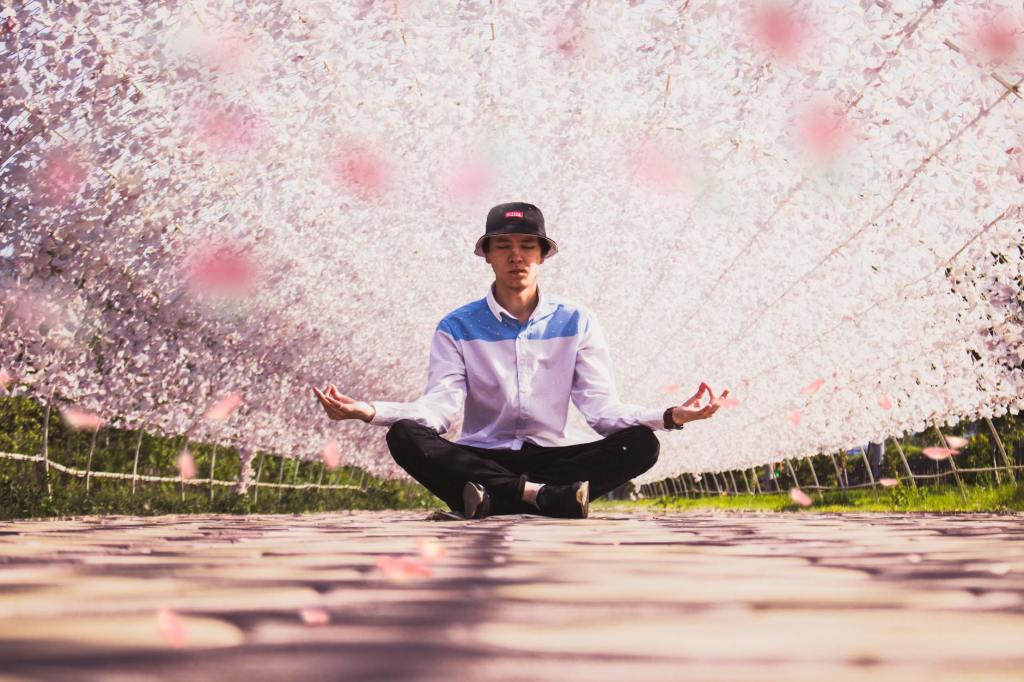
Transcendental-mantra-meditation

Published by

on

When I was 19 years old, I went backpacking through India and Nepal with the intention of making it to the Annapurna base camp (read more here about how I ALMOST made it). One of the gifts that I brought home from that journey was an increased awareness of how wonderful the world is, and the second gift, was an interest in yoga and meditation.

Yoga was not yet a big thing in Australia in the late 1980s / early 1990s, whereas meditating I could do on my own. For a while, I was a consistent meditator, throughout my 20s and early 30s.

Once, and only once, while I was in a deep meditation I had an out-of-body experience where I genuinely felt as if I had transcended my thinking-feeling self and became one with the universe.

It was very trippy, and quite wonderful, and whilst it probably should have turned me into a lifelong committed meditator… things got super-busy and my meditation and yoga practices both fell to the wayside.

When I came across the phrase ‘transcendental meditation’ more recently, I was excited to check it out again, and borrowed a couple of books from my local library in an ‘old fashioned’ attempt to learn more.

The first book I opened was “Strength in Stillness: The Power of Transcendental Meditation” (2018) by ‘meditation guru’ Bob Roth. The book calls this form of meditation “TM” (which made me think of ‘trade mark’ which is ironic because Mr Roth seems to have adopted the teachings of the Indian Yogi Maharishi Mahesh and then registered it under copyright). The book starts with a promise that TM will change your life and then… how to say this politely…? Provides nothing… nothing but a whole lot of smoke and mirrors but no answers, no guide, no nothin’ – unless – you move to the next stage which is to pay him to join one of his classes.

The basic premise of TM seems to be that you repeat a single mantra over and over in your mind – but that mantra can only be given to you by a professional teacher, and only they can explain how to use the mantra properly over the course of 4-7 lessons. The majority of the book was just a whole lot of celebratory endorsements (think Hugh Jackman, Katy Perry, Jerry Seinfeld, Ellen DeGeneres, Russell Brand). It read like a looooong infomercial where any meaningful guidance was ungenerously placed behind a very thick paywall.

[I raced over to Goodreads after writing this, because I felt a bit guilty – but it turns out plenty of other people reluctantly gave the book 1 star (because 0 was not an option) – and for the same reasons, writing comments like: huge waste of time / money, a sales-brochure filled with cringey celebrity shoutouts, what a rip-off and… barf… is this a cult? A Reddit feed had plenty of people who said TM was worth the investment, whilst others said it was a never-ending cash grab, and someone suggested you try the free 1GiantMind app instead.]

[I then popped over to Roth’s TM website (here) and, sigh, the ‘how to’ page says: “Only certified TM teachers teach the authentic TM technique that can enrich the entirety of your life.”]

[I’m not a fan of this sort of gatekeeping ‘secrets’ that could benefit others. It’s why everything on my RESOURCES page is free. Whilst I understand the desire to be compensated for your time / skill / effort, charging for every scrap of advice seems to go against everything I imagined mindfulness ought to be… as I’ve written about before: “It’s about the healing – not the healer” / “mindfulness and its discontents” / “Hiss… Growl… Grumble… Sigh…“]

A more generous book is Jacqui Lewis’ “The 14 day Mind Cleanse” (her website is here). Adopting a daily meditation practice is her first step in giving your mind a spring clean (undertaking a digital detox, establishing calm rituals and ‘banning busy’ are others). She notes there are three main types of mediation (page42):

+ contemplative techniques: “where your mind is taken on a journey” or you contemplate a single thing such as gratitude (she gives examples such as guided meditations on YouTube or at the end of a Yoga class)

+ concentration techniques: “where you focus your mind” by repeated chants, zero-in on your breathing or different parts of your body (Vipassana and Zazen are her examples)

+ transcending techniques: “where you work gently with a mantra to allow the mind to naturally and effortlessly transcend thought” (she includes transcendental, Vedic and integrated meditation as forms of this)

Ms Lewis’ preference is for the last form of meditation because it can be done anywhere without silence, solitude or a yoga position. She also offers a customized mantra-for-you service that you use twice a day for 20mins each session, and she too touts it as a “total game-changer” but rather than shut you down at that pay-to-play stage, she suggests that beginners can focus on any single word and still benefit, rest and relax.

She recommends 10 minutes a day (set a timer if you’re a type A personality, she says, otherwise go with the flow). She suggests you use the mantra-word “one” (as in the first number or all numbers distilled / you are one mind+body united / you are one with the universe) and repeat it softly over and over in your mind. If thoughts arise (and they will) just drift back to the mantra-word, and allow it to become your anchor point around which your thoughts will drift.

[I tried this mantra, and a strange thing happened – I found it best if I placed the word in the middle of my mind’s eye (like a gently glowing neon sign on a dark background). Somewhere along the way the word ‘one’ turned into the number ‘1’ which later morphed into the Roman Numeral for 1 which is ‘I’ – as in me, myself and I… which is potentially the opposite of what transcending self is supposed to be about, but in other ways, it was a clear signal that our subconscious minds are happy to take the reins when the busy-brain is asked to shhhhh for a while.]

I googled videos to try, and found a good (10min) explanation of TM (but again, it says you’ll need to speak to a teacher to receive your customized mantra):

[Video source: Transcendental meditation Introduction and Guidance]

I also found a channel on YouTube that includes potentially not TM’d TM exercises to try. They each appear to be about 30 minutes long (I aim to try a couple this weekend): Raphael Reiter – YouTube

While writing this post, I remembered the phrase that I used to repeat over and over 30 years ago: “om mani padme hum”. I looked it up over on Wikipedia and “Oṃ maṇi padme hūm̐” is Sanskrit for “praise to the jewel in the lotus” and “the mantra is seen as the condensed form of all Buddhist teachings”. The six syllables: om ma ni pad me hum, each refer to a different teaching; generosity, ethics, patience, diligence, renunciation, and wisdom.

You’ve probably seen the “om” symbol if you’ve ever been to a yoga class – if not, I’ve placed it into my own healing mandala below to show you what it looks like:

the symbol for om over a blue and purple mandala

SO – I think that meditating with a mantra is a nice idea, but rather than paying a master to give it to you (but don’t let me stop you if you’re keen), I think you can try it out for yourself, either by using the word “one” or “OM” or else, follow me in my most recent experiment; pick one or more of the ‘seed mantras’ associated with your chakras (working from your body’s bottom (literally) to your head’s ‘crown’) and say it silently in your head over and over, or hum it out loud (because humming sends a beautiful vibration through your body – read more on my blog here):

  • Root Chakra – LAM 
  • Sacral Chakra – VAM 
  • Solar Plexus Chakra – RAM 
  • Heart Chakra – YAM 
  • Throat Chakra – HAM
  • Third Eye Chakra – OM
  • Crown Chakra – Silence (OM) 

Here’s an image montage to help you understand where each chakra is (and there’s more info on my blog here):
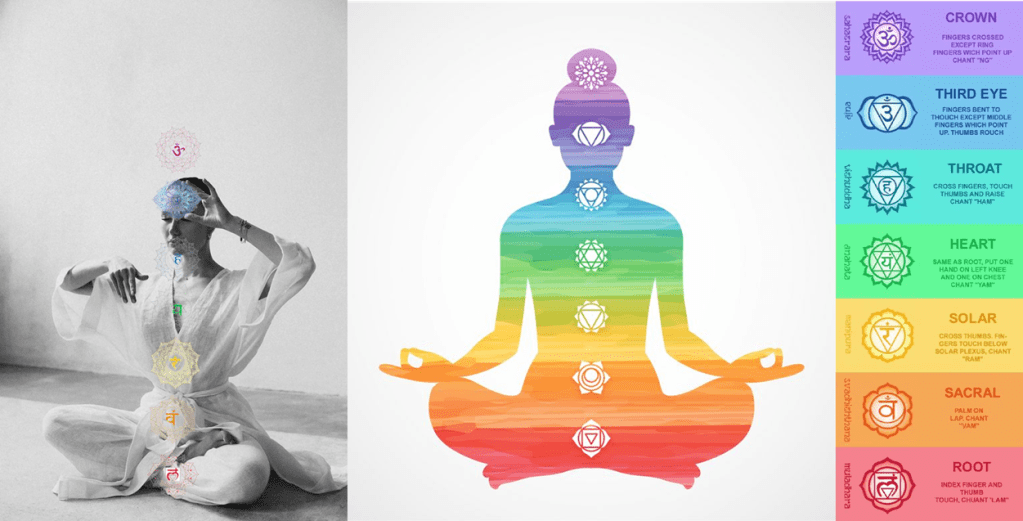
[Image sources: Pin on Arte inspirador / The 7 Chakra Colors and Their Meanings / energy symbole]

*

Waiting for the right advice is important – but sometimes (where the risks seem low) I’m a fan of “have a go and see what happens”.

Take care taking care,

Linda x

*

PS – I’ve marked this exercise under the ‘Moderate‘ tab of mindfulness activities to try, not because it’s particularly hard, but because you might have to do a little research yourself to supplement your training. (Here’s the links for the “Easy” and “Difficult” activities to try if you’re interested in dialing your self-help healing experience up or down.)

PPS – let me know if you’ve paid for the trademarked TM course and if it was a real game-changer – I’d love to hear feedback!!


Discover more from The Mindful Migraine

Subscribe to get the latest posts sent to your email.

41 responses to “Transcendental-mantra-meditation”

  1. Edward Ortiz Avatar

    Interesting! After what you said about the book, I went and checked out some of the reviews. One of the reviewers even included a photo of a page, hilarious.

    Liked by 1 person

    1. The Mindful Migraine Blog Avatar

      My fav was a comment by Zachary G: “If I could describe in one word it would be “shit”. […] My grandmom bought this as a Christmas present for me and was super excited for me to read it. I don’t have the heart to tell her that this book is more useful as toilet paper.”🤣

      Liked by 1 person

      1. Edward Ortiz Avatar

        🤣 Awesome!

        Liked by 1 person

  2. joannerambling Avatar

    This was really interesting, meditation is powerful

    Liked by 1 person

    1. The Mindful Migraine Blog Avatar

      I think it is – but it doesn’t come naturally to me – so I’m still very much a beginner (again)!!

      Like

  3. Monika dass Avatar

    We often use ॐ (Aum) ( Om) during worshipping .. during chanting lords name!

    For example…
    om namah shivay ( to greet lord shiva) 🙏
    Om bhagvate Vasudevaya namah ( to greet lord Vishnu… lord Narayana)
    Etc..

    ओ + उ + म् = ॐ

    & this is gayatri mantra…
    nearly each & every children in India grow up listening & uttering the gayatri mantra…
    ॐ भूर्भुवः स्व:
    तत्सवितुर्वरेण्यं भर्गो
    देवस्य धीमहि
    धियो यो नः प्रचोदयात् ॥

    Om Bhur-Bhuvah Swah
    Tat-Savitur-Varennyam
    Bhargo Devasya Dhiimahi
    Dhiyo Yo Nah Prachodayaat

    Thank you for sharing this mind-brightening piece…🌻

    Liked by 1 person

    1. The Mindful Migraine Blog Avatar

      Oh! You’re se welcome! Thank YOU for providing more insight! I love the idea that children grow up hearing such lovely mantras (in Australia, we grow up listening to Kookaburra-birds laughing… and the TV)

      Liked by 1 person

      1. Monika dass Avatar

        We also grew watching TV… but we also learned mantras & worshipping lords as it’s each and every religion’s ritual to pray & remember lord for better living and most importantly .. for better human being…
        We have numerous mantras..
        SHORT AND LONG AS WELL..
        But I prefer my worshipping as simple as possible…. not unnecessarily making it complicated…
        after all… God watch our each & every actions we do throughout the day… not just how many difficult mantras we are chanting …
        In fact
        The top of all.. is

        ” Hare Krishna Hare krishna
        KRISHNA KRISHNA HARE HARE
        HARE RAM HARE RAM
        RAM RAM HARE HARE..”
        ( in short… Hare Krishna.. Hare Ram)
        ….
        & gayatri mantra.. as I already mentioned above…

        & yes ..
        On top of all
        Om 🕉 ( start with sound ooooo….. uuuuuu…mmmm)
        It naturally happens.. o sounds turns into u(ooo) & then convert into mmm..(humm.. sound)

        Have you ever heard Hare Krishna hare ram chant.. ?
        If not.. give it a try… !
        I am sure you will love to hear it… !

        Is kookaburra a bird that laugh?

        Liked by 1 person

        1. The Mindful Migraine Blog Avatar

          So good – I’m going to write these down and give them a go!

          And yes, the kookaburra is the one that laughs (sometimes at dawn – which is actually no laughing matter!!) 🤣

          Liked by 1 person

          1. Monika dass Avatar

            That’s interesting…
            I will search on the web to watch his laugh… 😅

            Have a joyful weekend…🌻

            Liked by 1 person

  4. Alice In Menopause Avatar

    Linda, this is spot on. Great in depth information on the Chakras as well. I’m finishing up a Chakra Coaching Certification now and you’ve got it down. Not mention, this is the time to really go inward and align with our higher selves. Try imagining a white light running along your spine from your Root Chakra up to your Crown. It is simple, but you’ll feel it.

    Liked by 1 person

    1. The Mindful Migraine Blog Avatar

      Oh wow! I did it and you’re right – I did feel it – and it made my chest and chin both lift up straighter – how wonderful!

      (I love your new website by the way – and am happily embracing my grey-haired self (thanks to a New Years Revelation which has me part meditator, part warrior – all wise!!) If you ever want to write a guest post about using Chakras for healing, I’d happily publish it!!) xx

      Liked by 1 person

  5. The Oceanside Animals Avatar

    Lulu: “Don’t feel bad about giving the book one star! Our Dada is not at all shy about handing one-star ratings to books, even ones that lots of other people liked, because as he puts it ‘All those other people are wrong.’”

    Liked by 1 person

    1. The Mindful Migraine Blog Avatar

      YES! Everyone else IS wrong sometimes! And besides, I think it is a community service – it saves people from spending their time or money where they don’t have to!

      Like

  6. Jacqui Murray Avatar

    I would have dumped that book, too, when I cam eto all the movie star endorsements. Yikes! I’m digging into Shamanism for a book I’m writing which is entirely internal, get in touch with yourself and nature and a lot more. I like the idea we are our own guide.

    Liked by 1 person

    1. The Mindful Migraine Blog Avatar

      Oh… Shamanism is so fascinating… I’m only at the tip of the iceberg looking into that subject, but it seems like a wonderful form of wisdom! How exciting for you – happy researching / writing!! xox

      Liked by 1 person

      1. Jacqui Murray Avatar

        I like that it’s spiritual without being religious. That suits me (though I am firmly grounded in God).

        Liked by 1 person

        1. The Mindful Migraine Blog Avatar

          I think you can be both – I feel attached to Mother Nature in a way that makes ‘religious’ people a bit nervous – but I believe you can have faith and still be attuned to the outdoors. xx

          Liked by 1 person

  7. My Mindfulness Journey Blog Avatar

    This post is a thoughtful, thorough, and very relatable exploration of meditation and personal growth. I like how it combines personal experience, practical experimentation, and critical reflection on the commercialization of TM. The contrast between rigid, paywalled systems and accessible, DIY approaches makes the post feel empowering—encouraging readers to explore mindfulness in ways that actually work for them. The inclusion of mantras, chakra guidance, and personal insights makes it both informative and engaging. 🧘‍♀️✨

    Liked by 1 person

    1. The Mindful Migraine Blog Avatar

      oh, thank you! You’re so welcome. I try to include as much info as I can (sometimes it’s a lot I know) – but it gives people the best chance to get some insight into a big topic. Hope today is as mindful as possible, L xox

      Liked by 1 person

  8. richardbist Avatar

    I tend to shy away from anything that has celebrity endorsements. I know the celebrities are getting paid, so I’d rather do like you did and simply research it on my own.

    I’ve never tried TM…I’m more of a seat-of-my-pants meditator. I basically sit cross-legged on a cushion and focus on my breath until my mind clears and begins to wander. I may have some instrumental music playing softly in the background, but generally I prefer silence. It works for me.

    I should probably give TM a try at some point, just to see what it does for me. Thanks for the insight and suggestions, Linda.

    Hope you have a wonderful day! 🌞

    Liked by 1 person

    1. The Mindful Migraine Blog Avatar

      My pleasure – it was an interesting experiment, but I tried a few other ways related to it, and it does seem more complicated – I like your more simple, and immediate, way of meditation – just sit and be still and let your mind wander into calmness. Have a wonderful day too – hope the weather is just how you want it! 🙂

      Liked by 1 person

  9. Skyseeker/nebeskitragac Avatar

    When I meditate I don’t use mantra or breathwork, I let my mind loose and just observe it. It’s a bit harder than using a mantra or counting breaths but it suits me better.

    Liked by 1 person

    1. The Mindful Migraine Blog Avatar

      I like guided meditations best, where they get you to listen to their words – it helps me stay focused. But just doing it like you said, without any word or sounds is good too… so long as I can pull my mind back from shopping lists etc. So glad it works for you – YAY!! 🌞🌟

      Liked by 1 person

      1. Skyseeker/nebeskitragac Avatar

        There is someting about listening and paying atenttion to words that makes you relaxed, I noticed it too. 🙂

        Liked by 1 person

        1. The Mindful Migraine Blog Avatar

          yep – it’s like you’re letting someone else do the thinking for a while! 🙂

          Liked by 1 person

  10. Johnbritto Kurusumuthu Avatar

    A thoughtful and insightful post. You clearly show how mantra-based meditation can gently quiet the mind and help the body move toward deeper relaxation and healing. It is encouraging to see how such simple practices can support mental clarity, emotional balance, and overall well-being.

    Liked by 1 person

    1. The Mindful Migraine Blog Avatar

      It’s not my favorite way of meditating, but I’m keen to keep trying it out. Best wishes to you, always, Linda 🙂

      Liked by 2 people

      1. Johnbritto Kurusumuthu Avatar

        🤝🙌🙏

        Liked by 1 person

  11. swadharma9 Avatar

    what a good, informative post! my spiritual practice includes a sanskrit mantra ( the very ancient & popular “om namah Shivaya”). i have learned several, for different purposes, but all are messages that are very uplifting & helpful & inspiring to me. especially the Shivaya one. ❤️🙏🏼❤️

    Liked by 2 people

    1. The Mindful Migraine Blog Avatar

      Yay! 🥳 so glad that it’s working for you and I love the idea of having several mantras to choose from that inspire you in different ways at different times xx

      Liked by 2 people

      1. swadharma9 Avatar

        all i can say is that there was an empty place inside me that felt much fuller as i deepened into the mantras over time. it has been eight years now, & i am a better version of myself because of it (of all the various practices that i have tried, this one hit the inner mark most helpfully).👍🏼❤️

        Liked by 1 person

        1. The Mindful Migraine Blog Avatar

          oh, what a lovely comment – I’m sure you were a good version of yourself before, but I’m thrilled you’re an even better version now! 🌞🌟

          Liked by 1 person

  12. Renate Avatar

    I practice TM with a mantra from a teacher. I found it quite helpful and it has helped me get back into meditating. I was meditating on and off 30years ago but “fell off the wagon” for 7 year so TM was a great new way to get back into meditating daily. I now use different meditative practices depending on how I am feeling.💜

    Liked by 1 person

    1. The Mindful Migraine Blog Avatar

      Oh wow! 🤩 I knew people must be getting benefits for it still to be around! Glad it helped you, and I’m starting to realize that different meditation styles probably suit different times and moods… I’ll keep it in my kit bag of tools to keep trying. Thank you for the feedback 🤩

      Like

  13. LaDonna Remy Avatar

    This is informative. I appreciate the many resources you have provided. I do practice meditation but have not engaged in TM. I have heard both positive and negative experiences and do appreciate this perspective.

    Liked by 1 person

    1. The Mindful Migraine Blog Avatar

      Thanks 🤩 I remain curious , hence the long review, but I think I prefer guided meditations that always leave me feeling like I’ve taken a relaxing little journey (free of cost – so no anxiety about getting my money’s worth!) if time permits, I’m keen to try a few more self guided goes in the future. Xx

      Liked by 1 person

      1. LaDonna Remy Avatar

        I agree. ❤️

        Liked by 1 person

  14. John Avatar

    Wow man, that’s a lot of information, Linda but I’ll not be sending Bob any moola. I see those loooong info ads on Instagram and they are ridiculous. I always report them if possible. 😂

    Liked by 1 person

    1. The Mindful Migraine Blog Avatar

      Yeah, sorry, it was a loooong post! I remain curious about this style of meditation, but I’m also not keen on paying for someone to tell me what word to use! Stay well my friend! 🌟

      Like

      1. John Avatar

        Thank you, you too Linda. 😊

        Liked by 1 person

Leave a reply to Skyseeker/nebeskitragac Cancel reply