

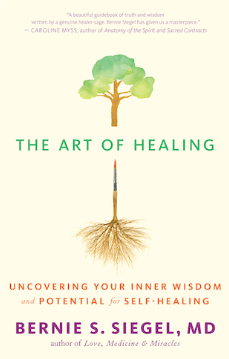
Hello lovely people, today is a (long-ish) book review (with a personal craft project detour) for Doctor Bernie S. Siegel’s “The Art of Healing: Uncovering your inner wisdom and potential for self-healing” (2013) (He also has a blog here).
[Image source: Berniesiegelmd.com]
Straight up I want to clarify something; I support the idea of healing yourself and genuinely, wholeheartedly, believe I have greatly improved my health as a result of taking proactive steps in that direction – but – if you have a medical condition such as chronic migraine, please don’t assume that ‘mind over matter’ is going to be enough to ‘cure’ you.
The sorts of mindfulness activities that I use and advocate are designed to relax your nervous system and help you separate suffering from pain – but – I’m still a long way from believing that meditation and manifesting can change you on a cellular level. I’m not saying it’s not true (I remain hopeful), I’m just not a true believer (yet).
I guess this is a long-winded way of saying that the author IS a believer and so my reading of his work might be tempered by the fact we are not fully in alignment. Nonetheless, there was a lot that I got out of this book that I think is worth sharing.
The book starts with Siegel (as if looking straight at me) stating that we are relentlessly bombarded with information and our minds are like a TV with a remote control – what we see depends on what channel we tune into – if you only listen to one form of input, your life will potentially be framed and limited by those boundaries. Moreover, if you don’t feel comfortable believing that cells are intelligent and communicate messages to each other, then research how bacteria resists antibiotics or the wounds of living things heal (page 5).
As he writes: “I can’t accept that” – really means – “I can’t explain that” (7).
And doctors like to explain things… yet patients need more than cold hard facts.
Siegel suggests that if patients don’t feel like they’re being treated as human beings, mistrust brews, and both disease and treatment options become sources of fear, and the result can be “feelings of isolation and powerlessness” (12-13). He confesses that he used to see a patient’s cancer and focus on the physical aspects of that alone, without seeing the full patient or considering their emotional wellbeing, their spiritual condition, or the extent of their will to live and participate in healing (16-17).
I often refer to the mind-body connection, but Siegel goes further, and believes that a mind-body-soul approach should be embraced when we chose to heal (30), and he suggests that taking notice of the symbols in your life is one way to get started (32).
Siegel proposes that you look around you at the signs and symbols that you see – what do they stand for, do they resonate with you, and why?
[For example think of all the crosses in your life and what they all stand for (as I did here)]
He then said something that made me stop reading and get up out of my chair: “Cut out a symbol that reminds you of a loving feeling, and tape it to your mirror or fridge as a love letter to yourself. Create shrines of love throughout your home…” (32)
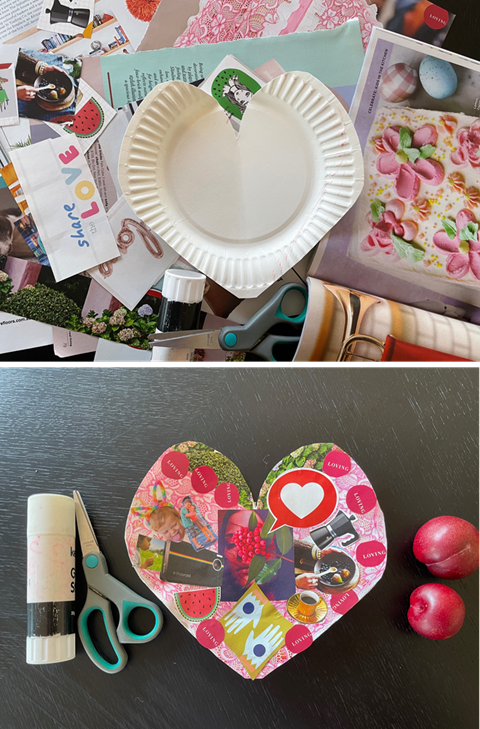
Not long ago, I wrote about how I created kiddy craft as a distraction from my pain, and covered a paper plate in magazine pictures that I felt related to ‘illness’ and ‘wellness’. The book made me realize that a paper plate covered in love would make a nice project so away I went.
I ended up with a strange assortment of images that reminded me of love; happy children, photographing memories, shared food, warm coffee, kind words… whilst the result was potentially limited to what was in the magazine, there was a nice mixture of romantic haze and practical acts of service:
[Image source: me]
The book then launches off, reminding readers that the power of visualization is not just how you look at something or your mental images – it ought to be as sensory as possible.
When he says “imagine lemons” you might picture yourself putting them in a shopping cart and think of their cost, but you can also visualize holding one in your hand, smelling it as you cut into its thick rind, and consider what it feels like to squeeze a segment and watch juice spraying out, or the tingle on your tongue when you taste it. Now your whole brain is engaged in the process, and if you were really into it, your mouth might be producing saliva or your lips puckering up as you shudder at the memory of bitterness. (34)
Now imagine yourself – in sensory detail – succeeding in your healing journey and being perfectly well.
“The mind is powerful.” (37)
Siegel writes that he can ask a cancer patient to draw a picture of their upcoming treatment and determine the likelihood of success based on what they draw, the details they include and the colors they chose. Then he can use compassionate communication to address their concerns. (37)
Throughout the book he returns to this notion, and shows picture examples, such as ones where chemotherapy is likened to poison, doctors are devils, and patients depict themselves alone in a gloomy room accompanied by a clock with no hands, versus images where patients are surrounded by family holding hands, and medicine that flows into them alongside rainbows, love hearts and halos of light.
He reminds us we don’t have to wait for a doctor to reverse our anxieties – we can heal ourselves. Our bodies are as powerful as our minds; “The potential for self-healing is built into you; a cut finger that heals by itself is evidence of that. When you practice guided imagery, you are reprogramming your body.” (38) And Siegel believes that as you improve your mental imagery of yourself and rehearse seeing yourself healed, “your internal chemistry changes and your body benefits” (40).
[Not that long ago, I reviewed a book that referred to the way our postures reflect the hormones in our body (here) and since then, I regularly go around the house fist-pumping the air in a celebratory way (for no reason at all) and I HAVE felt a shift in my energy and internal wellbeing… so… maybe I do believe.]
In the same way that Siegel looks to drawings to gain hints of a patient’s attitude towards their health, he also believes in dream analysis. He is so persuaded by their power, that he will do a biopsy on a patient whose mammogram is clear but who had a nightmare that her body was not (44). He writes of another doctor who ordered a heart-check and found blocked arteries because his patient kept having distressing dreams about beavers blocking a dam (45), and a lady whose treatment options were determined based on the advice she received from a white cat called Miracle in her dreams (46). He suggests that you can keep a dream journal by your bed to record what you can remember, even if it is only images / signs / symbols. (53)
[If I’m accidentally sounding flippant, I don’t really mean to be – perhaps there is some truth in this sort of thing – once, in my 20s, I was supposed to go on a camping trip with my sister, but woke up after a restless night and cancelled at the last minute – I didn’t understand why, I just didn’t feel like it was a safe thing to do – a few hours later, she was in a car crash where the whole passenger side of her car was crushed.]
One section of the book I found very moving is this:
“The process of restructuring your life, of becoming an authentic person, requires that you see yourself as dynamic, ever changing, and becoming. I always like to remember that graduations are commencements, and the Bible ends in a revelation, not a conclusion. […] Life is a journey. Rather than search for meaning in life, we bring meaning to our lives by how we love ourselves and how we love the world.” (49)
Siegel seems to lament that modern medicine is filled with medical disclaimers about side effects, and this is what patients focus on; cautions about liver failure, hair loss or infertility (for example) rather than hearing a doctor say, “this can make you well and add years to your life” (58).
[I for one prefer to hear the risks, but I can see what he means – it’s a bit like the “don’t hit the pole” post I wrote where all your attention is focused on the darn pole.]
In terms of pain, he writes “Pain helps us to identify and define ourselves; when we realize that, and work with it, all pain becomes labour pain, or growing pains. […] And labour pains are worthwhile when we give birth to our true selves.” (61)
[I understand what he’s saying, and I sort of get it – but I’m not sure I’m totally buying what he’s selling – pain sux, and chronic pain sux big time.]
Over and over, he returns to the importance of signs, symbols, names, and recurring numbers, as “signposts that a greater intelligence is playing a guiding role” in the way your life is unfolding. (116)
[I am coming to believe this – see the end of my first post of 2026 here].
There were also some other broader takeaways that I found helpful:
“When we love our lives, our bodies often get the message, decide to live, and heal.” (124)
He advocates for the power of love and the wise voice within you (124) as well as the vital force of laughter as it floods your body with endorphins (126).
Optimism heals whilst negativity, arising from fear, steals hope. A life lived in negativity affects your body, weakening your immune system, increasing blood pressure, and causing inflammation of the circulatory system (129).
Taking time out to rest and restore yourself is part of living authentically (140).
In the same way that he speaks of making shrines to love in the opening pages, Siegel uses the idea of making shrines to yourself in the end pages; find photos of yourself as a child and “Fall in love with that child” – in your mind each time you glance their way, value them, speak to them, comfort them, nurture them, and then, in those moments when you feel disturbed or anxious, remember those words of wisdom to yourself. (147)
[Coincidentally, about the time of writing this, my husband found a photo of me that I had floating around since I uploaded a copy of it for a previous post (“My First Migraine“). He stuck it on our fridge and my first instinct was a sort of pity for her frightened face – but since then, I’ve been chatting to her; chin up lovely, it’s only a photograph, no one is stealing your soul – everything will be ok.]
Towards the very end, Siegel reminds readers that we are communal animals – so go find your tribe, share your experiences, and help each other. (148) [yay team!]
“You do have control over your thoughts and actions, so take control – it is your right. Rehearse being the person you want to be, and each day act like you are already that person.” (152)
One last takeaway that struck me, and then I really ought to let you go… It was a story about how one of his children had to do an art project, and unsure how to fill the canvas, he just wrote “words” over and over again – which reminded Siegel (a surgeon) that just as a scalpel can kill or cure, so can words, such that wordswordswords can also be a sword; swordswordsword. (157)
Words matter – speak kindly to yourself, and don’t forget to fake it til you make it as you visualize yourself into the person you want to be; happy, healthy, you-nique.
Take care, always, Linda x


 The Mindful Migraine
Leave a reply to The AndHereIam Blog Cancel reply