

Today’s post is about the impact of microaggressions. Theoretical and personal examples are listed, so feel free to look after your mental health and give today a miss if you think the content might be upsetting. Carry my support and understanding with you today and always.
*
*
*
Before we get to microaggressions, let’s cover a bit of backstory from my life. As one of the few women on a construction site (when I was a Project Manager), each day felt like I was running the gauntlet of some invisible obstacle course in which I could faceplant at any minute.
Or perhaps a better analogy was living in an Escape Room scenario where any ‘button’ I might push might save me or hurt me. If I do ‘that’ will the guys cope or chuck a hissy fit and call me rude names? If I say ‘this’ will it be adhered to or trigger a negative response that makes everyone bristle? And specifically – if I go into that portable toilet, will I come out with my dignity intact?
Strange comment you might think – but you’d be wrong. Construction sites are notoriously blokey and that includes the toilet arrangements which usually involve a Portaloo sitting in the middle of everything. There were never any female amenities, and whilst that might not sound like a big thing, every time I moved towards the loo, I felt eyes follow me there, and a hushed breath-hold of anticipation.
I personally have never been in a tipped-toilet… but it happens…
Needless to say, I found other ways to wee that felt safer: off-site.
But I still didn’t always feel safe. Every day life was filled with what we now call “micro-aggressions” – I’ve had my foot spat on by someone who said they didn’t take instructions from girls, I’ve had men refuse to shake my hand when we’re introduced, I’ve been called every name in the book (to my face or behind my back (but within hearing distance)), I’ve been ‘accidentally’ pushed into walls, I’ve had things thrown at me, and I’ve had dirt kicked onto my legs – which sounds like a nothing thing, but it’s one of those primal signals of contempt that is issued to the wider group.
I’d say that I was lucky – most of what happened to me was not full-blown aggression – but it still meant I often left site feeling sad, humiliated, fragile and occasionally fuming.
The reason for today’s post is that my teenage daughter’s best friend has recently become an electrician’s apprentice, and I realized I’ve been holding my breath for her as I read this article: Skilled workers are considering leaving the trades — and toilets are to blame
In the article, 17-year old Logan the ‘sparky’, explains how she stopped drinking water at work to avoid the whole toilet debacle… and got migraines as a result.
The article notes that the number of women in the trades sits at roughly 3 to 4 per cent – regardless of spikes in recruitment. “It isn’t the old adage that women don’t want to do trade work,” Clea Smith, CEO of Tradeswomen Australia, says, “It’s that the workplaces aren’t safe or supportive.” 71 per cent of women (working for smaller businesses) reported gender-based discrimination and many went on to leave their jobs. One female tradie suggested that the microaggressions were like “death by 1,000 cuts”.
The story had an upside, with a duo of female tradies creating “GO bags” that would get women out of toileting trouble (as much as possible)… when they need to go.
It’s early days for the Go Company but long overdue: go ladies!
Circling back to the topic of microaggressions, when I looked up the examples that the Mental Health America website uses (“you look so exotic”), I realize that what happened to me on construction sites was actually aggression. There was nothing particularly micro about it in hindsight. But I also remembered that I copped a lot of the “you should smile more” nonsense the article also uses as an example.
As the website says: “Microaggressions are verbal or nonverbal insults that target a person’s ethnicity, country of origin, race, age, gender, sexuality, disability status, religious affiliation, or economic status. Many people who commit microaggressions don’t mean to cause any harm. But their impact can be devastating, especially over time.”
The term “microaggression” was first used around 1970 by Harvard psychiatrist Dr. Chester Pierce who noticed that people would say “you’re so brave” to a disabled person, or how some white people avoided eye contact with a non-white person as if they were dangerous, or say, “you speak good English” to a foreigner, implying they don’t ordinarily speak intelligently.
The article breaks microaggressions down into 3 versions:
+ Microinvalidations – whether accidental or not, they reveal a personal opinion which denies another person’s lived experience: “anyone can get ahead, you just have to work harder”
+ Microinsults – indirect insults which nonetheless focus on a person’s perceived marginality: “you’re so good at coding for a girl”
+ Microassaults – deliberate insults intended to hurt someone based on their marginalized status (even when said as a ‘joke’): “go back to your own country”
The consequences on an individual’s health are not hard to image; low-self-esteem, fatigue, failing motivation, lack of trust, depression…
The bigger picture is problematic as well: “Microaggressions can promote an intolerant, discriminatory culture. The more unconscious bias goes unchecked, the more common it will become.”
So how do you handle microaggressions?
Mental Health America says this:
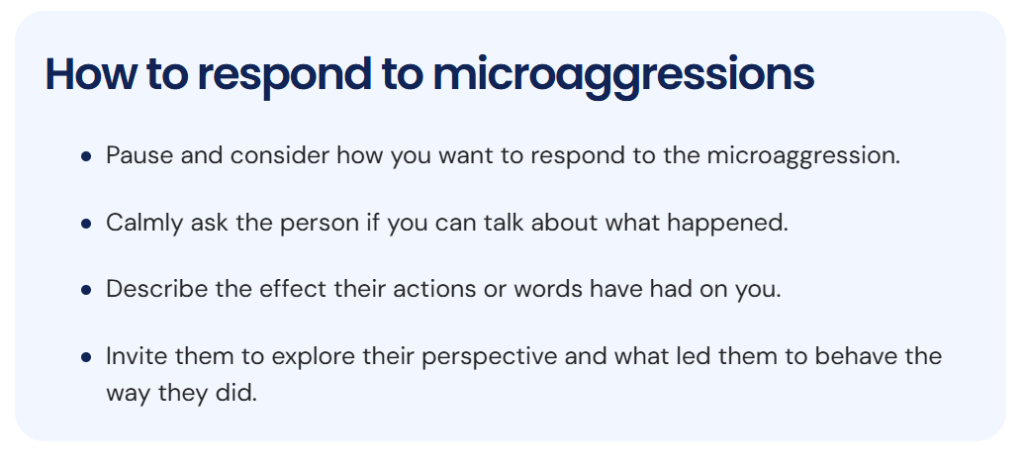
[Image source: screen shot: Microaggressions: What they are, how they impact people, and how to respond | Mental Health America]
*
Great advice.
BUT
Do I think I could have followed it on a construction site – yes – but probably only in 1 out of 10 situations… the other 9 I was too busy trying to keep my head down, avoid eye-contact or getting the heck away if I could – things can escalate quickly, and I feel like saying, “I invite you to explore the impact of your behavior on my feelings”, would be the equivalent of petrol on an ember…
SIGH.
Interestingly, I know that when I am not the target of the microaggression, I find it easier to stand up and say “stop!”
I have a clear memory from 20+ years ago of interrupting a foul-mouthed tirade against the interior designer. I kicked the yelling man off site (even though he was the owner of the property) and told him not to come back to my construction site until he had a better attitude and an apology for her. (It took over an hour, but he eventually returned calmer, and carrying a bunch of flowers… the move helped restore the vibe on site, but it did not restore my lost respect for him).
But perhaps that’s a solution too – each and all of us can stand up a little more for another person who’s under attack – call out the bad behavior, and slow it down… because I can’t bear the thought of a world that is becoming less and less tolerant…
This post ended up a little sadder than I intended – and it is absolutely NOT meant to create a man versus woman vibe – only highlight how bad behaviors (from anyone) have an impact on others.
Microaggressions are the daily lived reality for many people, and in my quest for a nicer world in 2026, I’ll be on the lookout for more incidents (accidentally committed by me, or by others) and I’ll try to turn the volume down on them.
No more death by papercuts.
Kindness matters.
Sending lots of love and support to all of you.
Always.
Take care taking care, Linda x


 The Mindful Migraine
Leave a reply to sedge808 Cancel reply