

Today’s post is a (long, but totally worth it) book review of pain psychologist David Walton’s “Chronic Pain Management” (2021). It hooked me in, because the cover seemed to be calling to me from the library shelf, and the opening words made me say a vigorous “yes!” in my head:
“Pain is not pleasant. It hurts. But many chronic pain patients attending pain clinics say the real problem isn’t the amount of pain as such. It’s how the pain weaves its way into their everyday lives, limiting activity and preventing any sense of being in control that they find most exhausting…” (page iii)
The opening chapter is pretty blunt – if you live with chronic pain, you’re likely to be ruminating a lot about that pain and the limitations it places on your life… which becomes a form of ‘passive’ thinking (rather than strategic action) which is… problematic… and likely to lead you to a life lived with more pain (6).
That doesn’t mean, as Walton points out, that “positive thinking” alone is going to help you – our brains and our nervous systems are complex, and so is pain control (7).
But we need to try – as Walton notes – a huge percentage of the population experiences chronic pain at some point in their life. It has an impact on the quality of our lives, and is for many, disabling, and for a few, it makes life unbearable. Chronic pain conditions include arthritis, back pain, nerve damage, and cancer treatment. As he notes “It can distort their lives, finances, living arrangements and relationships” (8).
Or, as one patient states, “Pain changes you completely… It just takes your life away. Your whole personality changes” (13).
Yes.
Those are words I can relate to.
As is Walton’s note that patients are often prescribed treatment options which don’t work, which leads them to lose faith in medical practitioners, and then increasingly “People with chronic pain can inhabit a world of uncertainty, anxiety and often isolation” which leads to a “depressing downward cycle into hopelessness” (15).
[See my posts on “Doctors behaving badly” and “Pain + fear = chronic pain”]
Walton notes that when he tells patients to take personal control of their pain, almost every patient reacts badly – they are too busy, offended by the suggestion they are not trying hard enough, put out by the implication they are weak. He says he gets it, “almost certainly you are coping with your pain ‘as best you can’,” BUT you have to move past the negative reaction in order to heal, you have to take responsibility for your personal wellbeing, you need to discover what triggers your pain flares, learn from what works (and doesn’t) and manage ways to reduce it, spend more time doing things that make you happy, plan and organize your life to build in more recovery time, and find ways to boost your resilience (18-19).
[This is EXACTLY my experience when I freaked out and called my neurologist rude names at his suggestion that I should make some lifestyle changes (Re-finding the ‘i’ in ‘Linda’) – but the reality is, when I DID start to make those changes, I DID get better – tough love moment – the doctor was right, and you DO need to save yourself.]
The book then includes several questions where you rank your response. For example; “I have to dress slowly due to my pain” or “worrying thoughts have gone through my mind a lot recently”. Your replies are then given a score, and the score reveals whether you are coping pretty well and seeing the positives in life regardless of your pain, or your pain is having a significant effect on your life, and you might struggle taking on more responsibility for self-managing your pain right now.
A bit later in the book Walton adds a few more causes for chronic pain: osteoarthritis, fibromyalgia, surgical issues, sleeplessness and… migraines (39). Some pain, he notes, relates to our nerves, such as shingles, whilst others occurs when chemicals are released into our bloodstream, such as inflammatory responses associated with rheumatoid arthritis (41).
[Disclaimer – a quick reminder that I am not a medical doctor and may not be presenting the material I read perfectly – please do NOT take medical advice from this blog, but DO speak to a trained professional for accurate and personalized medical information.]
Pain that comes and goes (such as a tension headache) is classified as “recurrent pain” and tends to be associated with a specific reason which comes and goes (such as dehydration or stress). “Acute pain” is when you experience pain due to a specific event (such as a bone fracture or childbirth) and time tends to heal the pain. “Chronic pain” however, does not always have an obvious cause, and it does not appear to have a useful purpose [a twisted ankle gets you to rest your foot for a while – migraine doesn’t seem to heal a structural issue… it just is.]
Treatment options for all pain types is different for different people. For some, medications work, for others it might be mindfulness, meditation, yoga, breathing awareness or therapy (all of which I like to elsewhere on the blog (click the SEARCH tab to find out more)).
One of the reasons different things work for different people is a result of how we sense pain – we each have a different pain “threshold” and “tolerance” for pain. The first relates to how long we can wait before we sense pain, and the second relates to how much we can handle that pain before we break down (42).
It’s such a complicated phenomenon that research has produced some unusual results. For example, tests suggest that people who were in love could halve their pain by thinking about their partner, whereas those who looked at their sore limb through a magnifying glass reported their pain increased. Studies show that an injection hurts less if you don’t look at it happening, and those who catastrophize the event that caused their pain are more likely to live in pain longer. Lastly, the pain children experience is highly influenced by the way their parents react (45.)
[See my post on “keep smiling as you go under” about teaching my daughter to swim (and healing my relationship with chronic pain).]
OK, but before we start to feel like pain’s a “made up” issue – Walton also notes that there are structural changes that occur due to chronic pain. The brain’s amygdala and hippocampus (which affect memories and emotional control, for example, shrink by 10-15% in patients who have suffered chronic pain for more than a year, and it can also lead to the shrinkage of the nerve-sheaths (myelin) which affects the nerve fibers in the central nervous system which then activates inflammation and decreases your pain thresholds even further (53).
The book goes into great detail about how pain is sensed by the body and the messages relayed to the brain, too complicated to go into here. It also investigates decades of research that showed the mind-body connection and the influence emotions have over pain. All of which can be summarized by one sentence:
“One important lesson we can draw from pain research is that pain affects everyone differently and that to manage it, you need a bespoke, individual plan which reflects your needs and particular situation” (70).
It also states (yay me (and all of you who are following along)): “Another key point is that chronic pain can be modified by a range of approaches, including some, like mindfulness, relaxation or visualization, which don’t require medical expertise” (70).
He notes that many patients, such as those with arthritis, are told there’s nothing they can do to stop the pain other than depend on increasing amounts of medication – but – that’s not true, and many patients improve their wellbeing through positivity, not in a ‘flaky’ way, but by being their own pain-manager and systematically monitoring their pain and taking strategic action to improve their situation.
[See my posts on being your own CEO and “closing the gap” about reducing pain thresholds and increasing pain-resilience for hints and tips.]
The book includes a short scored test to determine how you might be dealing with your pain, that highlights 3 potentially UNHELPFUL ways of thinking: helplessness (“I feel overwhelmed by my pain”), rumination (“I can’t get the pain out of my mind”) and magnification (“I worry the pain will get worse over time”). It then provides some ideas about how to turn the volume down on these three unhelpful habits.
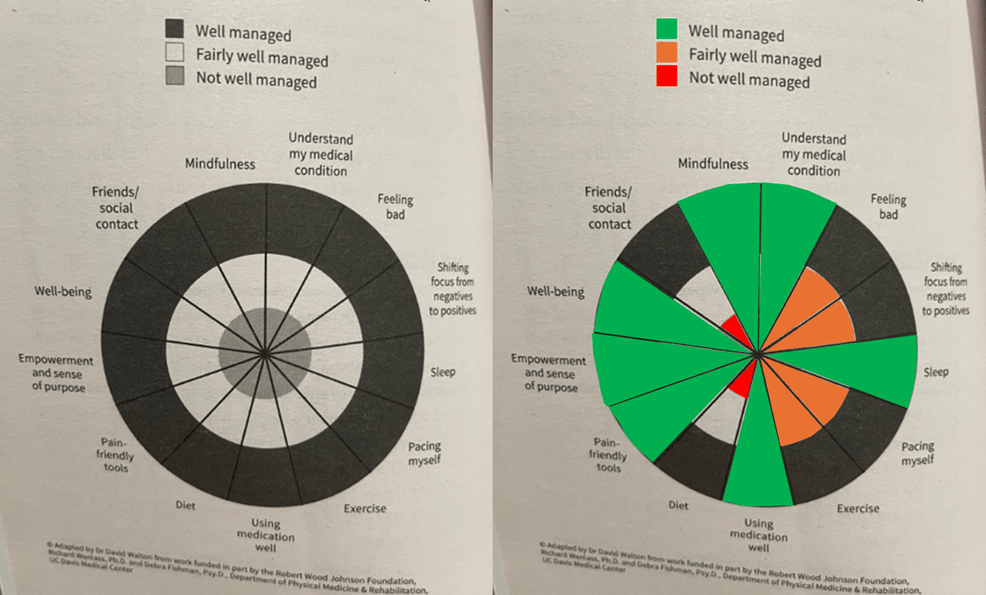
The second half of Walton’s book helps you make a personalized pain-management plan. It includes keeping a diary (like my free Trigger Tracker (here)) and filling out a “pain wheel” which I have never seen before (but when I saw it, I instantly thought of archery practice combined with a Ferris wheel).
It’s hard to photograph, but you can see a low-resolution photo of page 136 below. It is basically a series of life-elements such as mindfulness, sleep, diet, exercise, understanding your medical condition, dealing with bad thoughts and so on. You map on the circle whether you feel like you’re managing that segment well (outer edge of circle) or not (inner wedge of the pie), and you’ll end up with a wedgy-pie like my one below (which I added color to, in order to see it better).
[Image source: Walton’s book page 136 & my digital overlay]
I answered it one at a time going around the wheel, but I thought it was interesting that I scored well in mindfulness, understanding my condition, pain tools and my medication management, and that (perhaps unsurprisingly) I also scored high on wellbeing and empowerment (as a result). It was a wake-up call for me though that it’s time to get more focused on eating well and re-establishing friendships that I let slide whilst being in survival mode for so long.
The book then recommends that you set some SMART goals in the areas you need to improve and start practicing methods that help with pain management (including several that appear here on The Mindful Migraine Blog).
Towards the end of the book (p187) it offers advice on migraines (there’s no index so there was no shortcut to finding the info!) It states:
“While there is currently no cure for migraines, a number of treatments are available to help reduce the symptoms” including, painkillers, triptans, anti-emetics (for nausea), lying in a dark room, fizzy-cola, and relaxation techniques including mindfulness.
The book ends with some warnings about the risks of painkillers, and lists a few alternative treatment options, such as acupuncture, reflexology, aromatherapy, hydrotherapy, tapping, massage [the links go to my posts about my experiences with these alternatives… yes… I really have tried everything to get better!]
The book ends with these wise words: “Ultimately, the major task of pain management belongs to you. […] Take small steps to begin your journey and give yourself credit for achieving even small improvements. Good luck!” (246)
Indeed!
Good luck peeps – may the pain be bearable, and your journey towards greater health and happiness be beautifully bespoke!
Take care taking care, Linda x


 The Mindful Migraine
Leave a comment