
A while ago I shared a post I found on social media, about neuro-immune lag and the 48-hour protocol. The idea is that migraines are a ‘threshold’ condition, where our brains can only take so much over-stimulus before they crack and send us into migraine-mode. That post (here) explained that when you know you have a big event coming up, you should be as careful as possible for the 48 hours beforehand. And the 48 hours afterwards. That’s how you minimize the risk of migraine. I love the simplicity of that advice.
Today’s post is another absolute gem I found online here: Instagram.
It’s worth watching the original animated post because The Gaming Doc has a fun way of explaining medical conditions. That said, I’m still going to paraphrase what he says, because it’s the BEST explanation of “Cortical Spreading Depression” I’ve ever heard.
OK, here goes:
What is a Mexican Wave?
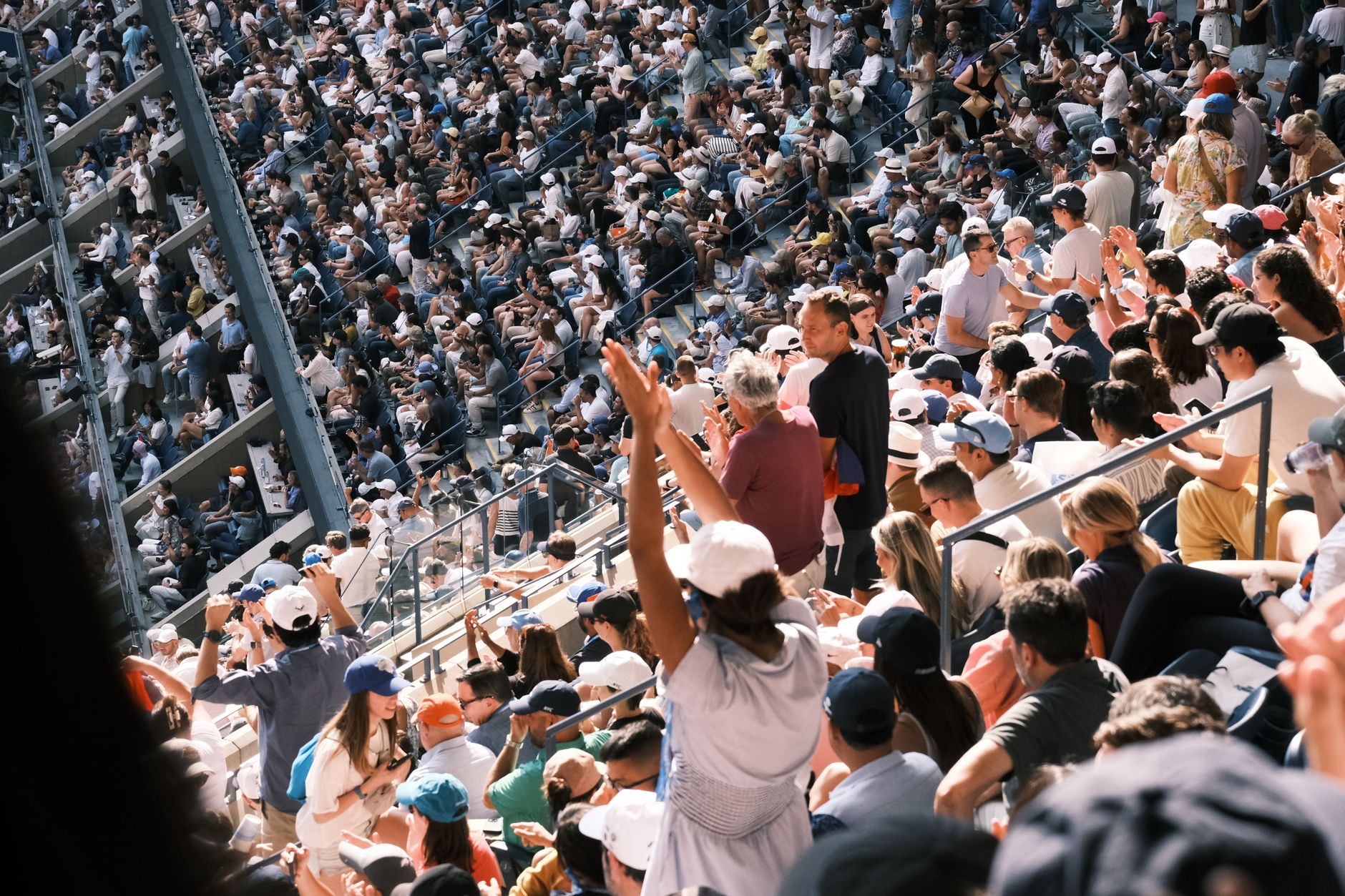
A ‘Mexican Wave’ is something that happens in sports stadiums. Someone stands up, throws their hands in the air and screams “who-hoo!” excitedly. Then sits down. The person next to them, encouraged by their enthusiasm, stands up, throws their hands in the air, screams “who-hoo!” and sits down. So does the next person, and the next. Sometimes, the ‘wave’ of excitement is so contagious it goes all the way around the stadium back to where it started. When it does, everyone erupts in a loud cheer.
[It’s great seeing thousands of people, often cheering for opposite teams, join together in a moment of solidarity!]
Out of curiosity, I looked up the origins of the phrase. The Wave has apparently been a thing for a long time. However, the first time it was televised was during the 1986 World Cup held in Mexico. Plenty of people still call it just “the wave”, but I prefer ‘Mexican Wave’. If you shorten it to MW it looks like the ripple effect of people rising up and down out of their seats.
Anyway…
The Mexican Wave = Cortical Spreading Depression
The Gaming Doc says that a stadium full of people is the same as a brain full of brain cells. Normally, they are calm and communicate with each other through silent electrical signals. BUT. During moments of hyper-excitability, one of those cells gets REALLY excited and goes “whoa!” This triggers the cell next door to go “whoo!” This passes a signal to their neighbor to get excited and “woo-hoo!” This hyper-excitability spreads, like a wave, from cell to cell until it affects every single cell in your brain.
This is called: Cortical Spreading Depression.
Which as the good Doc points out, is kinda stupid given the cells are hyper-excited… which is the opposite of being depressed…
But here’s where I guess the depression bit comes in. After the cell has done their super-excited “woo-hooing!”, it sits back down and says; “hmmm… that was fun, I’m satisfied… I think I’ll just have a rest for a moment and switch off.”
That’s why the Mexican Wave is the cause of so many of your migraine symptoms.
First up, you get the revved-up symptoms: aura, flashing lights, tingling, all caused by the brain’s hyper-excitability. Once that wave has passed, the Mexican Wavers all collapse back into their seats and take a moment to rest, rather than function. This creates a different set of symptoms: temporary blindness, numbness, inability to speak, weakness in your arms or legs…
[I’m going to add the inexplicable desire to manically clean the house as a symptom of the mega-excitable stage. It probably also explains the sudden and delightful onset of projectile vomiting. On the MW flipside, I’m going to add extreme brain fog. My brain’s shut-down can be so severe I can’t add 2+2 or remember the name of household items (a condition I’ve blogged about before, called aphasia).]
After all these fun and games, and flopping down exhausted… everything eventually goes back to normal. The brain goes back to functioning as if nothing ever happened.
Here’s the “rough part.”
Going numb down one side of your body is almost indistinguishable from a TIA (Transient Ischemic Attack (or mini-stroke)), stroke, or brain bleed. That’s why you HAVE to go to the hospital to have it checked out. Then, as he says, you’ll have to sit in a chair for 20 hours while they run CT scans and blood tests. Then doctors will probably rule out the scary conditions and diagnose you with migraine. (Most likely hemiplegic (read more here)).
But why is this happening?
As The Gaming Doc says; “because f*k you, that’s why, for the most part.”
It happens randomly across people, maybe once, maybe several times. There is a genetic element which causes it to run through families. Other than that, doctors can’t add any more details.
So, as the Doc says; there you go, now you know.
Insta comments
Whilst the f*k-you is a little bit depressing (cortical pun intended), it is also strangely comforting to be able to visualize the MW going on. With more than 7,000 likes on the Doc’s original post, and 200+ comments – safe to say I’m not the only one feeling that way. My fav comment was someone saying that the next time they have a migraine, they’ll be imagining brain cells screaming “woohoo!”
After all that woo-hooing, I’m off to take a nap!
Take care taking care,
Linda xx
*
PS – if you want to read more about the 4 stages of migraine (which the Mexican Wave is a part of), pop across to my post here that explains them in more detail.


Leave a Reply