

“I’d rather die than get another migraine!” – that’s the dramatic start to the introduction of “The Migraine Brain” (2020) by Dr Carolyn Bernstein. It was attention getting, no doubt, but it also got me immediately on edge. I recognized the sentiment, sure, but I also think of that form of catastrophizing as related to the ‘old’ version of me who was a Healthcare Loser, not the new version of me who is focused on positivity and healing. As much as humanly possible, my exclamation tends to be:
“I’d rather figure out what’s going on than get another migraine!”
The book’s introduction then lists similarly dramatic responses from other patients, including one person who said childbirth without anesthetic was a “piece of cake” compared to migraine pain. [Again, at the risk of sounding like a naysayer… I don’t agree – speaking from personal experience, both situations are painful, but not better or worse, just different.]
Dr Bernstein, the neurologist-author, notes that she had her first migraine at 20. She then runs through how productivity is affected by migraine, the prejudice against patient pain, and the fact that patients are often told they’ll just have to live with it. [Been there, done that, didn’t get a t-shirt].
On page 7 of her introduction, Dr Bernstein includes the following “Migraine Mantras” – all of which I like:
+ Migraine is a treatable illness – you CAN feel better;
+ You have a right to make your health a priority; and
+ Controlling migraines is 50 percent education and 50 percent treatment.
Chapter One then goes through different types of headaches and migraines, and how to know if you actually have migraine. It notes that you are “born with” migraine illness – it’s genetically in you from the very start. That said, everybody’s profile is different; we all have different triggers, symptoms, treatment options…
Chapter Two explains how the migraine brain is different to “normies” (my phrase not hers!). The migraine brain “is as high-maintenance as they come”… it’s like a thoroughbred horse, she writes, “hypersensitive, demanding, and overly excitable. It usually insists that everything in its environment remain stable and even-keeled” (p.40).
[Again, I really don’t like picking on an author’s writing style – but whilst I agree with what she is saying – and quite like thinking of myself as some fancy thoroughbred – the mixed metaphor isn’t great – a thoroughbred with a yacht keel? Imagine! (I asked AI to imagine it as well over on Instagram!)]
Metaphors aside, what she says is true; the migraine brain is “always on alert, ready to overreact to any stimulus it finds displeasing” (p.40) whether that’s perfume, lack of sleep, changes in the weather, the consumption of red wine, low blood pressure, hormone fluctuations (all triggers of mine), as well as chocolate, aged cheese, or even dust. The result is “excitation” – the triggers “don’t merely upset your brain, they cause it to careen out of control with a biochemical chain reaction that may result in anything from severe head pain to vomiting to dizziness, or, in rare cases, paralysis” (p.41).
The trigeminal nerve which runs through your face also acts out. If you can trace the line of pain across your face, or the pain pounds in time with your heartbeat – chances are it’s the branches of the nerve that you’re feeling. The picture she includes (on the left) is a bit MigraineGothic, but alongside the other one I sourced, I’m starting to understand why my eyebrow and jaw are often in pain:
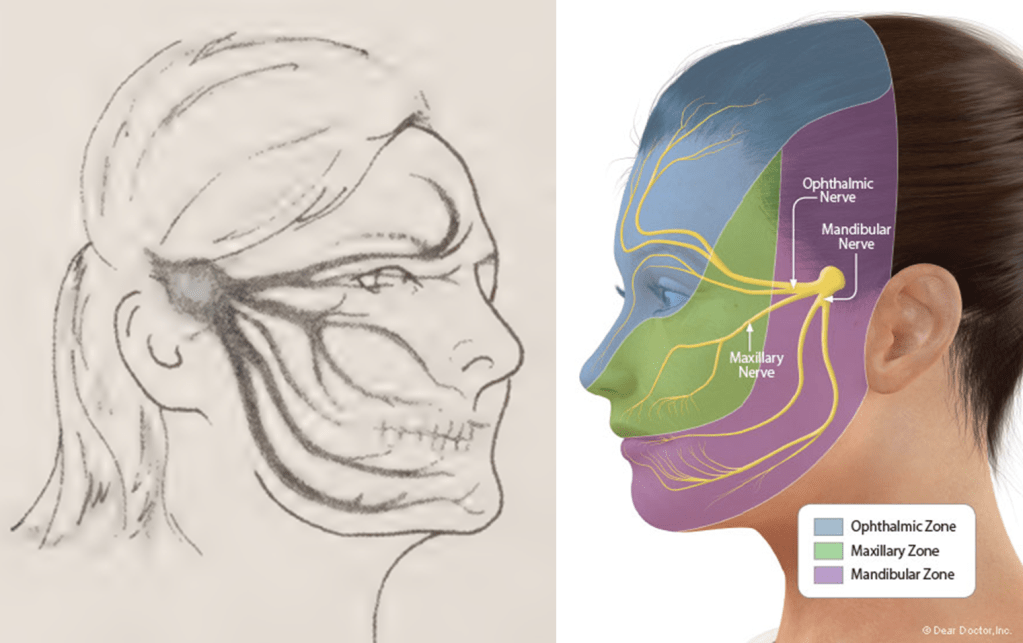
[Images sources: page 46 & Trigeminal Neuralgia – A Nerve Disorder That Causes Facial Pain (deardoctor.com)]
Dr Bernstein then ends chapter 2 with quirky habits that migraine patients have adopted; eating masses of salty pasta to recover from a migraine / a good sobbing session / a lady who pulls her hair to yank the pain away / eating very spicey food (all of which are horrors to me). What I did relate to, however, was a note about how during a migraine a lady called Nonnie can “see sounds and hear the light”. That’s me! I tried to explain it to a member of my family once, and they assumed I was making it up… but it’s weirdly, impossibly, true… somehow the wires get crossed, it’s not scary, just surreal… or more accurately, my real in that moment.
[The condition is called “synesthesia” – it is a neurological condition in which information stimulates more than one of your senses at a time – or the wrong ones at the wrong time… thanks migraine!]
The book then talks about the stages of a migraine attack, more on triggers, hormones, and recommendations about tracking migraines (I’ve got a trigger-tracker HERE I made and used if you need it). The book also talks about how to make a doctor’s appointment, the drugs that are available, and whether you should go to a hospital or not during an attack.
There was also a chapter on “Complementary and Alternative treatments”. The chapter recognizes that the mind and body work together, and the health of one influences the health of the other. She also suggested that alternative treatment activities provide a sense of empowerment – you move out of your “sick role” and start to take an interest in healing yourself, and in your overall well-being (p.190). You shift your mindset from being a “sick person” to “someone who gets migraines” [it’s small but important distinction, which took me a while to recognize].
Dr Bernstein notes that you have to do your research about alternative treatments, suggesting some are helpful, some have no scientific basis, and some can be hurtful to some people: be curious – but be safe. She gave an example of “bad advice” – which was to eat nothing but bananas and yoghurt… common sense says there’s a lot of food groups missing off that list. Another lady who was pregnant was taking herbal supplements for her migraine, many of which were not suitable for pregnant or nursing mothers. The author reminded readers that if anyone is promoting a “cure” you should be careful – migraine is usually more complicated than any single answer.
Her list of alternative treatments (from page 190) included:
+ biofeedback / relaxation techniques
+ yoga
+ nutritional supplements (magnesium, riboflavin, coenzyme Q10)
+ energy healing
There was one subset of a chapter I quite liked – how to make your HOME migraine free – the first part is to make it as relaxing a place as possible (a “sanctuary” of rest) and the second part is to minimize triggers (eliminate toxins, flickering lights, annoying fragrances and (I kinda love this) ask frustrating visitors to leave).
The last chapter is also interesting – it recommends a “Migraine Makeover” which involves creating your own personal migraine plan. Earlier in the book she noted that one person will swear by magnesium (caffein, triptans, yoga…) and another will call the same treatment option “useless”. You are unique – so your treatment plan needs to be too.
Dr Bernstein then runs through a few sample patients (pregnant mum, busy worker, retiree etc) and shows how each needs to adjust their treatment options, manage their triggers differently, and determine the sort of help they might need – the pregnant mum might benefit from more sleep, for example, whilst the busy worker might want to check their diet, reduce their stress through workout routines or reinvestigate preventative medication options, whereas the retiree might do well to explore the co-morbidities that come with aging… or whatever… I’m trying to summarize pages of data with an overview… but you get what I mean.
The migraine plan you end up with, will basically be a version of my SWANEY idea – check your Sleep, Water intake, pay Attention to triggers, Nutrition, Exercise, and adopt a Yes-I-can-heal-attitude, plus one I didn’t have, which is medication intake (preventative and abortive).
The reason I read this book, is because I liked the title – I often write about “my migraine brain” – it helps me separate my sense of self from my illness. It’s not me that’s tired or moody or annoyed by bright light – it’s my migraine brain. I used to love hanging out in the sunshine or travelling the world – now, my brain says no to excessive movement or the heat and glare… my migraine brain says no – not me. I know that means that “I” miss out, but it’s not by choice… I’m just protecting my migraine brain.
Overall, the book was comprehensive and well labelled, so it’s easy to flick through and draw out what’s relevant to you.
This blog post was longer than I expected – sorry – but not bad considering the book was over 300 pages long!
Hope it helps, or at least motivates you to look for a book on migraines next time you’re near your local library!
Take care reading about how to take care, Linda x
[PS – Regarding yesterday’s post about the step after self-actualization that I was trying to imagine… turns out it’s a thing. I have a digital friend on LinkedIn, Shabanam Rakhiba, who helps women with their chronic illness issues – she read my post yesterday and wrote one of her own for clarification: “We often hear about Maslow’s Hierarchy of Needs, where self-actualization—the pursuit of personal potential—is the highest goal. But later in life, Maslow added another level: self-transcendence. // Maslow described it as reaching the ‘highest and most inclusive levels of human consciousness.’ It’s where we focus on things like compassion, unity, and helping others.” … Yay me I guess… yay Maslow… and yay all of us who are helping others, and in doing so, transcend our pain!]


 The Mindful Migraine
Leave a comment