
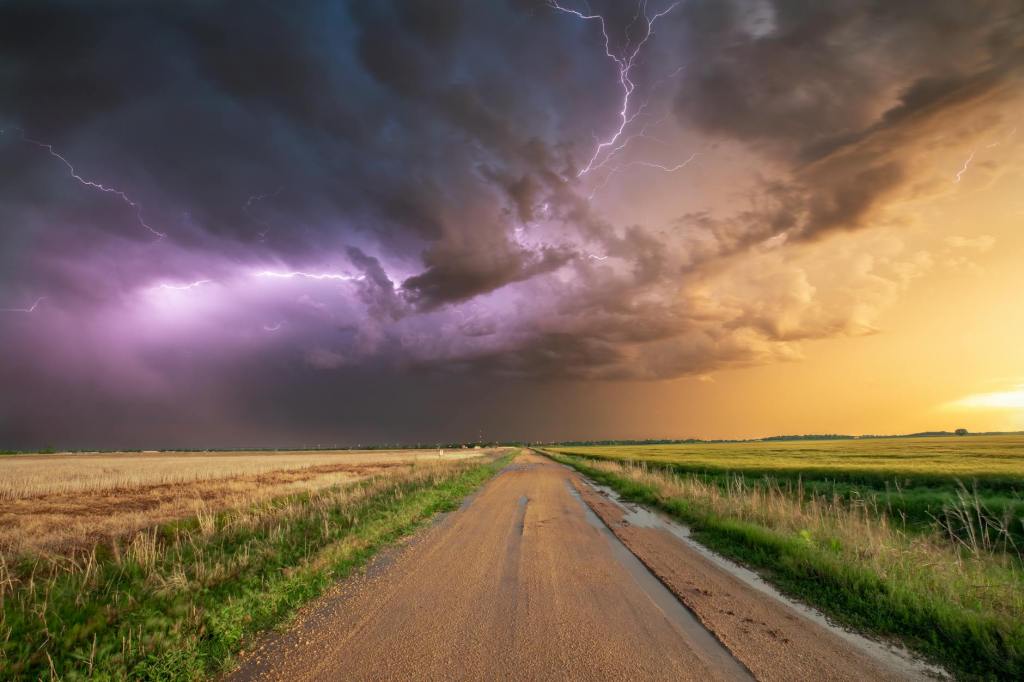
People who get migraines are human barometers. That’s my truth and I’m sticking to it no matter what the science says – when the barometric pressure drops (as it often does when a storm is coming) – I can feel it in my head… sometimes I get a migraine, sometimes I just feel iffy… but I DO feel it.
And if you say, “yeah but you can often see a storm coming through the window by the arrival of those big, grey clouds, so der…” I’d agree, BUT I’d still tell you that there is a sensory response going on that has nothing to do with what my eyes (or weather app) is telling me.
Anecdotal evidence from many migraine-people that I have met, confirms that I am not alone in my weather-aware-brain.
So – are we making all this up – or – is there some real science going on?
A quick google search confirms: it’s real.
BUT the experts are still not exactly sure why.
Over on PBS.org, they interview a neurologist who explains:
“Doctors still don’t fully understand why some brains are more sensitive to environmental changes. // What we do know is that people with migraines have especially sensitive nervous systems, and that certain environmental changes – like shifts in air pressure, temperature, humidity and air quality – can activate pathways in the brain that lead to pain.”
There were a few hypotheses floated in the article, including:
- Some scientists believe that when the air pressure drops, the change affects the pressure inside your head and how blood vessels in your brain dilate and constrict.
- Another theory is that changes in barometric pressure cause a small imbalance in the pressure between the inside of your skull and the outside environment which stimulates the pain-sensitive nerves in your head.
- Others blame inflammation and the way in which the brain processes sensory input and changes in serotonin levels.
So yes, sudden changes in humidity or the temperature can be a trigger. So too are lightening, strong winds and sunlight glare.
[I’ve met a lady who said drafts were enough to trigger a migraine – I was skeptical… until I started to pay more attention (read more here)… oh, and then there’s my findings regarding all those other ‘quirky’ migraine triggers, such as Daylight Savings, brushing your hair, your pillow, menopause and mold… and let’s not forget those other even more quirky potential triggers I’ve experienced, such as letting my hair go gray, jump-scares, nightmares… and and and…]
Over on the Heathline.com site, they reference several studies into the relationship between weather and migraines. They write: “A review of 17 studies from 2017 to 2022 found that changes in weather conditions […] were linked to more frequent and severe migraine attacks. // Storms, temperature extremes, and changes in barometric pressure might all contribute to these attacks by altering levels of serotonin and other brain chemicals. // Research on the connection between migraine and weather has been mixed, in part because it’s difficult to study. Weather changes can trigger varying reactions, so it’s hard for researchers to narrow down one cause. // Not everyone responds to each weather change in the same way, either.”
There’s a lot of truth in that.
Even one person (such as me) can be affected by different triggers on different days (because migraine is a threshold condition – one trigger is manageable, but three issues on one day is too much, and the weather might be the straw that broke the camel’s back, as it were, and puts you into bed, crippled by pain). We also change as we age – so what didn’t cause a problem in the past (such as partying in a thunderstorm) is a big no-no when we’re older (and potentially perimenopausal).
The article runs through several other potential environmental triggers (such as dust, altitude changes and strong winds), and (importantly) notes that it might not be the weather itself that is always to blame: other issues, such as dehydration, might be the cause, and be exacerbated by certain weather conditions.
It concludes by noting that more research is required.
Both articles note that you can’t control the weather, but you can learn more about your potential triggers and do what you can to prevent migraines by using that awareness when the weather changes (as much as possible). They recommend you keep a diary (you can download my free printable Trigger Tracker here) and that you keep your preventative and acute medications with you at all times just in case.
I found one other site (TheMighty.com) that put forward another hypothesis: “Migraine involves brain regions that regulate internal balance (homeostasis), including the hypothalamus, which also helps control body temperature. // Because of this connection, rapid environmental shifts may increase neurological sensitivity and trigger migraine attacks.”
[Disclaimer – please remember that you should NOT take medical advice from the internet – including this blog – be sure to speak to a trained professional about your individual situation and for advice that is tailored to your personal condition.]
If you’re interested in understanding more about your migraine and potential triggers – click on this blog’s “Triggers” tab for more posts, or click on one of my prior posts (including one of my very first posts: Climate and migraines and some others that are more recent):
Goldilocks, routines and migraines
So then, here’s hoping that the weather stays kind to all of us, and you get as much sunshine / rain / snow as you hope for… and your brain can handle!
Take care taking care out there,
Linda xx
PS – I recently came across an app that uses your apple watch and the local weather to help warn you that a migraine might be coming. I don’t own an apple watch, but this sounds like a great idea. Many apps record the pain levels after the event, which is a helpful tool for keeping doctors in the loop (and being able to access certain medications which require a “chronic” diagnosis) but it isn’t helpful in predicting. Whilst many of us know the weather is changing because we start to feel unwell, that ability to read our body’s signals comes from a lot of lived experience. It’s a nice idea that an app might short-cut some of that learning. (Note: for a lot of people, myself included, the weather is only one trigger – hormones are another that can override / undermine the weather conditions). Regardless, if you’re interested in looking into this further, here’s the link to the app store – I can’t endorse the product because I haven’t tried it, but the idea sounds intriguing, it’s called “Phoebe” and you can read more here: Phoebe: Headache Engine App – App Store


 The Mindful Migraine
Leave a comment