

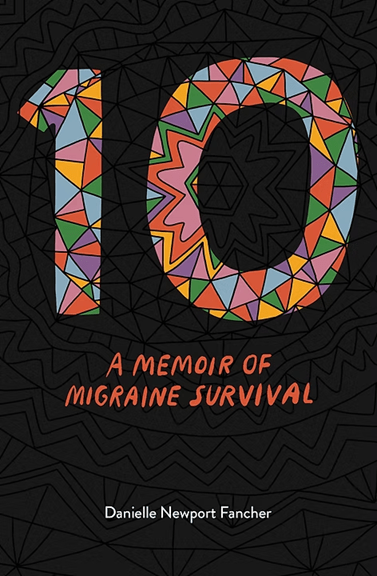
Today is a book review of “10: a memoir of migraine survival” (2018) written by Danielle Newport Fancher – here’s her website: Books | Migraine Writer in which she refers to herself this way:
“Danielle Newport Fancher lives a double-life. In one life, she’s a smart, upbeat, and happy 30-year-old; her body is fit, she comes across as confident, and she always wears a smile. In her other life, invisible to the rest of the world, every minute presents a challenge to stay alive. That’s because she is at the mercy of her impulsive and unsympathetically cruel migraine brain.”
The book opens with a lovely quote from speaker/author Christine Caine:
“Sometimes when you’re in a dark place you think you’ve been buried, but you’ve actually been planted.”
In the foreword, Dr Frederick Godley says the memoir is not [just?] for people who suffer with migraines; they know it all already. Instead, it is for those who DO NOT have migraines, so that they might get a glimpse into “an unfamiliar world” reduced “of its simple pleasures” (page xi). He writes that “migraine is a neurological disease. The headache, aura and other symptoms are the outward manifestations of a spectrum of underlying genetically produced cellular malfunctions. Hormones or head injury further complicate how our nervous system works, or misfires. And what contributes most to this neurologic porridge we often just don’t know.” (xiii)
“…neurologic porridge” – hey, will you look at that! – I’ve been calling my migraine-brain Goldilocks for years!!!
Ms Fancher starts her work with a statement of purpose, noting that she has long tried to hide her migraines from others, worried she would be judged as week or flawed [like my posts on a Migraine Minimalist or Why do we hide our chronic illness?], but she soon discovered that writing was a form of coping, and she slowly overcame her sense of being vulnerable to help others (xv-xvi). The label of the book “10” represents her daily pain level on the 0 to 10 pain scale. UGH – poor her! 😦
[If you’re new to pain scales, you can read more on my blog here.]
The book follows a roughly chronological order, from her first migraine attack; a black spot appeared in her vision as she was easing out of a carpark (the spot slowly grew larger until she realized she could no longer remember how to operate the car, and a traffic jam of honky-cars sat behind her). She realized she had probably inherited her mother’s migraines but was frustrated no one had told her what to expect.
[I was much younger (here) but equally confused.]
Her next migraine happens during an important test, but she tells no one and later wonders why her shame had been greater than her need to seek help or a second chance.
Early in the book (page 10) she has a wonderful quote, I’m going to include in full:
Migraines are the bitchy teenage friend that wants you all to herself: She says: “You must stay on the couch with me today,” “You are not allowed to have fun with other people,” and “I always need to be on your mind” when you make any attempt to escape her dominance.
As with all the migraine stories I read, there are things that I relate to (such as the quote above, the fear and fatigue, how a shower can be exhausting, the wish for a ‘magic pill’ to replace the Botox and Triptans, how she moves like “molasses”), AND others that I can’t understand because I lack the same experiences (the psychedelic rainbow auras and how she drinks whisky gingers even after she’s moved into chronic-migraine-mode).
Ms Fancher recounts missing out on scuba diving the coral reefs of Australia, the friends telling her to just give it a go, the sadness of coming so far and failing at the last moment… ugh… a dozen similar crash and burn dreams came to my mind… so much lost… so much “stolen” as she says, by migraine.
Her journey sounds very similar to mine, and probably yours; doctor after doctor, medication after medication, trying acupuncture, meditation, chiropractors, EFT tapping, Qigong, Yoga, … she even explores colonics and hypnosis, neither of which I have tried… (yet).
I also really appreciated this quote: “For a migraineur, the bed is everything. The bed is the happy place, the sanctuary, […] the one special place where the migraine can take over and where you don’t have to apologize for the pain or pretend that everything is okay. In your bed, you can just ‘be’.” (82)
One of my least favorite anecdotes (because it was so sad) was her calling her boyfriend Sam for a lift home. She tells him the pain is unbearable and she can’t see, and he replied he is too busy; couldn’t she just drive herself? Wait… WHAT!? There is so much realness in this small moment. This is often our reality. The people we know and love, and work with, and spend a lot of time with, can still be accidently dismissive of just how hard it is to function with a migraine.
A similar thing then happens soon after when her tennis coach accuses her of being lazy, even though his ex-wife had migraines. (Perhaps there’s a hint in the “ex”… oh and Sam is quietly written out of the story a few chapters later too…)
Another hard to read passage relates to a hypnotherapist who thinks that because Ms Fancher can tell when a migraine is coming on, she must want to be sick because she doesn’t stop it from following through… ugh… nope. When Fancher explains it is prior experience which allows her to recognize the clues, the hypnotherapist reiterates migraines must be a self-fulfilling prophecy, brought on by her own negative expectations…
[I don’t buy into the self-fulfilling prophecy BS… but I’m also not going to rule it entirely out in all instances – read more here: Why you might not be healing and Pain + Fear = Chronic Pain]
Fancher is incredibly honest, recounting another time in which her mother is the sick one, and she, in Paris for the first time, is feeling pain-free and becomes impatient with her mother for slowing them down. The understanding that she can be EITHER the tired one or the pushy one lends her grace enough to accept that others might be rude when they have no clue.
On her third or fourth neurologist, she goes in full of hope only to be told there is no cure – her heart sinks – and she’s told the best she can aim for is to manage the pain…
[Been there, done that: Doctors behaving badly]
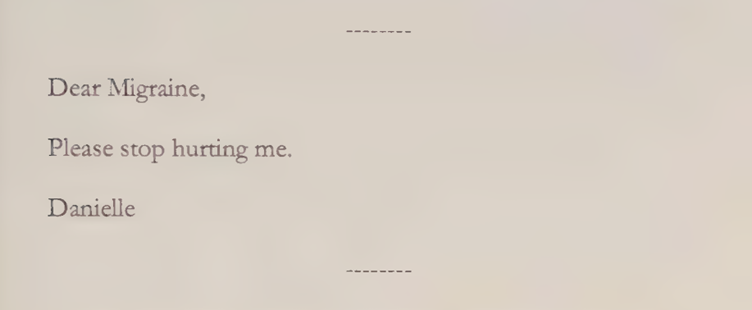
There were plenty of moments when I got a bit teary reading her story, like this screen shot from page 125:
But there were also a few laugh-out-loud moments. For example, Fancher had been listing all the ‘helpful’ things people say to her and all her replies, but this one (on page 171) made me choke on my herbal tea:
Positive Comment: “It will probably just magically disappear one day.”
Response: Fake smile.
Thought: Fck you.
To end with, I’ll give you an aside she made that has really stuck with me, weeks after I read the book; a friend got a tattoo when she was young, and it seemed like such a permanent, life-long decision. But, when she was older, the same lady had a new tattoo inked over the top of the old one; even ‘permanent’ need not be forever.
Take care taking care, Linda xx


 The Mindful Migraine
Leave a comment